Can red light therapy meaningfully support muscle recovery, or is the promise brighter than the evidence? If you’re considering red light therapy for muscle recovery after training or an injury, it’s reasonable to want more than confident marketing claims. Research on photobiomodulation, the clinical term for light-based treatment, is promising, but results can vary by treatment approach and individual.
This guide explains how red light may relate to muscle recovery, what current evidence can and can’t establish, and what to consider when comparing treatment approaches. You’ll also learn why it’s best viewed as one possible part of a broader recovery plan, not a substitute for the fundamentals of care.
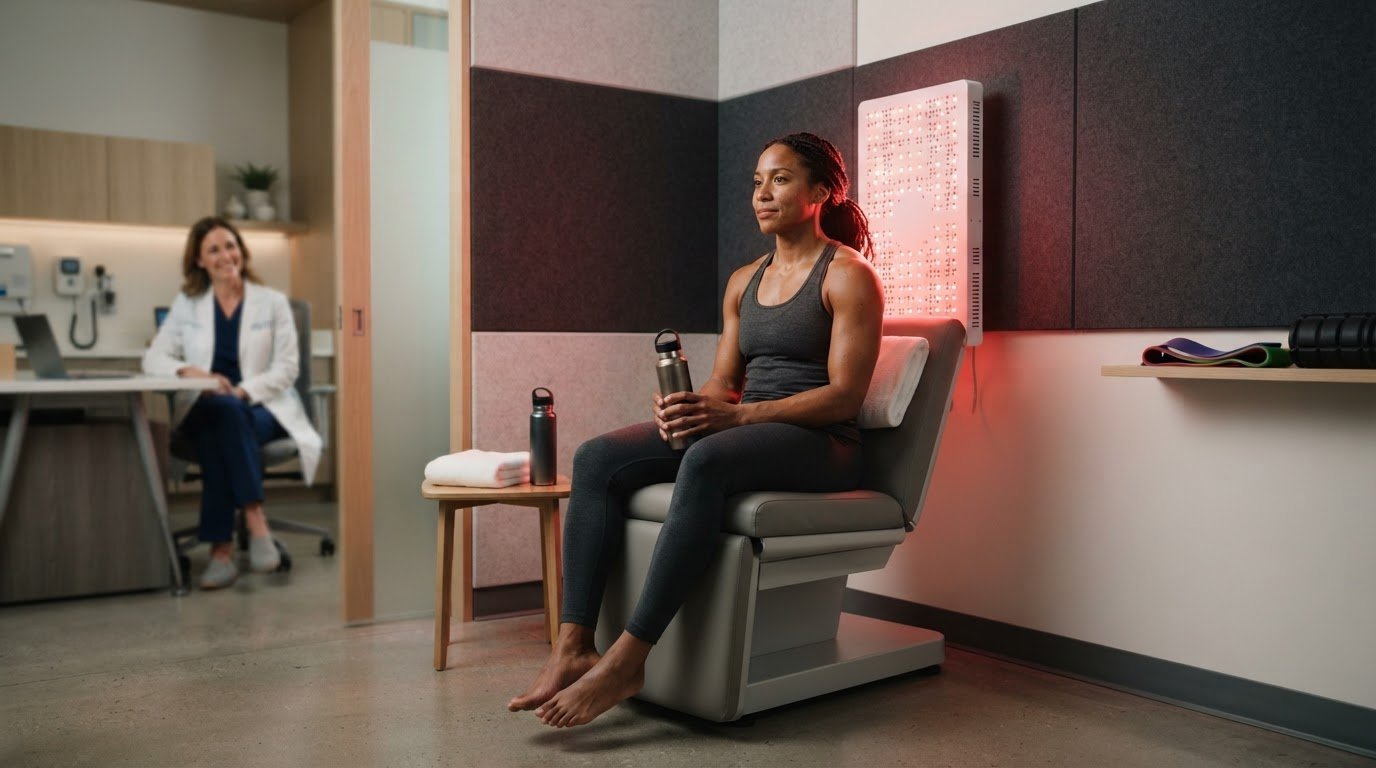
My Health 360 offers whole-body red light therapy and low-level laser therapy within recovery and performance care. A Meet and Greet appointment is an opportunity to discuss your goals and whether red light therapy may be a good option for you with Medical Director Dr. Umbrine Fatima.
Key Takeaways
- Understand what red light therapy for muscle recovery is intended to support and how it differs from other uses of light therapy.
- Learn why proposed biological mechanisms and early findings don’t guarantee the same recovery benefits for every person or treatment approach.
- Compare clinic-based whole-body therapy and home devices by setting, clinician involvement, personalization, and the questions their evidence raises.
- Assess treatment in practical steps: define your recovery goal, review the evidence, discuss your health context with a physician, and reassess.
- Contact My Health 360 for a Meet and Greet appointment to discuss with Medical Director Dr. Umbrine Fatima whether red light therapy may be a good option for you.
Red Light Therapy for Muscle Recovery: What It Is and Isn’t
Could light exposure help your muscles feel or function better after exertion? Red light therapy, also called photobiomodulation, uses red or near-infrared light directed at tissue. It is studied for several purposes, including muscle-related concerns, but evidence for one use doesn’t prove benefit for another. The treatment’s name alone doesn’t establish that it will address your recovery goal.
In brief: Red light therapy is a light-based treatment being studied for its effects on tissue. It may be considered as one part of a recovery plan, not a complete plan or a substitute for medical assessment.
What does red light therapy aim to do?
The proposed mechanism is that cells absorb some of the delivered light, potentially influencing cellular energy processes and signaling related to inflammation and tissue repair. This offers a rationale for research, but a plausible biological explanation is not the same as a demonstrated, predictable improvement in soreness, strength, or recovery for an individual.
The terminology can also be confusing. Photobiomodulation is an umbrella term for certain light-based approaches. Low-level laser therapy is a related term, though devices and methods can differ. The overview of Low-level laser therapy (LLLT) describes the terminology and proposed mechanisms, but a general overview can’t establish whether a particular treatment will work for a specific person or muscle-recovery goal.
Light-based treatments are also used for purposes such as skin care and general wellness. Those aims differ from recovery after exercise or injury. Evidence or claims relating to one application shouldn’t automatically be applied to another.
Where does it fit within muscle recovery?
Muscle recovery depends on more than one intervention. Training demands, rest, nutrition, and the nature of an injury or symptom all matter. Red light therapy for muscle recovery is best considered a potential adjunct, not a replacement for appropriate evaluation, rehabilitation, or other care recommended for your circumstances.
Start by defining what you want to address. Post-exercise soreness, a return to training, and symptoms following an injury may call for different considerations. Discuss your health context and expectations with a physician. Interest in a therapy doesn’t establish that it is suitable for you, and worsening or persistent symptoms merit clinical attention.
My Health 360 offers whole-body red light therapy within recovery and performance care. Discuss your goals and whether it may be a good option for your individual recovery plan with Medical Director Dr. Umbrine Fatima.
How red light therapy may support muscle recovery: mechanisms and evidence
Research asks two distinct questions: could light exposure influence processes involved in recovery, and does that translate into a meaningful benefit for people? The first has a plausible biological basis; the second remains less certain. The accessible overview of what is red light therapy provides general background, but evidence for a particular use needs to be judged by studies measuring that outcome.
What does research say about soreness, fatigue, and recovery?
Photobiomodulation is thought to influence cellular activity, including processes related to energy production and inflammatory signaling. These proposed pathways help explain why researchers study the therapy, but they don’t prove that it speeds muscle repair or restores performance. Laboratory findings, changes in blood markers, and a person’s experience of soreness are different kinds of evidence. One cannot stand in for another.
A 2025 meta-analysis in Sports Health reported modest improvements in some markers of muscle damage and soreness, with results appearing more favorable when treatment was used before and after exercise. A 2021 systematic review also reported reductions in creatine kinase, a blood marker associated with muscle damage. These findings are encouraging, but a change in a marker doesn’t necessarily mean a person feels better, returns to training sooner, or heals an injury faster.
Some individual human studies have reported less delayed-onset muscle soreness or changes in performance after treatment. Interpret those results in light of the studies’ size, exercise conditions, and treatment methods. Soreness, fatigue, performance, and tissue healing are separate outcomes. Evidence for one doesn’t establish benefits for all. Overall, red light therapy for muscle recovery shows potential, but a consistent, predictable clinical benefit for every person hasn’t been established.
Why do results differ between studies and individuals?
Studies may differ in their light source, treatment parameters, timing, body area, exercise task, and measured outcome. Participants may also vary in training status and recovery needs. These differences make findings difficult to compare directly. A result from a specific exercise study may not apply to injury recovery or your circumstances. No single study can establish a universal approach.
Evidence summary: Research suggests possible benefits for some muscle-related outcomes, but it doesn’t establish a guaranteed or broadly applicable recovery effect. Consider your specific goal and health context with a physician before deciding whether it belongs in your plan.
My Health 360 offers whole-body red light therapy within recovery and performance care. Discuss with Medical Director Dr. Umbrine Fatima whether it may be a good option for you at a Meet and Greet appointment.
Red light therapy options compared: clinic treatment, home devices, and other recovery tools
Choosing an approach starts with a practical question: what recovery concern are you trying to address? Clinic-based whole-body treatment and at-home devices differ in setting and clinical context, while rest, movement, and medical care serve distinct roles. The comparison below highlights what to consider without assuming that one setting or tool is best for everyone.
How should readers compare clinic-based and at-home approaches?
Setting alone doesn’t determine effectiveness. Published findings relate to the methods used in each study, so results from one device or treatment context can’t automatically be applied to another. Consider the evidence for the outcome you care about, and discuss personal suitability with a physician if your health history or an injury is part of the picture.
| Approach | Setting and clinician involvement | Personalization and access | Evidence question |
|---|---|---|---|
| Clinic-based whole-body red light therapy | Delivered in a clinical setting; physician-led care can provide an opportunity to discuss suitability. | Requires access to the clinic; treatment can be considered in the context of individual recovery goals. | Do studies reflect the treatment method and outcome relevant to your goal? |
| At-home light device | Used independently at home, without the same clinical setting. | Home access may be convenient, but the user is responsible for following device guidance. | Does the research apply to this device, its use, and the intended recovery outcome? |
| Rest and appropriate movement | Part of day-to-day recovery; medical guidance may be appropriate for injury or persistent symptoms. | Can be adapted to activity and recovery needs. | Is the plan appropriate for the person’s symptoms and circumstances? |
How does light therapy compare with other recovery practices?
These approaches aren’t interchangeable. Rest supports recovery from exertion, while appropriate movement may help maintain function or support a gradual return to activity. Medical evaluation addresses symptoms that need assessment. Red light therapy for muscle recovery is a potential adjunct, not a replacement for these measures or for care recommended by a clinician.
Before comparing options, name your goal. Managing post-exercise soreness, maintaining training, and addressing symptoms after an injury may lead to different conversations. My Health 360 offers whole-body red light therapy within recovery and performance care. Discuss whether the procedure may be a good option for you with Medical Director Dr. Umbrine Fatima.
How to assess red light therapy for muscle recovery safely
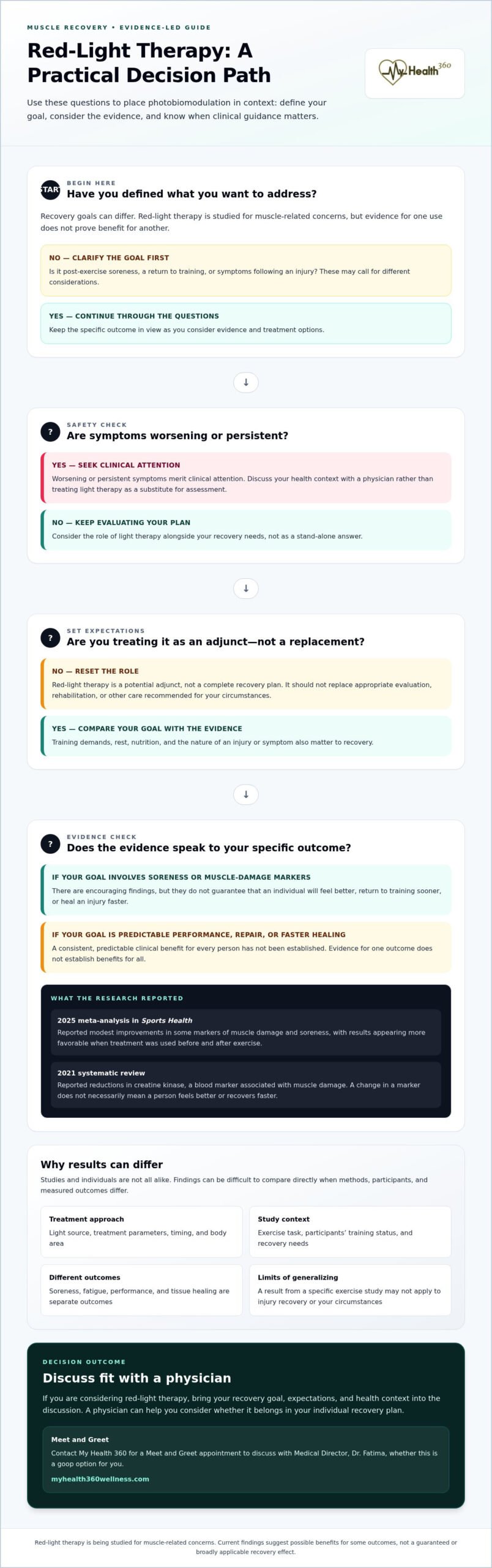
A measured decision starts with your recovery needs, not a device claim. Before considering red light therapy for muscle recovery, follow a clear sequence: define the concern, review the evidence for that goal, discuss whether treatment may suit your health context, and reassess based on meaningful changes.
What should you discuss before starting?
Share what you’re experiencing, when it began, what seems to affect it, and what you hope to improve. Mention relevant health history and current care, including steps you’re already taking for recovery. This context helps a physician consider your suitability rather than treating a general wellness claim as a personalized recommendation.
Useful questions include:
- What is the rationale for considering light therapy for my specific recovery goal?
- What does the evidence show for that goal, and what remains uncertain?
- How will we assess progress, and what should prompt a change in the plan?
Don’t assume a particular schedule or outcome in advance. If symptoms are severe, persistent, or concerning, pause plans for treatment and seek clinical guidance so the underlying issue can be assessed.
How can you judge whether an approach is helping?
Choose a practical measure tied to your goal. If your concern is post-exercise soreness, for example, consider whether it changes in a way that matters to your daily activity or training. If your aim is returning to movement after an injury, discuss appropriate progress measures with a physician. Avoid relying on broad promises of improved wellness that don’t match the concern you’re tracking.
Keep expectations grounded. A perceived improvement may be meaningful to you, but it doesn’t, by itself, prove that light therapy caused a biological change or accelerated tissue healing. Review your experience alongside other changes in activity and care, and revisit the plan if symptoms worsen or progress doesn’t match expectations.
My Health 360 offers whole-body red light therapy within recovery and performance care. A Meet and Greet appointment is an opportunity to discuss with Medical Director Dr. Umbrine Fatima whether the procedure may be a good option for you.
Discuss physician-led red light therapy with My Health 360
After reviewing the potential and limitations of red light therapy for muscle recovery, consider how it relates to your own goals and health context. My Health 360 offers whole-body red light therapy within recovery and performance care. It may be one component of an individualized plan, not a stand-alone promise of faster recovery or a specific result.
What to expect from an individualized discussion
A Meet and Greet appointment gives you an opportunity to discuss what you hope to address, relevant health context, and questions about the treatment. Medical Director Dr. Umbrine Fatima, an American Board Certified Internal Medicine specialist, can discuss whether the procedure may be a good option for you. Suitability and possible benefits are individual considerations; interest in the therapy alone doesn’t establish that it’s appropriate for your needs.
You might explain whether your goal relates to exercise soreness, training, or recovery after an injury, and share any care you’re already receiving. You can also ask how red light therapy might fit alongside other elements of a broader recovery approach, what uncertainties remain, and how you and your physician would assess whether it’s meeting your goal. The discussion should help you make an informed decision, not imply a guaranteed outcome.
For a broader perspective on recovery planning, explore the related whole body habilitation article alongside this discussion.
A clear next step before deciding
If you’re considering whole-body red light therapy, a conversation can help put it in context. Discuss your goals and questions with Medical Director Dr. Fatima, including whether this procedure may be a good option for you.
Make your next recovery decision with clarity
Red light therapy for muscle recovery may be worth considering, but promising mechanisms and encouraging research don’t guarantee a meaningful result for every person. The key question is whether it fits your specific goal and health context. Compare treatment approaches thoughtfully, keep broader recovery habits in view, and discuss suitability with a physician before deciding.
My Health 360 is a physician-owned recovery and performance center offering whole-body red light therapy as one potential component of individualized care. Medical Director Dr. Umbrine Fatima, an American Board Certified Internal Medicine specialist, can discuss your goals and whether the procedure may be a good option for you.
Contact My Health 360 to arrange a Meet and Greet appointment and discuss your questions with Dr. Fatima. This conversation is a practical next step toward choosing a recovery approach with clarity.
Frequently Asked Questions
Can red light therapy help with muscle recovery?
Red light therapy may support some muscle-recovery outcomes, but benefits aren’t established for everyone. A 2025 meta-analysis in Sports Health reported modest improvements in some measures of muscle damage and soreness. Findings vary across studies, and changes in a marker or reported soreness don’t necessarily mean faster healing or a reliable return to performance. Consider the evidence alongside your specific recovery goal and clinical context.
How does red light therapy work for muscle recovery?
Red light therapy, also called photobiomodulation, exposes tissue to particular types of light. Researchers propose that cells absorb the light and that this may influence cellular energy processes and signaling related to inflammation. These mechanisms are being studied, but a plausible explanation doesn’t prove a specific recovery benefit. Effects may differ by treatment method and measured outcome, so findings shouldn’t be assumed to apply to everyone.
How soon can you expect to notice muscle recovery benefits?
There’s no reliable timeline that applies to everyone. Studies vary in treatment approach, participants, and outcomes, and don’t establish when a particular person should notice a change. If you’re considering red light therapy for muscle recovery, first identify a specific goal, such as changes in post-exercise soreness, and discuss with a physician how progress could be assessed. A promised timeline isn’t a guarantee of results.
Is red light therapy safe for everyone?
No treatment should be assumed suitable for everyone. Whether red light therapy is appropriate depends on individual health context and the reason for considering it. Evidence about potential benefits doesn’t establish personal safety. Share relevant health history, symptoms, and current care with a physician before proceeding. If symptoms are severe, persistent, or concerning, pause plans for treatment and seek clinical guidance so the underlying issue can be assessed.
Can red light therapy replace rest or other recovery practices?
No. Red light therapy shouldn’t replace rest, appropriate movement, or medical care when needed. Muscle recovery involves more than one factor, and light therapy is best considered a possible adjunct rather than a complete recovery plan. Start by clarifying whether your concern is exercise soreness, maintaining training, or symptoms after an injury. That distinction can help guide a conversation about care relevant to your circumstances.
What is the difference between clinic-based and at-home red light therapy?
Clinic-based therapy takes place in a clinical setting, while at-home devices are used independently. The setting can affect access to clinician discussion and how treatment is considered within an individual recovery plan. Devices and treatment methods can differ, too, so findings from one setup may not apply to another. Compare evidence for the specific outcome and approach rather than assuming clinic and home treatments are equivalent or that one is automatically superior.
What should I ask a physician before trying red light therapy for recovery?
Describe your recovery goal, symptoms, relevant health history, and current care. Ask why red light therapy may be considered for your situation, what evidence supports that use, what uncertainties remain, and how you might evaluate progress. You can discuss these questions with Medical Director Dr. Fatima at My Health 360. Contact My Health 360 to arrange a Meet and Greet appointment and discuss whether the procedure may be a good option for you.