
What if feeling “not sick enough for a pill” doesn’t mean you have to accept low energy, slow recovery, or a stubborn physical plateau? A Performance medicine specialist looks beyond the presence or absence of disease to consider how your body is functioning, adapting, and recovering. That broader perspective can be valuable when your goals extend beyond symptom relief.
It’s frustrating to put in consistent effort and see little progress, or to recover more slowly than you expect after exercise or injury. Performance medicine brings medical insight to a whole-person view of health, considering factors that may influence function and resilience. The aim isn’t a one-size-fits-all promise, but a clearer understanding of your health and the options that may fit your goals.
In this article, learn what a performance medicine specialist does, how this approach differs from conventional, illness-focused care, and how assessment, recovery support, and whole-body habilitation can contribute to goals such as strength, energy, cognitive function, and healthspan. You’ll also learn how My Health 360’s integrative concierge care connects performance with recovery and overall well-being.
Key Takeaways
- A Performance medicine specialist can connect your health goals with a personalized, medically guided plan focused on function and resilience.
- Sports medicine often focuses on injury diagnosis and return to activity, while performance medicine may also consider how to support function when you aren’t injured.
- Metabolic health and musculoskeletal function are useful areas to discuss when building capacity, supporting recovery, and maintaining long-term function.
- Performance-focused care can be relevant to people seeking to maintain strength and vitality with age, as well as those with goals related to focus, energy, or stress resilience.
- My Health 360 offers integrative concierge medical care, whole-body habilitation, and performance-focused services.
What is a Performance Medicine Specialist?
What if your health goals aren’t about treating an illness, but about having more capacity for the life you want to lead? A Performance medicine specialist takes a proactive, medically informed approach to health, considering how the body functions as a whole and where personalized support may help maintain or improve that function. The focus isn’t limited to addressing a specific problem. It can also include supporting healthy systems and building resilience.
Performance medicine uses clinical knowledge to interpret information about areas such as metabolic health and musculoskeletal function in context. Rather than treating one measurement as the whole story, a physician considers how relevant factors relate to a person’s symptoms, goals, history, and daily life. This broader perspective distinguishes optimization from a narrow focus on injury or illness. The foundational concept is explored in Performance Medicine, a developing field related to, but distinct from, sports medicine, functional medicine, and anti-aging medicine.
The Shift from Reactive to Proactive Care
Conventional care is essential for evaluating symptoms, diagnosing disease, and addressing immediate medical needs. But when results fall within standard reference ranges, concerns such as low energy or slower recovery may not point to a clear diagnosis or treatment pathway. You may still want to understand your health more fully, even when there is no single finding that explains how you feel.
Performance-focused care asks how available findings relate to your function and goals. A physician can distinguish between a result that helps assess a particular concern and one that meaningfully informs an individual plan. “Optimal” isn’t a universal target or a reason to chase numbers in isolation. It requires clinical interpretation. A physician-guided longevity plan can connect that interpretation with priorities for sustaining function and healthspan, the years lived in good health, not simply lifespan.
The Science of Human Optimization
Integrative care offers a framework for considering how different aspects of health relate to one another. In integrative medicine for longevity, the aim is to connect relevant clinical information with the person’s broader health picture. Evidence-informed decisions matter: performance plans should be guided by medical judgment and relevant evidence, not trends or isolated measurements.
Physician oversight is especially important when a plan involves advanced interventions. A physician can weigh potential benefits, risks, and individual circumstances, then help keep the approach aligned with your goals. At My Health 360, physician-led integrative concierge care connects longevity goals with personalized guidance.
Performance Medicine vs. Traditional Sports Medicine
Sports medicine and performance medicine can both address physical function, but they often begin with different questions. Sports medicine commonly evaluates and treats injuries, using tools such as imaging when a clinician needs to assess structural damage. Performance medicine may also consider people who aren’t injured, with attention to how healthy systems are working and where informed support may help.
A Performance medicine specialist doesn’t need to be treating an elite athlete. A corporate leader managing demanding days, a busy parent balancing work and family, or someone hoping to stay strong with age may all have goals related to energy, recovery, focus, or physical capacity. The point is to connect health with everyday demands, not only competition or return to play.
Beyond the Injury Model
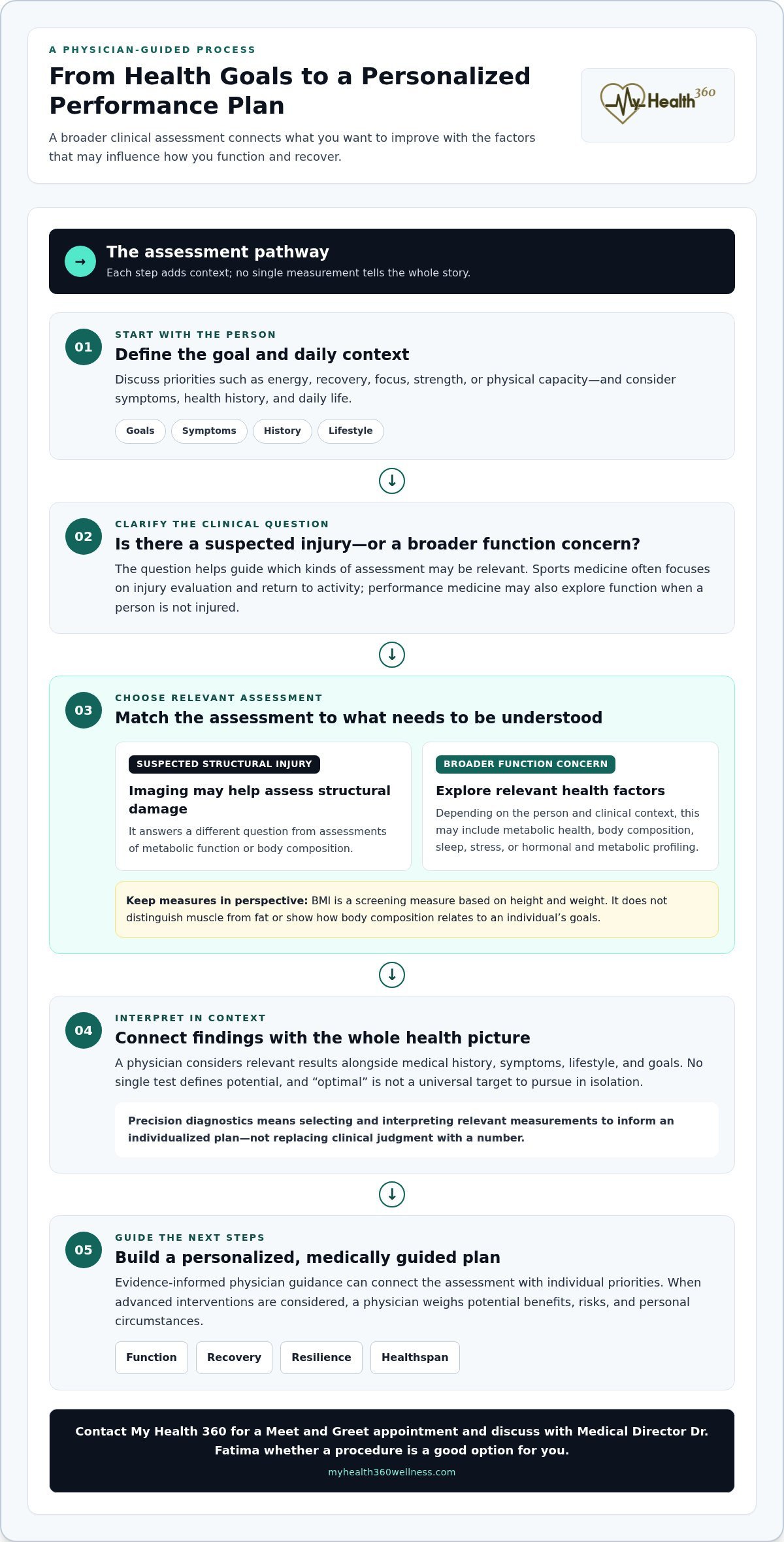
Consider someone who feels depleted by midafternoon despite having no diagnosed injury. Imaging may not answer questions about daily vitality, but a broader clinical assessment can explore relevant factors such as metabolic health, body composition, sleep, and stress. The aim isn’t to promise constant energy. It’s to consider a wider range of factors that may affect daily function.
This wider perspective informs concierge performance medicine, where physician-led guidance can connect individual goals with an integrated plan. At My Health 360, whole-body habilitation and recovery support reflect the idea that performance includes both how the body functions and how a person feels in daily life.
Key Diagnostic Differences
Imaging has a role when there’s a suspected structural injury. It answers a different question from assessments that explore metabolic function or body composition. BMI, for example, is a screening measure based on height and weight. It doesn’t distinguish muscle from fat or show how body composition relates to an individual’s goals. A more detailed assessment may offer useful context when clinically appropriate.
Hormonal and metabolic profiling can also contribute to a physician’s understanding of a person’s health, but results need to be interpreted alongside medical history, symptoms, and lifestyle. No single test defines potential. Precision diagnostics means selecting and interpreting relevant measurements to guide an individualized plan. These measurements can inform physician-led care, but they don’t replace clinical judgment.
A performance-focused plan starts with understanding your goals and the factors that may affect them. My Health 360’s integrative concierge care connects that discussion with physician guidance and relevant services.
Core Pillars of a Performance Optimization Plan
A performance plan is most useful when it considers how different aspects of health work together. Metabolic health influences how the body processes and uses energy, while musculoskeletal function supports movement and strength. Recovery and body composition may also matter, depending on a person’s goals and clinical needs. A Performance medicine specialist helps connect these areas rather than treating them as unrelated concerns.
- Metabolic health: Consider how the body’s energy systems support daily activity, exercise, and recovery.
- Musculoskeletal function: Focus on strength, mobility, and joint function in relation to your needs.
- Recovery: Explore appropriate habilitation strategies and technologies as part of a broader plan.
- Aesthetic performance: Consider how body composition and appearance relate to confidence alongside functional goals.
Whole-Body Habilitation and Recovery
Whole-body habilitation is a proactive framework for preparing for physical demands or supporting recovery after an injury or procedure. Instead of focusing on one isolated area, it considers broader physical needs and personal goals.
My Health 360’s BioPrime program supports pre-event or pre-operative whole-body habilitation, while Bio-Restore is designed for post-operative or injury-related habilitation. These programs provide structured recovery support. Individual plans and outcomes depend on clinical assessment and personal circumstances.
Technology and Aesthetic Performance
Technology can complement, rather than replace, a physician-guided plan. Emsculpt Neo uses HIFEM and radiofrequency technologies and may be considered in relation to muscle conditioning and body-composition goals. Morpheus8 uses radiofrequency technology in an aesthetic treatment setting, connecting skin and tissue appearance with the broader relationship between confidence and well-being. The suitability of either procedure depends on individual assessment.
These approaches reflect a broader view of performance: strength, movement, recovery, and appearance can all contribute to how a person experiences their health. Aesthetic goals can be considered alongside functional ones, without assuming that a procedure will deliver a particular result.
My Health 360’s whole-body habilitation and aesthetic services can be discussed as part of an individualized approach to performance and well-being.
Who Should See a Performance Medicine Specialist?
You don’t need to compete in sports to have performance goals. A Performance medicine specialist may be relevant if you want to preserve strength as you age, feel more capable through demanding workdays, support recovery after an injury, or explore how body composition and confidence relate to well-being. The right focus depends on your health history and what you hope to improve.
- The aging-gracefully patient: Someone interested in maintaining strength and function may want to discuss bone health, metabolic changes, and ways to support long-term vitality with a physician.
- The corporate athlete: A demanding schedule can make mental clarity, energy, and stress resilience important topics in a health conversation.
- The post-injury or post-operative patient: Whole-body habilitation, including Bio-Restore, can provide a structured framework for recovery and a return to daily activities.
- The aesthetic-focused patient: Someone with body-composition goals may consider how a Medical Gym Membership or Emsculpt Neo fits into broader functional and personal goals.
Identifying Your Performance Gaps
Brain fog, persistent fatigue, or slower-than-expected recovery can be reasons to take a closer look, though they can have many causes. Routine test results within reference ranges don’t always explain how you feel or whether specific factors affect your day-to-day function. A physician can interpret findings in context rather than treating a single result as the complete picture.
A clear, physician-led roadmap can also make health goals feel more manageable. Instead of trying disconnected interventions, you can discuss priorities, relevant assessments, and a practical way to review progress over time.
Pelvic and Sexual Wellness as Part of Vitality
Pelvic health can influence comfort, confidence, and how freely you move through daily life. Urinary leakage, for example, may affect exercise choices and other routines, making it a meaningful concern to raise as part of a broader health discussion. Learn more about urinary incontinence and pelvic health.
Sexual wellness also belongs in a whole-body conversation. Changes in comfort, desire, or function can have different contributing factors, so they warrant thoughtful, individualized clinical attention. My Health 360’s Emsella and Women’s Health offerings can be discussed in the context of pelvic and overall wellness, without assuming one approach suits everyone.
My Health 360 provides a setting to discuss pelvic health and wellness goals with a physician as part of a broader conversation about your needs.
The My Health 360 Approach to Performance
Performance care benefits from more than a collection of wellness services. At My Health 360, the approach is physician-led and individualized, bringing clinical judgment together with whole-body habilitation and recovery technologies. Medical Director Dr. Umbrine Fatima, an American Board Certified Internal Medicine specialist, provides medical oversight to help align a person’s goals and health context with appropriate next steps.
That distinction matters. An individual service is most useful when considered in a broader medical context. My Health 360 is physician-owned and combines integrative concierge medical care with habilitation and performance services. The aim is to pair technology with clinical judgment and attention to individual needs, not to treat a device or procedure as a substitute for thoughtful assessment.
Physician-Led, Personalized Care
An initial conversation is an opportunity to discuss what you want to change, what’s getting in the way, and relevant parts of your health history. From there, a physician can help establish a useful baseline and shape a plan around your priorities. Measurements should serve the clinical picture, not become a contest to collect data or pursue numbers without context.
Depending on individual needs, a broader plan may include whole-body habilitation, IV Hydration, or whole-body red light therapy. These offerings have different purposes, so their relevance depends on the person and the physician’s assessment. This is how the role of a Performance medicine specialist extends beyond recommending a single intervention: it’s about making considered choices that fit into a coherent health plan.
Bringing Performance and Aesthetics Together
Functional goals and aesthetic goals can overlap. Someone working on strength and body composition may also care about how their appearance affects confidence. Aesthetic procedures can be considered as one part of a broader, personalized approach, with suitability discussed in light of individual circumstances. Learn more about PDO threads and non-surgical rejuvenation.
Concierge care isn’t a promise of a particular result. It offers a physician-guided way to connect your priorities with appropriate options and revisit the plan as your needs evolve.
Take the Next Step Toward Personalized Performance
Optimizing health isn’t only about addressing illness or recovering from injury. A proactive, whole-person approach can help you understand what may be influencing your energy, strength, recovery, and long-term well-being. A Performance medicine specialist brings these goals into a physician-guided plan, with clinical context informing which strategies may be appropriate.
At My Health 360, care is physician-owned and led by Medical Director Dr. Umbrine Fatima, an American Board Certified Internal Medicine specialist. The integrative concierge model combines individualized medical guidance with options that include HIFEM and radiofrequency technologies, connecting performance, recovery, and aesthetic goals with medical oversight.
Ready to explore what a personalized approach could look like for you? Contact My Health 360 to schedule a Meet and Greet appointment and discuss with Medical Director Dr. Fatima whether a procedure may be a good option for you.
Frequently Asked Questions
How is performance medicine different from my yearly physical?
A yearly physical generally reviews your health and screens for potential concerns, while a Performance medicine specialist also considers how to support your function and personal health goals. The discussion may include energy, recovery, strength, and relevant health factors, interpreted alongside your history and symptoms. The aim is a more individualized view of health, not a replacement for routine medical care or a reason to treat a single measurement as the whole picture. For comprehensive general practice and primary care screenings, patients can discover Hatmed Medical Centre to maintain an essential foundation of day-to-day health.
Do I need to be a professional athlete to see a specialist?
No, performance-focused care isn’t limited to professional athletes. You might be interested in maintaining strength as you age, managing the physical demands of work and family life, or supporting recovery after an injury. A physician can help connect your goals with relevant aspects of your health and discuss appropriate next steps. Athletic performance is one possible focus, but everyday vitality and long-term function matter, too.
What is the BioPrime whole-body habilitation program?
BioPrime is My Health 360’s pre-operative and pre-event whole-body habilitation program. It offers a structured way to consider physical preparation for an upcoming event or procedure, with attention to broader needs rather than a single isolated concern. A physician can discuss how habilitation relates to your circumstances and goals. The program doesn’t guarantee a particular outcome, and individual plans depend on clinical assessment.
How does concierge medical care improve my health outcomes?
Concierge medical care provides a physician-guided, personalized approach to performance and wellness goals. Rather than assuming one plan fits everyone, care can take your priorities and health context into account when considering options. This approach can support clearer, more coordinated decision-making, but it can’t guarantee a specific health outcome. At My Health 360, integrative concierge care is led by Dr. Umbrine Fatima, an American Board Certified Internal Medicine specialist.
Can performance medicine help with post-operative recovery?
Performance-focused care may support recovery planning after a procedure. My Health 360’s Bio-Restore program provides post-operative and injury-related whole-body habilitation, with the aim of supporting a considered return to daily activity. The appropriate approach depends on your health, procedure, and recovery needs, so discuss it with a physician. Habilitation complements individualized medical guidance and isn’t a promise to recover within a specific timeframe.
What role does medical aesthetics play in performance medicine?
Medical aesthetics can be part of a broader conversation about body composition, confidence, and personal wellness goals. At My Health 360, options include Emsculpt Neo, Morpheus8, and PDO Thread Lift. These procedures have distinct purposes and aren’t substitutes for a comprehensive health plan. A physician can help you consider whether an aesthetic procedure aligns with your goals and overall health, while discussing potential benefits and individual considerations.
Is performance medicine covered by traditional health insurance?
Coverage depends on your insurance plan and the specific service, so don’t assume every aspect of performance optimization or medical aesthetics is covered. My Health 360 provides integrative concierge medical care, and coverage arrangements may differ from those for services commonly associated with a yearly physical. Review your plan’s terms to understand what it covers and any out-of-pocket responsibilities before making decisions about care.
What kind of technologies are used in a performance medicine center?
Technologies vary by clinical purpose. My Health 360 integrates HIFEM, radiofrequency (RF), and red light technologies, alongside services such as IV Hydration and low-level laser therapy. These options serve different purposes and aren’t appropriate for everyone. Contact My Health 360 to schedule a Meet and Greet appointment with Medical Director Dr. Fatima and discuss whether a procedure may be a good option for you.