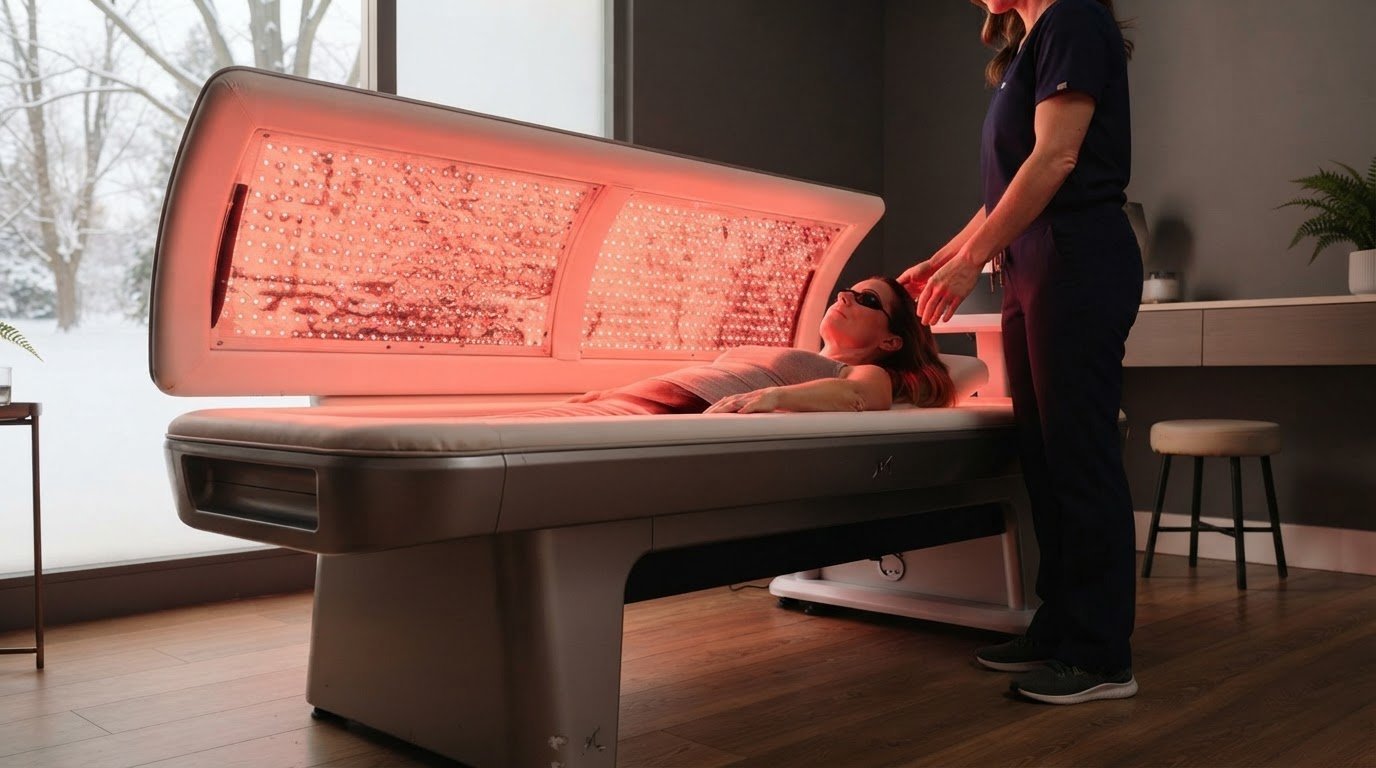
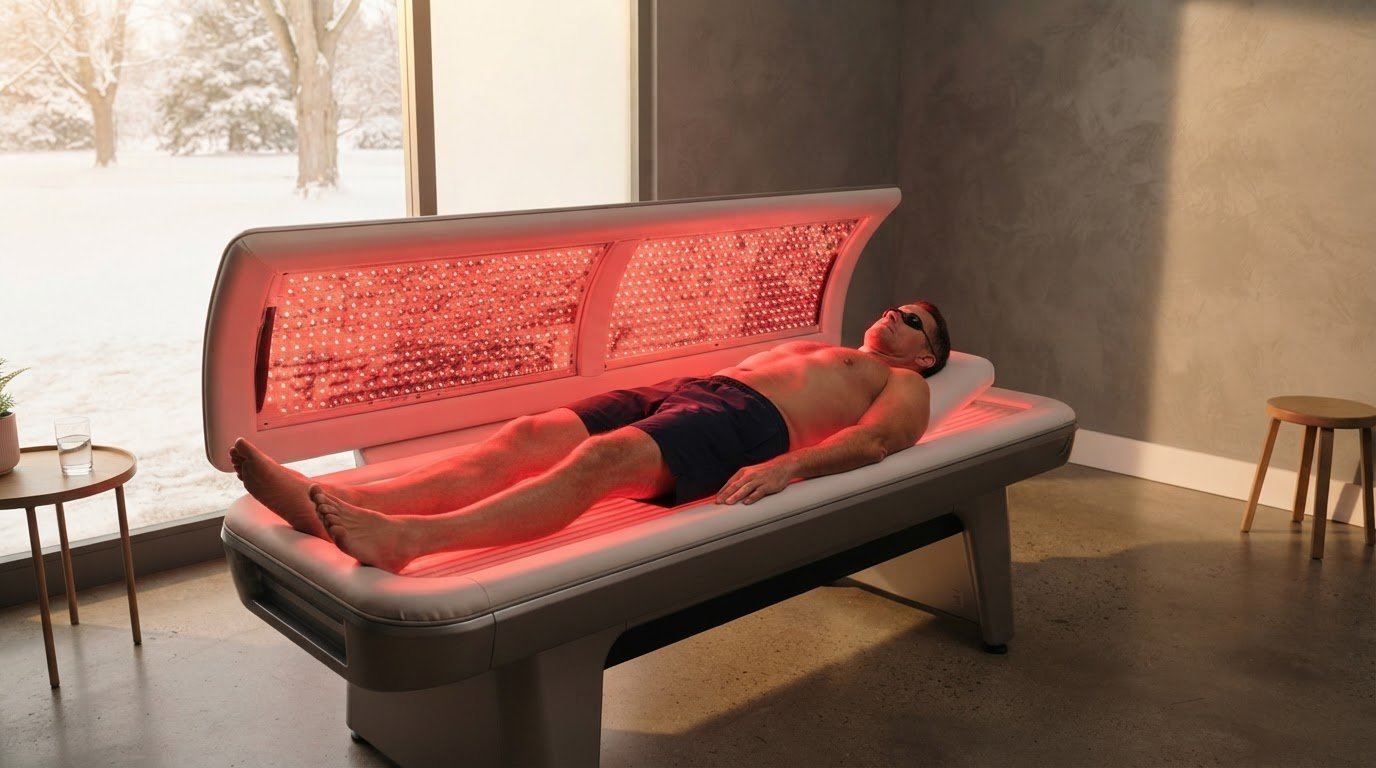
More coverage isn’t automatically a better fit for every goal. A whole-body photobiomodulation bed in Buffalo, NY, uses light across the body, while a localized device focuses on a selected area. Whole-body sessions commonly last 15 to 20 minutes, and the best approach depends on what you want to address.
It makes sense to ask how light is used in a wellness treatment and whether a full-body system differs from a smaller device. Photobiomodulation uses red and near-infrared wavelengths. One practical difference between whole-body and localized systems is the area treated.
This guide explains how full-body photobiomodulation works, what a session involves, and how light wavelengths fit into the process. It also compares whole-body sessions with localized treatments to help you understand the differences before considering which approach may suit your needs.
Key Takeaways
- Learn what makes a photobiomodulation session more consistent, including the role of treatment settings and exposure.
- Explore potential uses related to pain, recovery, sleep, and skin, while understanding that the purpose of treatment matters.
- See how red and near-infrared wavelengths differ and why wavelength selection is part of the treatment approach.
- Understand what photobiomodulation research can and cannot tell you about its clinical uses.
- Compare whole-body coverage with localized treatment to see how each system may suit different goals.
What Can You Expect From Your Full Body Photobiomodulation Treatment?
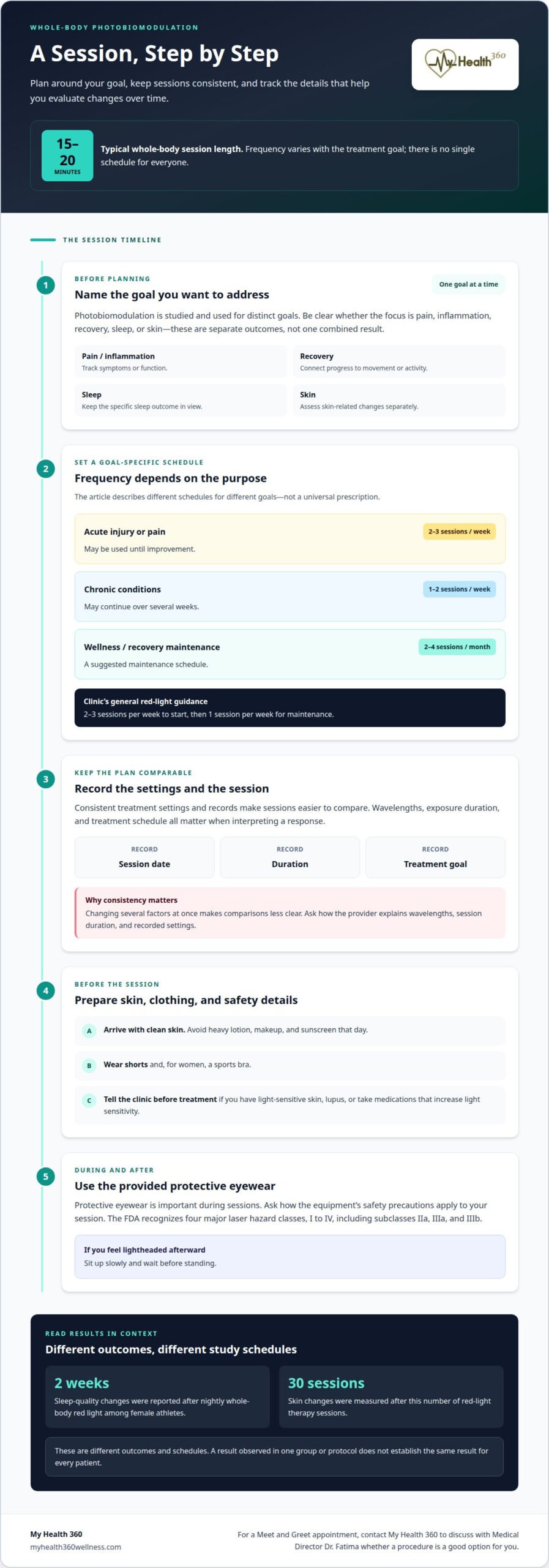
A whole-body session typically lasts 15 to 20 minutes, while frequency depends on the treatment goal. Consistent wavelengths, exposure, and session records help make each treatment easier to evaluate.
Clinical Evidence and Treatment Reproducibility
Reproducibility means using consistent treatment settings and recording them so sessions can be compared. That helps patients understand what was done and describe changes over time. A light bed’s wavelengths, exposure duration, and treatment schedule all matter when interpreting a response. Changing several factors at once makes comparisons less clear.
Clinical findings need context: an outcome observed in one group or protocol does not establish the same result for every patient. For example, research summaries describe sleep quality changes after two weeks of nightly whole-body red light among female athletes, and skin changes measured after 30 sessions. Those examples involve different outcomes and schedules, so they should not be treated as interchangeable evidence.
Session Length and Treatment Frequency
A typical full-body PBM session lasts 15 to 20 minutes. That duration provides a practical planning estimate, but the treatment goal influences how often sessions are scheduled. Acute injuries or pain may involve 2-3 sessions per week until improvement; chronic conditions may involve 1-2 sessions per week over several weeks.
For wellness and recovery maintenance, a suggested schedule is 2-4 sessions per month. The clinic’s general red-light guidance is 2-3 sessions per week to start, then 1 session per week for maintenance. These are different schedules for different purposes, not a single universal prescription. Record the session date, duration, and goal to track the plan consistently.
Before a session, arrive with clean skin and avoid heavy lotion, makeup, and sunscreen that day. Wear shorts and, for women, a sports bra. Use the protective eyewear provided. If you feel lightheaded afterward, sit up slowly and wait before standing. Tell the clinic before treatment if you have light-sensitive skin, lupus, or take medications that increase light sensitivity.
Packages, memberships, and introductory offers vary among Buffalo providers. No single package or deal applies to every photobiomodulation bed.
When assessing a provider and device, look for clear explanations of the wavelengths, session duration, and how treatment settings are recorded. Protective eyewear is important during sessions. The U.S. Food and Drug Administration recognizes four major laser hazard classes, I to IV, including subclasses IIa, IIIa, and IIIb. Ask how the equipment’s safety precautions apply to the session.
How Does Full-Body Light Therapy Help?
Photobiomodulation is studied and used in clinical settings for distinct goals, including pain, recovery, sleep, and skin. Evidence varies by outcome, so the treatment purpose matters when interpreting reported results.
Potential Uses for Pain, Recovery, Sleep, and Skin
Potential uses include temporary pain relief, inflammation management, recovery support, sleep, and skin-related outcomes. These are separate goals, not a single combined result. For example, findings about sleep in female athletes do not establish an effect on chronic pain, and skin measurements do not explain recovery after injury. Matching the question to the evidence helps patients assess what a study actually examined.
Reports describe improved sleep quality after two weeks of nightly whole-body red light among female athletes. Skin improvements were measured after 30 red light therapy sessions. Those examples show why both the outcome and treatment schedule matter: the sleep finding concerns a specific group and routine, while the skin observation used a defined session count.
Pain Relief and Tissue Repair
Pain relief means a reduction in pain, while tissue repair concerns changes in the body’s recovery process. Photobiomodulation therapy may be considered for pain or inflammation, though its effects can vary. “Temporary” is important: it describes the approved relief claim, not a permanent resolution of the underlying cause or a replacement for appropriate care.
For someone considering treatment for pain, a useful question is which symptom or function will be tracked. Changes in pain ratings, movement, or daily activity are different measures from tissue healing. Keeping those outcomes distinct makes progress easier to discuss and prevents improvement in one area from being treated as proof of change in another.
Inflammation and Recovery Uses
Inflammation and recovery are related treatment goals, but they describe different aspects of a person’s experience. Photobiomodulation may be considered in discussions about inflammation, but its relevance depends on the patient’s situation. Recovery may instead mean returning to activity after exertion or injury. Identifying the goal first gives a clearer basis for assessing whether a reported result applies to the patient’s situation.
Recovery observations should be tied to a specific example, such as comfort during movement or returning to a usual activity. Sleep findings from female athletes after two weeks of nightly exposure are a distinct example, not direct evidence of tissue repair. Separating sleep, pain, and activity outcomes keeps the discussion clinically meaningful.
Skin outcomes require the same precision. The reported measurement after 30 sessions concerns skin improvement, not pain relief or inflammation. A treatment plan should therefore connect the intended outcome with an appropriate measure, rather than relying on a broad claim that light therapy improves health.
These distinctions help patients understand what photobiomodulation may address and what an observed result means. Pain relief, inflammation, sleep, recovery, and skin are separate endpoints. Evidence for one should not be presented as evidence for all.
Red and near-infrared light wavelengths
Whole-body photobiomodulation uses red and near-infrared light, with wavelengths spanning 600-1070 nm. Beds use light sources that expose broad areas, while localized devices direct light toward selected tissue.
How Light Works in PBM
Photobiomodulation applies specific wavelengths of light to tissue as a non-invasive treatment. Wavelength describes the light’s position on the electromagnetic spectrum, measured in nanometers. Red light near 660 nm and near-infrared light above 700 nm are examples used in PBM. Knowing the wavelength helps patients distinguish a treatment’s light spectrum from its coverage area.
Light therapy doesn’t mean every wavelength behaves identically. A red-light source and a near-infrared source emit different portions of the spectrum, even when used in one session. The term “red and near-infrared” refers to those distinct bands, not one interchangeable color. For example, a device using red light around 660 nm differs spectrally from one using wavelengths above 700 nm.
Some consumer red-light products use visible wavelengths around 630-660 nm. That range overlaps the approximately 660 nm PBM example, but product type and treatment purpose still matter. A targeted device may focus on one area, while a full-body bed is designed for broader exposure. Coverage alone doesn’t identify the exact wavelengths a device uses.
Wavelengths and Bed Technologies
Wavelengths and delivery technology describe different features: wavelengths identify the light, while the device determines how it reaches the body. Full-body systems apply light across a larger area; localized systems concentrate it on a selected region. This explains why a broad light bed and a targeted unit aren’t automatically equivalent.
For a whole-body PBM bed, ask which red and near-infrared wavelengths it delivers and whether the device uses them together or separately. The relevant range is 600-1070 nm, with red light near 660 nm and near-infrared above 700 nm. These values describe wavelength, not exposure time or treatment frequency.
Blue light is a separate part of the spectrum, typically described around 405-470 nm, with approximately 450 nm as an example. It shouldn’t be confused with red and near-infrared PBM wavelengths. A device’s label or treatment explanation should make clear which spectrum is being used, rather than relying on a general “light therapy” description.
For muscle or other broad targets, the practical distinction is whether the system treats a large body area or focuses light locally. The wavelength range describes the light itself, while the treatment area describes its coverage. Considering both details helps patients compare whole-body and targeted approaches.
Photobiomodulation therapy and its clinical uses
Photobiomodulation therapy has been studied for decades, but its clinical uses depend on the condition and outcome being evaluated. The volume of research provides context, not a guarantee that a particular treatment will produce a specific result.
Research into photobiomodulation spans more than 50 years and includes 5,000+ laboratory studies. Laboratory findings help researchers examine biological responses, but they don’t establish clinical effectiveness on their own. Human studies, treatment protocols, and measured outcomes are also important when assessing whether a finding applies to patients.
That distinction matters in practice. A study about a particular condition, light source, or treatment schedule answers a narrow question. Its results shouldn’t automatically be applied to a different condition or device. For example, findings about hair loss concern androgenetic alopecia, not every cause of hair thinning.
Low-level light increased hair density compared with a sham device over 24 weeks in people with pattern hair loss. Photobiomodulation is one approach studied for hair loss. These details identify a specific use and study period; they don’t show that every red-light therapy device has the same design or produces the same effect.
Clinical applications are described in relation to pain and inflammation, alongside research into recovery, sleep, skin, and hair. Each area calls for its own outcome measure. Pain can be assessed as a symptom, while hair density and sleep quality measure different things. A change in one outcome isn’t proof of tissue repair, reduced fatigue, or improvement elsewhere.
For a patient reviewing a proposed use, three details help frame the evidence: the condition studied, the treatment protocol, and the outcome measured. A study of pattern hair loss over 24 weeks, for instance, cannot answer whether therapy addresses fatigue. Likewise, laboratory research can suggest a direction for further study, but it isn’t a substitute for clinical evidence in people.
For Buffalo-area readers, location and evidence answer different questions. Local access tells you where a service may be available, while clinical studies describe specific populations, treatment protocols, and measured outcomes. Neither alone establishes that a finding applies to every person or device.
The practical approach is to match the treatment discussion to your goal, then interpret supporting evidence within its limits. Research can inform decisions, but a study’s population, protocol, and measured effects determine what its findings actually support.
Whole-body versus localized PBM systems
The main difference is coverage: a whole-body system exposes a broad area, while a localized device targets a selected region. That distinction affects treatment planning, especially when the goal involves one specific site rather than broader exposure.
Localized PBM treatment typically takes 2-10 minutes per area. For example, a clinician may direct a device toward one painful joint or muscle group. A whole-body bed is designed to expose multiple body regions during a session. Broader coverage doesn’t automatically mean a better result; the intended treatment area and goal should guide the choice.
Start with the goal. A focused concern, such as discomfort in one shoulder, may call for localized exposure to that area. A broader wellness or recovery goal may make full-body coverage more relevant. The difference is where light is delivered, not proof that one approach produces greater healing or stronger cellular effects.
Device descriptions can be considered through two questions: which wavelengths are used, and how much of the body receives light? A red and near-infrared device may be localized or full-body. Comparing these features prevents the term “PBM” from obscuring important differences in coverage and treatment design.
- Coverage: Localized devices focus on a selected site; whole-body systems expose wider areas.
- Planning: A single-region concern, such as one joint, differs from a goal involving several body regions.
- Time: A localized session commonly takes 2-10 minutes per area; multiple areas can require separate applications.
- Evidence: Research findings apply to the specific device, protocol, and outcome studied, not automatically to every PBM format.
Scientific claims about proposed mechanisms also require care. Cellular processes are studied in photobiomodulation research, but a mechanism alone doesn’t establish a clinical outcome. A sleep-related goal may involve tracking sleep timing and circadian rhythm, but that doesn’t show that every full-body system changes sleep. Match the outcome being assessed to the evidence and treatment approach.
For a discussion of whether broader or targeted light therapy fits your goals, contact My Health 360 to arrange a Meet and Greet and discuss with Medical Director Dr. Fatima whether a procedure is a good option for you.
My Health 360
My Health 360 is the only clinic in Western New York where qualified physician Umbrine Fatima, M.D., performs all Morpheus8 treatments. In New York State, microneedling and skin penetration are considered the practice of medicine and are limited to physicians.
Other spas jeopardize patient safety when they allow estheticians, physician assistants, or nurse practitioners to perform Morpheus8. My Health 360’s physician-led approach offers a setting to discuss treatment and your wellness or recovery goals with Medical Director Dr. Fatima.
Contact My Health 360 to arrange a Meet and Greet and discuss with Dr. Fatima whether a procedure is a good option for you.
Make Your Next Step Personal
Choosing a light-based approach is less about selecting the largest device and more about defining what you want to address. If you’re considering a whole-body photobiomodulation bed in Buffalo, NY, start with a clear goal: a specific recovery concern, comfort during activity, or general wellness. That focus keeps the discussion on relevant treatment choices rather than broad claims about light. Consider which outcomes would make treatment worthwhile in your everyday life.
Discuss your health history, current treatments, and practical preferences with a medical professional. Suitability depends on individual circumstances, including your goal and relevant health factors. A Meet and Greet with Medical Director Dr. Fatima gives you an opportunity to discuss whether a procedure is a good option for you.
When you’re ready to explore that next step, contact My Health 360 to arrange a Meet and Greet. A thoughtful conversation can help you move forward with clarity and confidence.
Frequently Asked Questions
How Long Does It Take to Notice Results?
There isn’t one timeline that applies to every goal or treatment plan. Research examples describe improved sleep quality after two weeks of nightly whole-body red light among female athletes, while skin changes were measured after 30 sessions. These are distinct outcomes, not a promised timetable for an individual. Track the specific change you’re seeking, such as sleep quality or skin appearance, rather than relying on a general expectation.
Does Red Light Therapy Hurt or Tingle?
Photobiomodulation uses light exposure rather than needles or a step that penetrates tissue. Sensations can differ among people and devices, so there isn’t one feeling everyone should expect. Tell the staff if you feel uncomfortable during a session, and pause to discuss what you’re experiencing. This helps distinguish ordinary light exposure from discomfort that deserves attention before continuing.
How Often Should I Use It?
Suggested frequency depends on the goal: acute injury or pain protocols may use 2-3 sessions per week until improvement, while chronic conditions may use 1-2 sessions per week over several weeks. Wellness and recovery maintenance schedules may involve 2-4 sessions per month. These are different approaches, not one schedule to combine. Keep the goal and session plan consistent when assessing progress.
Where Can I Find a Whole-Body Photobiomodulation Bed in Buffalo, NY?
My Health 360 offers whole-body red light therapy for people in Buffalo and surrounding suburbs. If you’re considering treatment, contact My Health 360 to arrange a Meet and Greet and discuss with Medical Director Dr. Fatima whether a procedure is a good option for you. Bring your main wellness or recovery goal to help focus that conversation.
Which Buffalo-Area Clinics Offer Full-Body Red Light Therapy or PBM Beds?
My Health 360 offers whole-body red light therapy in the Buffalo area. The treatment discussion can help clarify how full-body light exposure relates to your wellness or recovery goals. To explore whether a procedure is suitable for you, contact My Health 360 for a Meet and Greet with Medical Director Dr. Fatima. This conversation can address your priorities without assuming that every treatment approach fits every person.
What Are the Addresses, Hours, and Contact Details of Buffalo PBM Providers?
For visit planning, contact My Health 360 directly and request a Meet and Greet with Medical Director Dr. Fatima. Ask for the current address, hours, and appointment contact details before setting out. This is useful if you’re traveling from Buffalo, Amherst, Williamsville, or another nearby community, since having the clinic’s current information helps you plan your visit.
What Conditions or Wellness Goals Is Whole-Body Photobiomodulation Used For?
Photobiomodulation is studied or used in connection with pain, inflammation, recovery, sleep, skin, and hair-related goals. These are separate applications, and evidence for one does not establish the same effect for another. For example, findings about sleep quality do not demonstrate a change in pain. Identify the goal you want to discuss, then consider evidence and treatment plans specific to that outcome.
What Does a Typical Whole-Body PBM Bed Session Involve, and How Long Does It Take?
A typical whole-body PBM session lasts 15 to 20 minutes. Sessions use light across the body, with protective eyewear provided. Arrive with clean skin and skip heavy lotion, makeup, and sunscreen on the session day. Wear shorts, and women can add a sports bra. If you feel lightheaded afterward, sit up slowly and wait before standing.