

What if the most credible longevity plan starts with fewer tests and a better conversation? When labels like integrative, functional, and longevity medicine overlap, it can be hard to tell what care actually includes, how recommendations are chosen, or whether a program is built around your needs.
It’s reasonable to want proactive, whole-person guidance while also asking for clear evidence and physician involvement. Integrative longevity medicine brings conventional medical care together with an individualized focus on longer-term health, but the term alone doesn’t tell you what a clinic will assess or recommend.
This guide explains where integrative and longevity medicine differ and overlap, and how physician involvement can connect personal health priorities with thoughtful follow-up. You’ll learn what to ask about a clinician’s background, how to weigh testing and treatment claims, and what signs suggest care is tailored rather than a preset menu. At My Health 360, integrative concierge medical care for performance optimization is physician-led by Dr. Umbrine Fatima, an American Board Certified Internal Medicine specialist. Use the questions ahead to prepare for an informed conversation about whether an approach fits your goals.
Key Takeaways
- Integrative longevity medicine connects a whole-person perspective with longer-term health priorities; the label alone doesn’t tell you what a clinic will recommend.
- Ask why each assessment is relevant to your goals and how its results could inform the plan.
- Compare integrative, functional, longevity, and concierge medicine by the care provided, not just the terminology.
- Before committing, clarify who will guide your care, what evidence supports recommendations, and how follow-up will work.
- Contact My Health 360 for a Meet and Greet appointment to discuss with Medical Director Dr. Fatima whether a procedure may be a good option for you.
What Does Integrative Longevity Medicine Mean for Your Care?
Integrative longevity medicine is a way of organizing care around the whole person and their longer-term health goals. It isn’t a single test, treatment, or guaranteed outcome, and the phrase doesn’t describe one standardized specialty. Instead, it signals an approach: understand the individual, consider relevant aspects of health, and discuss how care might support priorities over time.
A useful working definition: “Integrative longevity medicine is a care philosophy that brings a whole-person perspective to longer-term health goals; it is not a promise of extended life or a prescribed package of tests and treatments.” The distinction matters. A sophisticated assessment isn’t automatically useful just because it is available. Its value depends on whether a clinician can explain its purpose and relevance to your situation, and how its result could affect a care discussion.
Longevity medicine is commonly discussed in connection with prevention and using health information to inform care. Clinics may use the term differently, however. Ask what the provider means by “longevity,” what the approach includes, and how recommendations connect to your priorities.
How Is Integrative Longevity Medicine Different from Integrative Medicine?
These ideas can overlap rather than compete. A clinician may use an integrative framework while helping a patient consider longer-term goals. Before beginning, ask the practice to define both terms and explain how they shape the care it actually provides.
Who Might Explore This Kind of Care?
This approach may interest people seeking coordinated physician guidance around personal health or performance goals, especially when they want recommendations considered in the context of their wider health history. It isn’t a substitute for general primary care or emergency services. Whether a particular service or procedure is suitable depends on individual circumstances and should be discussed with a qualified physician.
My Health 360 is a physician-owned Longevity, Recovery, and Performance Center offering integrative concierge medical care for performance optimization. To explore whether a procedure may be a good option for you, contact My Health 360 to arrange a Meet and Greet and discuss your questions with Medical Director Dr. Fatima.
How Integrative Longevity Care Connects Personal Priorities to a Plan
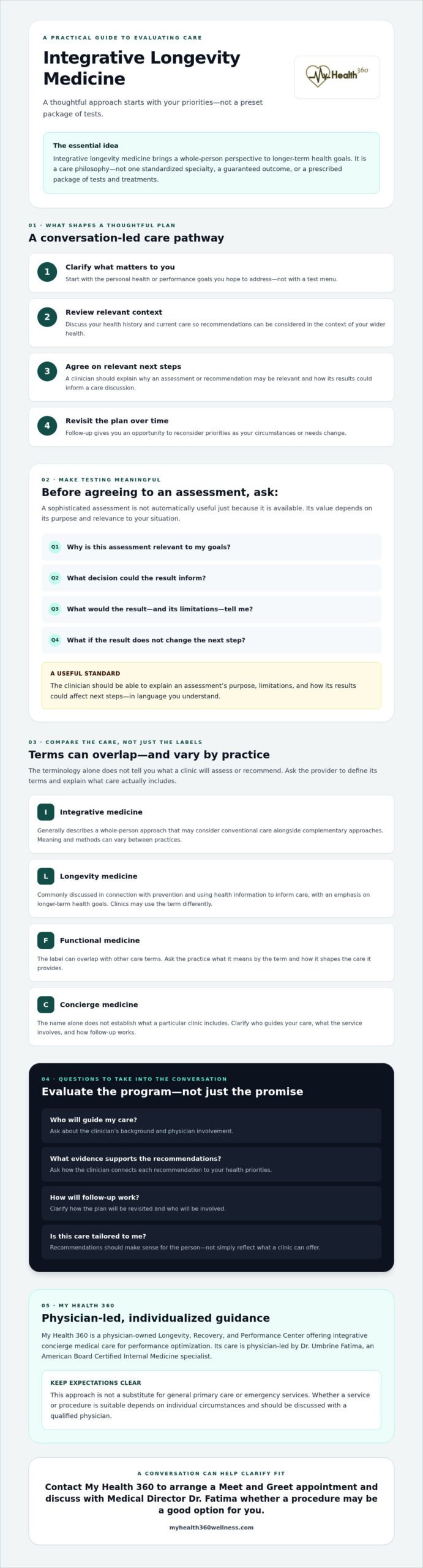
A thoughtful care plan should begin with your priorities, not a predetermined package of tests. In integrative longevity medicine, the process can be understood as a series of conversations: clarify what you hope to address, review relevant health history and current care, agree on priorities, then revisit the plan as circumstances or needs change. Recommendations should make sense for the person, not simply reflect what a clinic can offer.
The Andrew Weil Center for Integrative Medicine at the University of Arizona describes principles of this approach in What is Integrative Medicine? For a patient, the practical question is how a clinician applies those principles: what information informs a recommendation, why it may be relevant, and what the clinician can and cannot conclude from it.
Testing is useful only when its results can inform a relevant care discussion. An advanced assessment may sound compelling, but the clinician should be able to explain its purpose, limitations, and how results could affect next steps. Ask what decision the test could inform, what a result would and would not tell you, and what the plan would be if the result didn’t change the next step.
What Should an Initial Longevity Consultation Clarify?
A useful first discussion makes room for your goals, health history, current care, and questions. Ask how the clinician will use that information to shape recommendations, and whether any proposed assessment is intended to answer a specific clinical question. The physician should explain the rationale and limitations in language you understand, including what a result can’t establish. Before proceeding, clarify who will discuss findings with you and how recommendations will be reviewed over time.
How Should a Personalized Plan Be Reviewed?
Priorities can evolve, so ask who will discuss the plan with you and how follow-up decisions will be made. A physician should communicate what can reasonably be assessed, what remains uncertain, and when a recommendation may need reconsideration. Established health guidance and emerging approaches shouldn’t be presented as equally supported; ask what evidence informs a recommendation and how well it applies to your situation. No plan should be framed as a guarantee of disease prevention or a longer life.
At My Health 360, physician-led care is offered through integrative concierge medical care for performance optimization. To discuss your goals and whether a procedure may be a good option for you, contact My Health 360 to arrange a Meet and Greet with Medical Director Dr. Fatima.
Integrative, Functional, Longevity, and Concierge Medicine: How to Compare Them
These labels can help describe a practice, but they aren’t four separate, universally defined care models. A clinician may combine elements of several, and the terms alone don’t establish what services are provided or whether the approach is appropriate for you. Use them as a starting point for questions, not as proof of quality.
| Label | Commonly stated focus | What to ask and verify |
|---|---|---|
| Integrative | A whole-person perspective that may bring conventional care together with complementary approaches. | How does the clinician define integrative care, and how are recommendations selected for your circumstances? |
| Functional | Often emphasizes understanding factors that may contribute to a health concern. | What concerns will the clinician evaluate, and what evidence supports the proposed approach? |
| Longevity | Prioritizes longer-term health goals and how care relates to them. | How does the practice define longevity care, and what can its recommendations reasonably address? |
| Concierge | Describes a care-delivery relationship, which may emphasize a particular way of accessing or coordinating care. | Who makes clinical decisions, what does the relationship include, and how does the practice coordinate with your other clinicians? |
What Do These Medical Labels Usually Describe?
Integrative commonly signals a broad view of health, while longevity points to longer-term goals. Functional often describes attention to potential contributing factors; concierge describes how care is organized rather than a clinical philosophy. These emphases can overlap, and their meaning varies among practices. Ask the clinician to explain what each term means in their setting and what it changes about your care.
A longevity label by itself doesn’t prove better outcomes or more appropriate care. The useful distinction is what the physician evaluates, how recommendations are justified, and whether the plan fits your needs. A polished name or convenient care arrangement can’t replace clear clinical reasoning.
Which Questions Help You Compare Care Models?
In an initial conversation, seek specific answers to practical questions:
- Who evaluates my concerns, and who is responsible for clinical decisions?
- How do you explain the evidence, uncertainty, and purpose behind a recommendation?
- How will you coordinate with my existing clinicians when relevant?
- What does this practice mean by integrative, functional, longevity, or concierge care?
Clear answers make it easier to compare the care itself rather than rely on labels. For a discussion about your goals and whether a procedure may be a good option for you, contact My Health 360 for a Meet and Greet appointment with Medical Director Dr. Fatima.
How to Evaluate an Integrative Longevity Medicine Program
A thoughtful program should make its reasoning visible. Before enrolling, find out who evaluates your health concerns, how recommendations are tailored to you, and what happens after an initial plan is made. The goal isn’t to collect the most tests or services. It’s to understand what the care is intended to address and whether the approach fits your priorities.
A useful reminder: “A thoughtful care plan should explain its purpose, its limits, and how it will be reviewed.” Use this checklist to guide a conversation about an integrative longevity medicine program:
- 1. Clinician involvement: Who conducts the medical assessment, who discusses clinical recommendations, and how does the physician stay involved as priorities are reviewed?
- 2. Individual rationale: What is each recommendation intended to address, and why is it relevant to your health history and goals?
- 3. Evidence and uncertainty: What evidence supports the recommendation? What remains uncertain, and what are its limitations?
- 4. Follow-up and scope: How will you and the clinician assess whether the plan remains relevant? Which services does the practice provide, and which concerns or services are outside its scope?
What Should You Ask About Physician Involvement?
Ask directly who reviews your history and makes clinical decisions, and whether you’ll have an opportunity to discuss recommendations with the physician. Clarify how the physician will remain part of conversations as your goals or circumstances change. A particular staffing arrangement alone doesn’t establish the quality or safety of care; what matters is clear responsibility and communication about your care.
How Can You Assess Evidence and Follow-Up?
Ask the clinician to explain the reasoning behind a recommendation in terms you can understand. For example: “What question is this assessment meant to answer, and how could the result affect what we discuss next?” Then ask how the plan will be reviewed and what would lead to adjusting it. Clear communication should distinguish established guidance from approaches where evidence or relevance is less certain.
You don’t need to agree to a recommendation before you understand its purpose, potential limitations, and place in your care. If the rationale remains unclear, or you’d like another perspective, consider seeking a second opinion. My Health 360 is physician-owned and operated by Dr. Umbrine Fatima, an American Board Certified Internal Medicine specialist. Contact My Health 360 to arrange a Meet and Greet and discuss with Medical Director Dr. Fatima whether a procedure may be a good option for you.
Exploring Physician-Led Integrative Longevity Care at My Health 360
How can you tell what a physician-led approach means in practice? My Health 360 is a physician-owned Longevity, Recovery, and Performance Center offering integrative concierge medical care for performance optimization. Its offerings include this concierge care and whole-body habilitation programs. Ask how a service relates to your goals, what it is intended to address, and whether it is appropriate for your circumstances. Recommendations depend on an individual discussion, and no particular outcome is guaranteed.
My Health 360 is owned and operated by Dr. Its whole-body habilitation programs have distinct purposes, so a conversation with a physician can help you understand whether one relates to your circumstances. The center’s services are not a substitute for general primary care or emergency services.
What Services Does My Health 360 Offer?
BioPrime is pre-operative or pre-event whole-body habilitation. Bio-Restore is post-operative or injury whole-body habilitation. They are distinct programs for different contexts, not interchangeable labels or promises of a particular result. My Health 360 also offers integrative concierge medical care for performance optimization. Ask which services are relevant to your goal, what each is intended to address, and whether your situation calls for discussion with another clinician.
Understanding the scope of care is part of making an informed choice. Ask what the center provides, what falls outside its services, and how recommendations fit alongside any care you already receive. The phrase integrative longevity medicine describes an approach, not a guarantee that every type of health concern can be addressed in one setting.
What Happens at a Meet and Greet?
A Meet and Greet is an opportunity to share what you hope to address and ask questions about physician-led care. Consider bringing questions about the purpose of a proposed service, its relevance to your goals, and what you should understand before deciding. You can also ask how the Medical Director will discuss personal suitability and what further clinical conversation may be appropriate.
If you’re considering a procedure, contact My Health 360 for a Meet and Greet appointment and discuss with Medical Director Dr. Fatima whether it may be a good option for you. The conversation can help you explore fit without assuming that a particular procedure or program is right for everyone.
Take the Next Step Toward Informed, Personalized Care
Choosing integrative longevity medicine starts with understanding what a practice means by its approach, how recommendations relate to your priorities, and who will guide clinical decisions. Look for clear explanations of a plan’s purpose, evidence, limitations, and follow-up. A label or advanced test alone can’t tell you whether care is right for you.
My Health 360 is owned and operated by Dr. Umbrine Fatima. Offerings include integrative concierge medical care for performance optimization, BioPrime pre-operative or pre-event whole-body habilitation, and Bio-Restore post-operative or injury whole-body habilitation. Whether any service or procedure is appropriate depends on an individual discussion.
Ready to ask questions about your goals and options? Contact My Health 360 to request a Meet and Greet and discuss with Medical Director Dr. Fatima whether a procedure may be a good option for you. Take the time you need to make an informed choice, with a clear understanding of what comes next.
Frequently Asked Questions
What is integrative longevity medicine?
Integrative longevity medicine is an approach that considers a person’s broader health context while emphasizing longer-term health goals. It may combine conventional medical care with complementary approaches, depending on the clinician and practice. The term doesn’t refer to one standard package of tests or treatments, and it can’t promise a particular outcome. Ask what the practice means by the label and how its recommendations would relate to your individual priorities.
How is integrative longevity medicine different from functional medicine?
Integrative care generally describes a whole-person perspective, while functional medicine often emphasizes factors that may contribute to a health concern. Longevity care adds an emphasis on longer-term health goals. These descriptions can overlap, and practices may use the terms differently. Rather than relying on labels, ask who will assess your concerns, what the proposed care is intended to address, and how recommendations are supported and reviewed.
Is longevity medicine evidence-based?
Evidence depends on the specific recommendation, not simply on the “longevity medicine” label. Some recommendations may draw on established medical guidance, while other tests or interventions may have less certain relevance for a particular person. Ask what evidence supports each recommendation, what its limitations are, and how the information could guide a clinical decision. A physician should be able to discuss uncertainty clearly rather than presenting every option as equally established.
Can integrative longevity medicine replace primary care?
No. Integrative longevity medicine shouldn’t be assumed to replace general primary care, and it isn’t a substitute for emergency services. Before beginning, clarify what the practice does and doesn’t provide, and how it may coordinate with clinicians already involved in your care. If you have a new or urgent health concern, contact an appropriate healthcare provider or emergency service rather than relying on a longevity program to address it.
What should I ask before choosing a longevity medicine provider?
Ask who conducts your medical assessment and who makes clinical decisions. Find out why each proposed test or service is relevant to your goals, what evidence and uncertainties apply, and how follow-up will work. Clarify which services the practice provides and how it coordinates with your existing clinicians when relevant. If the clinician can’t explain a recommendation’s purpose or limitations in clear terms, consider pausing or seeking another medical opinion.
Does integrative longevity medicine guarantee a longer life?
No. A care philosophy, test, or treatment can’t guarantee a longer life. Longevity-focused care may involve discussing health priorities over time, but individual outcomes can’t be promised. Be cautious of claims that a program or assessment will definitively extend lifespan or prevent disease. Ask what a recommendation is intended to address, what is known about it, and what remains uncertain before deciding whether it belongs in your care.
How can I find out whether My Health 360 is a good fit?
Contact My Health 360 for a Meet and Greet appointment to share your goals and ask about physician-led care. The center is owned and operated by Dr. Umbrine Fatima, an American Board Certified Internal Medicine specialist, and offers integrative concierge medical care for performance optimization, BioPrime, and Bio-Restore. Discuss with Medical Director Dr. Fatima whether the services relate to your goals. Contact My Health 360 to request a Meet and Greet.