
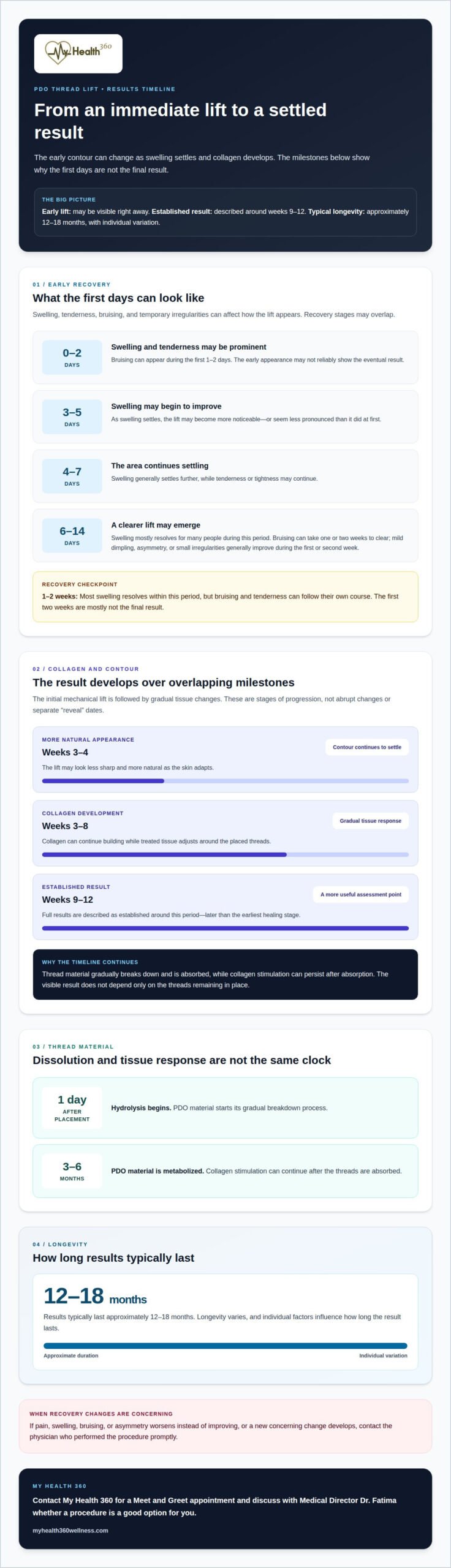
A PDO thread lift’s immediate lift isn’t the finished result. The PDO thread lift results timeline begins with an early change in contour, while swelling and bruising can affect how the area looks during the first days. As healing progresses, collagen develops and the result continues to settle, with the full effect described as established around weeks 9-12. Results typically last approximately 12-18 months, although longevity varies.
It’s understandable to want to know when you’ll see a difference and whether early swelling is part of recovery. Tenderness, bruising, swelling, or temporary irregularities may occur during the first week or two, so the appearance then may not reflect the settled outcome. These changes generally improve as recovery continues.
This guide explains how results develop from the initial lift through collagen remodeling, what to expect during recovery, and why PDO thread lift results may last for months after the threads dissolve. It also covers the factors that shape longevity, so you can form a realistic picture of the treatment’s progression.
Key Takeaways
- An early lift may be visible right away, but swelling and bruising can affect how it looks during the first days.
- Collagen-related improvement develops gradually, so assess the result over the following weeks rather than judging it during early recovery.
- Swelling, tenderness, bruising, and minor irregularities generally improve during the first or second week.
- Follow post-treatment guidance on facial movement and activity to support recovery while the threads settle.
- Results typically last approximately 12-18 months, with longevity influenced by individual factors.
Collagen stimulation and progressive improvement
A PDO thread lift can create an initial mechanical lift, followed by gradual tissue changes. Collagen development takes time, so the contour may look different as swelling settles and the skin adapts.
Several milestones help explain this progression: the lifting effect may look more natural during weeks 3 to 4, collagen can build during weeks 3-8, and full results are described as established during weeks 9-12. These stages overlap rather than occurring as abrupt changes.
Gradual Collagen Remodeling
Collagen remodeling is the tissue’s gradual response around the placed threads, contributing to changes beyond the initial lift. The appearance in the first days may not show how the result will look after the tissue has had time to adapt.
During weeks 3-8, collagen development can continue while the treated tissue adjusts. A gradual change may be more noticeable than a single dramatic shift: for example, the lift can appear less sharp and more natural as the skin adapts during weeks 3 to 4.
Thread Dissolution and Collagen Effects
Thread dissolution is the gradual breakdown and absorption of PDO material. Collagen stimulation is a tissue response that can continue beyond that process, so the visible result does not depend only on the threads remaining in place.
Hydrolysis begins one day after placement, and PDO suture material is metabolized over months 3-6. The threads dissolve within several months, while collagen stimulation can persist after absorption. As a result, seeing the thread material dissolve doesn’t mean the tissue response ends at the same time.
Collagen Response and Full Results
The collagen response is the gradual tissue change that develops after placement, with full results described as established during weeks 9-12. For the reader, this timing provides a more useful assessment point than judging the result during the earliest healing period.
Collagen can continue building during weeks 3-8, while the result may keep settling during months 3-6. These overlapping stages explain why improvement can continue after the initial lift becomes less prominent. The pdo thread lift results timeline is therefore a progression, not a single reveal date.
For a practical comparison, consider three checkpoints: the more natural appearance during weeks 3 to 4, ongoing collagen development during weeks 3-8, and established results during weeks 9-12. A change between these checkpoints can reflect normal progression rather than a sudden loss of effect.
Months 3-6 bring another stage: the thread material is metabolized while the tissue response continues to shape the result. Understanding these milestones can help you assess changes in context and avoid treating the early appearance as the final outcome.
How Soon Will I See Results After a Thread Lift?
An initial lift may be visible immediately, but swelling and bruising can change how the treated area looks. During days 0-2, swelling, tenderness, and possible bruising may be prominent. The early appearance is therefore not always a reliable guide to the result after recovery progresses.
- Days 0-2: Swelling and tenderness may be significant, and bruising can appear during the first 1-2 days.
- Days 3-5: Swelling may begin to improve, making the lift more noticeable. Some early lift can also appear less pronounced as swelling settles.
- Days 4-7: Swelling generally starts to settle further, while tenderness or tightness may continue.
- Days 6-14: A clearer lift may be visible as swelling mostly resolves. Bruising can take one or two weeks to clear.
These stages can overlap. Bruising may remain visible even as swelling improves, and tenderness can continue while tissue changes from thread placement settle. Mild asymmetry, dimpling, or small irregularities should improve during the first or second week. Skin puckering or dimpling typically smooths during that period, too.
Most swelling resolves within 1 to 2 weeks. That doesn’t mean everyone looks identical by then: bruising and tenderness can follow their own course. The first two weeks are mostly not the final result, so compare the area as recovery continues rather than relying on one early-day photograph.
Compared with facelift surgery, a thread lift generally involves a shorter recovery, though the procedures differ in scope. Recovery can also vary among thread-lift techniques, depending on placement and the treatment performed.
PDO thread lift pricing in the United States depends on the case and is provided after a quote request; the area treated and treatment plan affect cost.
Complications or unexpected changes can delay recovery. If pain, swelling, bruising, or asymmetry worsens instead of improving, or a new concerning change develops, contact the physician who performed the procedure promptly.
For a practical recovery check, note changes over time rather than judging the result at one moment. A photo taken later in the first week, for example, may show less swelling than one taken earlier, while bruising remains. Tracking both changes can help distinguish an evolving early appearance from the gradual settling expected during the first or second week.
If you’re considering treatment, contact My Health 360 to arrange a Meet and Greet and discuss with Medical Director Dr. Fatima whether a procedure is a good option for you.
Activity and facial-movement restrictions
After treatment, temporary limits on exercise and facial movement help protect the area while threads settle. Follow a gradual return to activity, distinguishing light movement from workouts or forceful jaw motion.
Post-Treatment Activity Limits
Activity limits are temporary changes to exercise and daily movement after threads are placed. They matter because the treated tissue is adjusting, and a gradual return avoids placing unnecessary strain on the area.
During days 0-2, avoid exercise and facial movement. Strenuous exercise is commonly restricted for 48 hours, while guidance also advises avoiding heavy workouts for at least a week. These recommendations distinguish strenuous activity from gentle movement around the home.
On days 3-5, light activity may be acceptable, but exercise should still be avoided. Light exercise is described as acceptable during days 6-14. Follow the specific aftercare plan provided for your treatment, since it accounts for the procedure performed.
Facial-Movement Restrictions
Facial-movement restrictions limit forceful motion while placed threads settle. They matter when the treatment area includes the cheeks or jawline, where chewing and wide expressions move nearby tissue.
For one week, avoid heavy chewing, wide yawning, and exaggerated facial movements. Choose softer foods if chewing feels strenuous, and avoid deliberately testing your jawline’s range of motion. These steps reduce unnecessary movement during early recovery.
Dental visits and facial massages are generally postponed for about 2 weeks after treatment. Both can involve pressure or movement near treated areas, so timing them later helps avoid disturbing the recovering tissue.
Other short-term limits address heat and pressure. Avoid saunas, steam rooms, and excessive heat for 72 hours. That period is separate from exercise guidance: a person may be ready for gentle daily movement while still avoiding heat exposure.
A practical sequence is to keep activity minimal during days 0-2, resume light daily tasks during days 3-5, then consider light exercise during days 6-14. Heavy workouts remain a separate consideration, with guidance advising avoidance for at least a week. Don’t treat “light activity” as permission to return to intense training.
A short, easy walk, for example, is light activity, unlike a strenuous workout. Speaking and ordinary expressions also differ from wide yawning or exaggerated facial movements. The distinction is about intensity and movement, not complete stillness.
These limits apply across the early recovery period, but their timing differs by activity: strenuous exercise has a 48-hour restriction, excessive heat has a 72-hour restriction, and heavy chewing has a one-week restriction. Dental visits and facial massage are delayed for about 2 weeks. Keeping these intervals distinct makes it easier to plan a measured return to routine.
Results Longevity: How Long Do PDO Threads Actually Last?
PDO thread lift results typically last approximately 12-18 months, although longevity varies. The visible effect can mature after treatment, then gradually soften as tissue changes continue. This period describes the aesthetic result, not how long polydioxanone threads remain physically present.
The material is metabolized over months 3-6, while collagen stimulation can continue after the threads dissolve. That distinction explains why the result doesn’t simply end when the threads are absorbed. The tissue response contributes to the lift, then changes gradually over time.
After placement, the result may mature and then decline over 6-18 months. In practical terms, the treated area can hold its appearance for a period before the lift slowly softens. A gradual change is different from an abrupt disappearance on the date the threads dissolve.
How quickly results appear and how long they last depend on tissue response, collagen development, the treated area, and aftercare. Early swelling can influence the first visible appearance, while collagen changes develop later. These factors shape both the progression and the period during which improvement remains noticeable.
Patients can use milestones to understand the difference between thread absorption and aesthetic longevity:
- Months 3-6: PDO suture material is metabolized, while tissue response continues.
- Months 6-18: The result may mature and then gradually decline.
- Months 12-18: Maintenance treatment may be considered as the lift softens.
These ranges describe overlapping processes, not a universal expiration date. A jawline change in later months, for example, may reflect gradual softening, even though collagen stimulation continued after absorption. Comparing your appearance over time gives a clearer view than treating thread dissolution as the only marker.
Aftercare supports recovery while threads settle and tissue responds. Follow the post-treatment activity and facial-movement guidance provided for your procedure. Do not interpret a temporary change during healing as the long-term result, since swelling can alter what appears visible early on.
Annual rejuvenation treatments are sometimes combined with thread lifts to maintain results. A maintenance discussion around months 12-18 can focus on whether the lift remains noticeable, how it has changed, and what aesthetic goals matter now. This timing is a consideration, not an automatic schedule for every patient.
The practical takeaway is to separate three events: the early visible lift, thread absorption during months 3-6, and gradual change in results over 6-18 months. Keeping those stages distinct helps set expectations and makes it easier to recognize why the result can persist after polydioxanone has dissolved.
Immediate post-procedure recovery
The first 0-4 hours after a PDO thread lift are the immediate recovery period. An initial lifting effect may be visible, but swelling can influence how the treated area looks.
Immediate Post-Procedure Effects
Immediate post-procedure effects are early changes that can appear during the first hours after placement. Recognizing them matters because the initial appearance includes both the lift and the body’s response to treatment.
Swelling, tenderness, and bruising may accompany the visible change, particularly during days 0-2. That combination can make the effect appear stronger or less even than the settled outcome. A mirror check during the first hours, for example, shows an early snapshot, not the complete aesthetic result.
Initial Lifting Effects
Initial lifting is the immediate mechanical change created when threads support tissue in a repositioned contour. This early effect can be noticeable before collagen development contributes to later changes.
A lifted contour may appear soon after treatment, while swelling adds temporary fullness around the area. As the swelling changes, the visible lifting effect may look different, too. This doesn’t mean the thread has suddenly stopped working; the first appearance reflects both thread placement and early recovery.
For days one and two, cool compresses are described using a 15-minute-on, 15-minute-off pattern. This gives a clear interval rather than continuous application. Use the compress guidance supplied for your procedure, and keep the distinction between the immediate lifting effect and temporary swelling in mind.
The first hours are not a useful time to judge whether the procedure has addressed skin laxity as intended. The visible contour reflects thread placement, swelling, and any bruising together. Assess the area as recovery continues rather than treating the first mirror check as a final result.
Bruising may be common during the first 1-2 days, and swelling can be prominent during days 0-2. Those overlapping effects can obscure the contour, especially in facial areas where small changes are easy to notice. The immediate effect is real, but its appearance can shift as early swelling settles.
For a simple record, note the treated area’s appearance during the first hours, then compare it with later recovery photos. Keep lighting and facial position similar in each image. This can help distinguish a change in swelling from a change in the lifting effect, without relying on memory alone.
To discuss whether a PDO thread lift suits your goals, contact My Health 360 to arrange a Meet and Greet with Medical Director Dr. Fatima. Use that conversation to review expected immediate effects and whether the procedure is a good option for you.
My Health 360: Emsculpt Neo
My Health 360 offers Emsculpt Neo for body contouring, a separate goal from the facial lift discussed in this guide. If you’re considering aesthetic care beyond facial laxity, this treatment may be relevant to your body-contouring goals; it isn’t a substitute for PDO threads or a way to extend their results.
The right next step depends on the area you want to address and the outcome you have in mind. A Meet and Greet appointment gives you an opportunity to discuss your goals and ask Medical Director Dr. Fatima whether a procedure is a good option for you.
Contact My Health 360 to arrange a Meet and Greet and discuss your options with Dr. Fatima.
Choose Your Next Step With a Clear Goal
Use the PDO thread lift results timeline as context for a personal decision: what change matters to you, and how would you like it to fit your broader wellness or aesthetic goals? Discussing your priorities can help clarify whether the procedure aligns with your desired outcome, rather than treating one approach as right for everyone.
My Health 360 offers PDO Thread Lift care, along with Emsculpt Neo, BioPrime pre-operative or pre-event whole body habilitation, and Bio-Restore post-operative or injury whole body habilitation. These offerings address different needs, so your goals should guide the discussion. Meet with Medical Director Dr. Fatima to discuss whether a procedure is a good option for you.
Contact My Health 360 to arrange a Meet and Greet and take the next step with a thoughtful plan.
Frequently Asked Questions
When do PDO thread lift results become visible?
An initial contour change can be visible soon after placement. How noticeable it looks depends partly on viewing angle, facial expression, and swelling around the treated area. For a useful comparison, view the same area under similar lighting and with a relaxed expression. Avoid treating one photograph or mirror view as a complete assessment of the result.
What is the week-by-week healing and results timeline after a PDO thread lift?
The progression moves from early healing, through tissue settling, to collagen-related change. These processes overlap, so a calendar week is not a precise checkpoint for everyone. Rather than expecting a uniform change each week, note whether the overall contour and comfort are changing consistently. This helps distinguish gradual development from a single-day fluctuation in appearance.
How long do PDO thread lift results last?
Results are temporary and typically persist for months, then gradually soften. Thread absorption is not the same as the end of the visible effect, so judge longevity by changes in the treated contour rather than by whether thread material remains. If you’re considering future treatment, use your aesthetic priorities and the way your results evolve as the basis for discussion.
When does swelling and bruising resolve after a PDO thread lift?
Swelling and bruising generally improve as healing progresses, though they can fade at different rates. A bruise may remain noticeable after facial fullness has started to lessen. Pay attention to the direction of change, not just whether a mark is still visible. If symptoms worsen instead of improving, contact the physician who performed your procedure.
How long does it take for PDO threads to dissolve?
PDO threads dissolve gradually over several months. Absorption begins after placement, but it is not an instant event or a visual signal that the result has ended. Collagen response can continue after the material is absorbed. This distinction is useful if the lift remains visible after the threads are no longer present as structural material.
What aftercare steps help optimize PDO thread lift results and recovery?
Follow the aftercare plan provided for your treatment, and keep its activity instructions accessible during recovery. If a planned task, such as exercise or a dental visit, seems to conflict with those instructions, clarify the timing before proceeding. Avoid adding massage or facial manipulation on your own. Keeping a simple record of questions, symptoms, and changes can also support a focused follow-up discussion.
How does the PDO thread lift recovery timeline compare with facelift surgery or other thread lifts?
A PDO thread lift generally involves a shorter recovery than facelift surgery, though the procedures differ in scope. Recovery can also vary among thread-lift techniques, depending on placement and the treatment performed.