
What if the traditional pre-operative clearance you receive simply confirms you are stable enough for anesthesia, rather than genuinely prepared to heal? While standard clearance focuses on baseline risk avoidance, proactive surgical readiness and conditioning shifts the entire clinical paradigm toward deliberate physiological optimization. It is completely natural to feel anxious about prolonged downtime, painful recovery cycles, or muscle atrophy and losing functional independence. Most patients intuitively sense that waiting passively for an operation leaves their body underprepared for the metabolic stress ahead; passive clearance merely green-lights a procedure without fortifying cellular reserves.
You don’t have to approach major surgery from a vulnerable posture. In this clinical guide, you will discover how physician-guided conditioning and targeted habilitation optimize your physiology for safer surgery and accelerated recovery. We will examine the evidence-based modalities spanning neuromuscular, metabolic, and cellular preparation that build deep functional reserves to tolerate surgical stress, mitigate complications, and get you back to your normal routine with confidence.
Key Takeaways
- Understand why surgical readiness and conditioning transforms standard operative clearance into an intentional strategy that builds metabolic, muscular, and cellular reserves.
- Explore the core physiological pillars, spanning neuromuscular preservation, mitochondrial health, and microvascular perfusion, that shield tissue from perioperative trauma.
- Examine clinical comparisons showing how active prehabilitation significantly mitigates complication rates and accelerates post-operative functional mobilization.
- Follow a phased chronological roadmap that structures biological preparation from initial comprehensive assessments through acute pre-surgical tapering.
- Discover how physician-directed pre-event habilitation protocols like BioPrime leverage targeted medical technologies to counter atrophy before an incision is made.
What Is Surgical Readiness and Conditioning? Beyond Standard Clearance
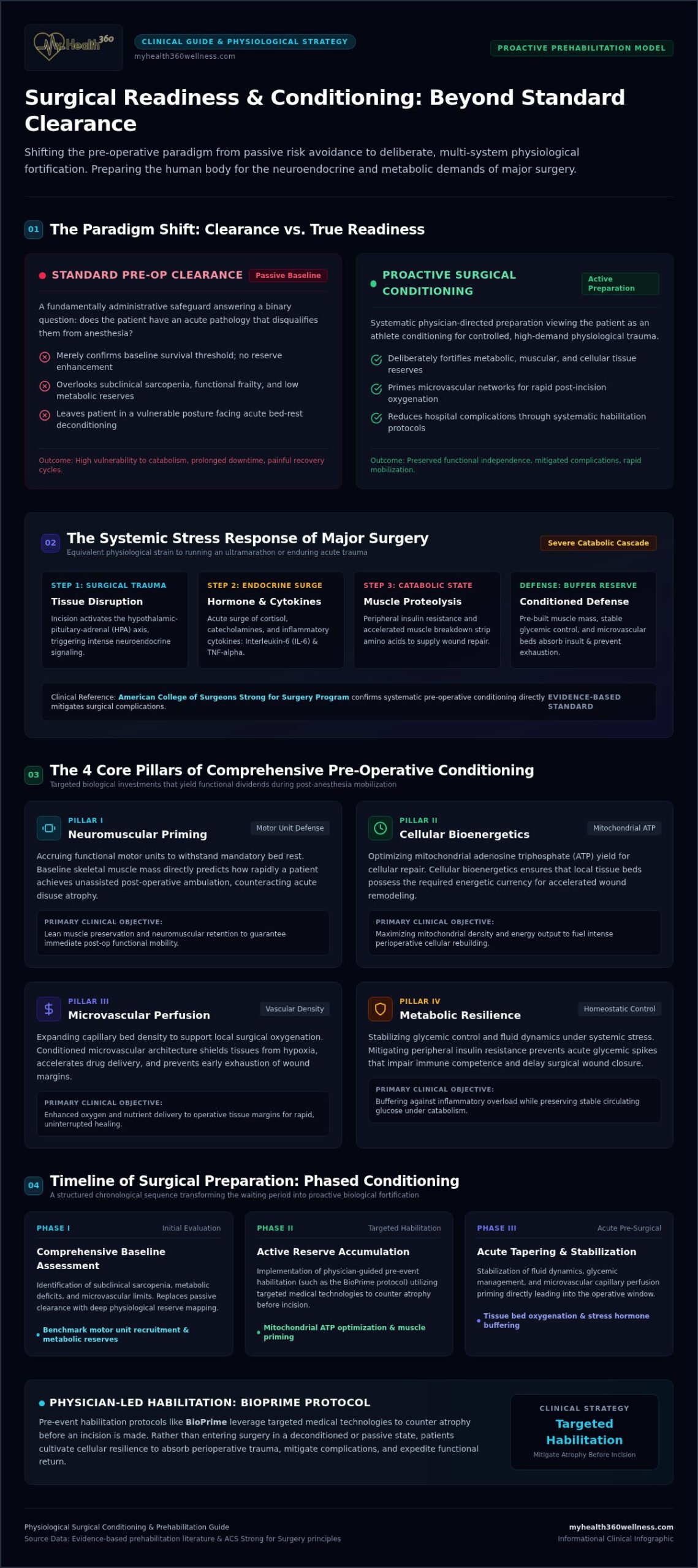
Major surgical intervention places immense biological strain on the human body. In clinical terms, an extensive operative procedure induces metabolic and neuroendocrine stress comparable to running an ultramarathon or enduring acute physical trauma. Surgical readiness and conditioning reframes this entire pre-operative window from passive waiting to proactive athletic preparation. Surgical readiness is the systematic enhancement of metabolic, neuromuscular, and cellular reserves prior to surgery. Instead of treating an upcoming procedure as an isolated mechanical event, this clinical paradigm views the patient as an athlete preparing for controlled, high-demand physiological stress.
The Critical Difference Between Clearance and Physiological Readiness
Standard medical clearance is fundamentally an administrative safeguard. It asks a binary question: does the patient display an acute cardiovascular, pulmonary, or renal pathology that disqualifies them from undergoing anesthesia? Passing standard lab panels simply confirms that an individual meets minimum baseline survival thresholds. It does not confirm that tissue beds are primed for rapid microvascular healing, nor does it guarantee the body can resist bed-rest deconditioning.
Published literature surrounding preoperative prehabilitation underscores that unaddressed functional frailty, subclinical sarcopenia, and poor metabolic reserve drive surgical complications, even in individuals who easily receive routine sign-offs. Proactive conditioning transforms pre-operative care by shifting the standard from a passive absence of disease to measurable physiological resilience.
The Systemic Stress Response of Surgery on the Body
Tissue disruption triggers an immediate, multi-system neuroendocrine cascade. Incisions activate the hypothalamic-pituitary-adrenal axis, prompting a surge of cortisol, catecholamines, and pro-inflammatory cytokines such as interleukin-6 (IL-6) and tumor necrosis factor-alpha. This biochemical surge orchestrates a severe catabolic state characterized by peripheral insulin resistance and accelerated muscle proteolysis, stripping amino acids from skeletal muscle to supply acute hepatic gluconeogenesis and local wound repair.
Without adequate physiological reserves, this post-operative catabolism quickly depletes the patient, leading to early exhaustion, impaired tissue oxygenation, and delayed wound closure. Pre-existing muscle mass, stable glycemic control, and conditioned microvascular networks serve as vital biological buffers. They absorb the surgical insult, protect vital organs against inflammatory overload, and preserve the physical stamina required for immediate post-operative rehabilitation.
The Core Pillars of Comprehensive Pre-Operative Conditioning
True physical readiness demands more than arbitrary walking goals or generic nutritional advice. Genuine surgical readiness and conditioning requires a multi-system, physician-guided framework engineered to fortify your physiology against acute operative stress. By viewing pre-operative conditioning as an biological investment, patients build specific cellular, vascular, and structural reserves that yield measurable dividends throughout post-anesthesia mobilization and wound remodeling.
Initiatives such as the American College of Surgeons Strong for Surgery program demonstrate that systematic pre-operative interventions directly reduce hospital complications. A truly comprehensive framework coordinates four distinct clinical pillars:
- Neuromuscular priming: Accruing functional motor units to withstand mandatory bed rest.
- Cellular bioenergetics: Optimizing mitochondrial adenosine triphosphate (ATP) yield for tissue repair.
- Microvascular perfusion: Expanding capillary bed density to support local surgical oxygenation.
- Metabolic resilience: Stabilizing glycemic control and fluid dynamics under systemic stress.
Neuromuscular Priming and Lean Muscle Preservation
Baseline skeletal muscle mass directly predicts how rapidly a patient achieves unassisted post-operative ambulation. Inactivity after surgery rapidly degrades motor unit recruitment and induces acute disuse atrophy. Advanced high-intensity focused electromagnetic (HIFEM) technology, such as Emsculpt Neo, induces supramaximal contractions that strengthen muscle architecture and build dense structural reserves without loading sensitive joints or increasing injury risk.
Cellular Bioenergetics and Tissue Microcirculation
Cellular repair after surgical incision relies entirely on mitochondrial ATP synthesis to fuel fibroblast proliferation and extracellular matrix remodeling. Integrating clinical photobiomodulation through whole body red light therapy stimulates mitochondrial cytochrome c oxidase, boosting energy production and mitigating oxidative damage. Simultaneously, optimized capillary microcirculation ensures sustained arterial oxygen delivery and rapid leukocyte transport directly to healing incisions.
Metabolic Resilience and Targeted Nutritional Hydration
Surgical stress triggers acute insulin resistance; stabilizing glycemic control pre-operatively prevents immune cell impairment and mitigates surgical site infection risks. Targeted internal medicine oversight ensures that oral intake and specialized IV hydration balance cellular turgor and restore vital electrolytes well before anesthesia induction, all without violating modern fasting parameters.
Coordinating these physiological systems under dedicated internal medicine oversight ensures every biological pathway is fortified. To learn how structured medical protocols unite these disciplines, explore how integrative concierge medical care for performance optimization primes your physiology before major operative stressors.
Standard Pre-Op Protocols vs. Active Prehabilitation
Should the weeks preceding an operation be spent in sedentary rest or purposeful physical preparation? Conventional clinical guidance often encouraged patients to rest quietly, assuming physical conservation prevented pre-operative fatigue. Emerging surgical science has thoroughly overturned this assumption. Passive waiting actively degrades functional stamina, whereas proactive surgical readiness and conditioning equips tissues to endure operative trauma with significantly fewer adverse events.
Clinical data clearly illustrate the gulf between conventional care and proactive conditioning:
| Recovery Variable | Standard Passive Protocol | Active Prehabilitation Conditioning |
|---|---|---|
| Complication Incidence | Baseline institutional rate (~30% in major elective cases) | Approximate 40% relative reduction in overall post-op complications |
| Mobilization Timeline | Delayed unassisted ambulation; prolonged bed rest | Accelerated unassisted ambulation; preserved motor function |
| Tissue Edema & Pain | Elevated local swelling; higher narcotic dependence | Blunted inflammatory cascade; reduced post-operative narcotic utilization |
| Length of Stay (LOS) | Standard projected hospital recovery timelines | Significantly shorter stays with faster discharge to home |
Passive Waiting vs. Active Physiological Optimization
Advising a prospective surgical patient to avoid physical exertion is physiologically counterproductive. Prolonged sedentary behavior induces measurable functional decline in as little as one week. It blunts autonomic vascular control, reduces insulin sensitivity, and increases the baseline risk of deep vein thrombosis. A conditioned patient, by contrast, enters the surgical suite with optimized cardiac output and robust autonomic nervous system regulation. That conditioning cushions them against intra-operative hemodynamic volatility.
Clinical Outcomes: Infection Rates, Pain Scores, and Mobility
Multiple systematic reviews, including large analyses across more than 150 clinical trials, reveal that over 80% of cohorts engaging in multimodal prehabilitation experience statistically significant improvements in functional outcomes. Higher pre-operative aerobic capacity and lean muscle mass promote brisk lymphatic drainage, which attenuates post-operative tissue edema. This reduction in local tissue tension curbs nociceptive signaling, directly correlating with lower self-reported pain scores and reduced post-operative analgesic needs.
Tissue oxygenation remains the ultimate determinant of wound integrity. Conditioned vascular networks deliver higher levels of dissolved oxygen to incisional margins, suppressing anaerobic pathogens and lowering surgical site infection rates. By viewing physical readiness as athletic preparation rather than an elective luxury, patients cut recovery times and regain their independent lifestyle far earlier.
Timeline of Surgical Preparation: A Phased Conditioning Roadmap
Achieving peak physiological preparedness requires an organized biological cadence rather than a rushed pre-admission checklist. Successful surgical readiness and conditioning relies on structured progression, moving deliberately from foundational tissue accrual to cellular tapering. Aligning physical and biochemical adjustments with specific pre-operative windows ensures your body peaks at the precise moment of surgical intervention.
Phase 1 (Weeks 6 to 3): Foundational Strength and Metabolic Priming
The initial phase centers on establishing clinical baselines and expanding biological reserve. Comprehensive evaluation includes functional movement scoring, segmented body composition analysis, and advanced metabolic blood panels assessing glycemic stability, serum albumin, and inflammatory markers.
- Neuromuscular loading: Initiate non-invasive supramaximal contractions alongside functional resistance work to expand skeletal muscle mass without articular wear.
- Nutritional calibration: Introduce targeted micronutrient loading and an anti-inflammatory dietary framework to saturate cellular nutrient reserves.
- Metabolic stabilization: Optimize insulin sensitivity and correct subclinical micronutrient deficiencies under physician supervision.
Phase 2 (Weeks 2 to 1): Tissue Perfusion and Cellular Charging
As the operative date approaches, physical conditioning shifts away from structural hypertrophy toward microvascular enhancement and cellular bioenergetics. Heavy mechanical stress tapers to eliminate systemic musculoskeletal fatigue, making room for targeted restorative therapies.
Whole body red light therapy saturates mitochondrial cytochrome c oxidase with therapeutic wavelengths, maximizing cellular ATP synthesis before tissue incision. Simultaneously, clinical staff carefully balance cellular turgor through medical IV hydration while auditing medications to systematically discontinue supplements or agents that could interfere with hemostasis and coagulation.
Phase 3 (Post-Op Bridge): Transitioning Readiness into Active Restoration
Conditioning does not terminate when you enter the operating room; it creates vital neuromuscular muscle memory that dramatically accelerates early post-anesthesia ambulation. Pre-conditioned motor units reactivate more readily, stabilizing joints and driving venous return during early recovery.
Once your surgical team grants initial procedural clearance, this groundwork feeds directly into active post-surgical recovery modalities. By approaching operative preparation through the lens of whole body habilitation, you construct an unbroken continuum that links pre-operative resilience directly to accelerated tissue repair. To optimize your personal operative timeline, explore customized physician-guided conditioning programs at My Health 360.
Physician-Led Habilitation: Optimizing Surgical Outcomes with BioPrime
Preparing the body for operative intervention demands clinical sophistication rather than generic wellness advice. True surgical readiness and conditioning requires rigorous medical precision, uniting diagnostic internal medicine with high-performance physical modalities. Under this physician-directed paradigm, patients shift from passive recipients of care into physiologically resilient candidates primed for rapid recovery.
The Role of Internal Medicine in Pre-Operative Optimization
Why should pre-operative conditioning be directed by an American Board Certified Internal Medicine specialist? While physical trainers focus narrowly on biomechanics, an internal medicine physician evaluates the complex physiological interplay of cardiovascular output, renal clearance, endocrine balance, and microvascular perfusion. Under the leadership of Dr. Umbrine Fatima at My Health 360, this high standard of medical oversight ensures that every biological system is safely pushed toward its functional peak.
This specialized oversight forms the bedrock of proactive care. By blending metabolic diagnostics with the philosophy of concierge performance medicine, clinical conditioning protects patient safety while building deep cellular reserves to tolerate surgical stress.
Synergistic Technologies: BioPrime and Targeted Neuromuscular Support
At the center of this pre-operative strategy is BioPrime, a specialized pre-operative whole body habilitation program designed specifically for surgical readiness. Unlike post-injury rehabilitation that works backward to restore lost baselines, habilitation deliberately builds biological equity beforehand. BioPrime constructs a multi-layered physiological buffer against surgical trauma by harmonizing three advanced modalities:
- Supramaximal neuromuscular accrual: Utilizing medical technologies like Emsculpt Neo, high-intensity focused electromagnetic (HIFEM) energy stimulates tens of thousands of muscle contractions per session. This builds deep core and pelvic stability without loading joints, raising blood pressure, or creating structural micro-tears.
- Mitochondrial photobiomodulation: Clinical-grade whole-body red light therapy floods tissue beds with targeted optical wavelengths, promoting cytochrome c oxidase activity, stimulating collagen remodeling, and dampening systemic inflammation.
- Intravenous metabolic optimization: Formulated IV hydration delivers balanced micronutrients and fluids directly to the extracellular matrix, optimizing cellular turgor and electrolyte balance before anesthesia fasting windows commence.
Approaching surgery with targeted physical and cellular readiness replaces uncertainty with biological confidence. For patients preparing for elective surgery nationwide, investing in structured physician-led habilitation transforms the entire recovery trajectory from painful downtime into a predictable, accelerated return to daily life.
Take Command of Your Recovery Before Entering the Operating Room
Entering surgery shouldn’t feel like a passive gamble on how your body tolerates trauma. Moving beyond minimum administrative clearance to structured surgical readiness and conditioning builds vital cellular reserves, preserves lean muscle tissue, and dramatically shortens post-operative downtime. When you train your physiology to withstand the metabolic demands of an operation, you protect your functional independence and accelerate your return to daily living.
At My Health 360, our proprietary BioPrime pre-operative whole-body habilitation protocols are directed by Dr. Umbrine Fatima, an American Board Certified Internal Medicine specialist. By uniting diagnostic medical precision with state-of-the-art non-invasive HIFEM, RF, and cellular photobiomodulation technologies, we systematically fortify your biological systems before your procedure. Explore physician-led pre-operative habilitation at My Health 360 to take an active, empowered role in your healing journey and enter the surgical suite with total confidence.
Frequently Asked Questions
How is surgical readiness conditioning different from routine medical clearance?
Routine medical clearance simply verifies that you meet the minimum cardiopulmonary threshold to survive anesthesia without immediate life-threatening events. In contrast, surgical readiness and conditioning proactively enhances your cellular, metabolic, and muscular capacity. Clearance ensures you are stable enough for an operation; conditioning actively prepares your tissues to heal, resist muscle atrophy, and accelerate functional mobility after the procedure is finished.
Can I do physical conditioning if I am having orthopedic or joint surgery?
Yes, conditioning is especially vital before joint or orthopedic operations. When compromised joints restrict conventional weightlifting, non-invasive modalities like high-intensity focused electromagnetic stimulation safely build stabilizing muscle groups without articular friction. Preparing stabilizing muscles around the hip, knee, or spine preserves crucial motor pathways. This targeted pre-operative strengthening ensures you can bear weight and complete physical therapy tasks much sooner after surgery.
How far in advance of my procedure should I start surgical conditioning?
Clinical research demonstrates that an optimal conditioning window spans four to eight weeks prior to elective surgery. This timeframe allows sufficient biological turnover for muscle hypertrophy, mitochondrial density enhancement, and glycemic stabilization. Even if your procedure is scheduled in two to three weeks, short-term conditioning protocols still provide documented improvements in cellular hydration, tissue perfusion, and autonomic nervous system resilience under operative stress.
What is the BioPrime pre-operative habilitation program?
BioPrime is a specialized pre-operative whole-body habilitation framework directed by Dr. Umbrine Fatima at My Health 360. Unlike post-surgical rehabilitation, which works backward to restore lost physical function, BioPrime builds physiological reserves beforehand. The protocol combines advanced non-invasive muscle stimulation via Emsculpt Neo, targeted whole-body red light therapy, and clinical IV hydration to optimize your cellular and structural resilience before an incision is made.
What happens if I cannot perform heavy exercise before my surgery?
Severe pain, cardiovascular restrictions, or structural limitations shouldn’t prevent pre-operative conditioning. Physician-directed protocols utilize passive and non-invasive clinical technologies designed to bypass biomechanical stress entirely. Using focused electromagnetic stimulation, patients experience supramaximal muscular contractions while lying completely still, avoiding joint load or cardiovascular strain. Combined with whole-body photobiomodulation and targeted nutritional hydration, your body achieves profound cellular readiness without strenuous conventional workouts.
Does surgical readiness conditioning actually reduce recovery time?
Yes, robust clinical data shows that structured surgical readiness and conditioning significantly speeds up recovery timelines. Patients engaged in prehabilitation experience an approximate 40% reduction in overall post-operative complications and report shorter hospital stays. By entering the operative suite with higher baseline lean muscle mass, stable blood sugar, and saturated mitochondrial energy stores, your body clears anesthesia faster, manages surgical inflammation better, and resumes unassisted walking days earlier.
Is physician oversight necessary for pre-surgery physical preparation?
Dedicated physician oversight is essential because intense conditioning must never jeopardize procedural safety or trigger counterproductive inflammation. An American Board Certified Internal Medicine specialist evaluates how pre-operative conditioning interacts with your renal function, cardiovascular reserve, metabolic health, and prescription medications. This rigorous medical governance ensures every nutritional adjustment, fluid therapy, and neuromuscular protocol aligns seamlessly with your surgical team’s anesthesia parameters and hemostasis guidelines.