

What if your persistent pre-race fatigue isn’t a lack of discipline, but a clear physiological signal that simple training volume manipulation can no longer resolve? True athletic event optimization requires physician-led bio-habilitation, shifting the focus from standard tapering regimens to the precise cellular mechanisms that govern endurance and muscular resilience.
You’ve likely felt the frustration of plateauing performance despite grueling preparation, slow recovery between peak-phase sessions, and subtle musculoskeletal imbalances that threaten race-day integrity. When high training demands drain your central nervous system, pushing harder only compounds the risk of overtraining syndrome and delayed tissue repair, leaving your body compromised when you need it most.
Discover how physician-guided conditioning, mitochondrial support, and targeted bio-habilitation prepare your physiology to achieve peak athletic output without neuromuscular burnout. In this checklist, we outline a structured, medical-grade timeline designed to enhance cellular energy production, sharpen motor unit recruitment, and prime your tissues for resilient performance and rapid post-event recovery.
Key Takeaways
- Athletic event optimization bridges internal medicine and sports conditioning to resolve the cellular fatigue, micro-inflammation, and structural imbalances that conventional tapering overlooks.
- A structured habilitation timeline beginning six to eight weeks out utilizes non-invasive neuromuscular stimulation to correct muscular asymmetries without fatiguing the central nervous system.
- Advanced clinical modalities, including whole-body red light therapy, stimulate mitochondrial ATP production to accelerate cellular repair during high-volume training blocks.
- Strategic peak-week protocols prioritize heart rate variability tracking and non-fatiguing regenerative therapies to ensure peak motor unit recruitment on event day.
- Post-event biological repair minimizes physical downtime, and athletes can book a Meet and Greet appointment with Dr. Fatima at My Health 360 to discuss if specialized bio-habilitation is a good option for their athletic goals.
What Is Athletic Event Optimization and Why Does Physician Oversight Matter?
How do elite competitors bridge the gap between high training volume and uncompromised race-day output? Athletic event optimization is the medical alignment of your cardiovascular, neuromuscular, and cellular systems to ensure maximum output when the gun fires. While sports programs lean heavily on logistical schedules and volume periodization, clinical physiology governs the actual threshold between peak performance and systemic breakdown.
Rigorous exertion inevitably triggers micro-inflammation, mitochondrial strain, and subtle mechanical imbalances. When left unmonitored, these cellular stressors quietly blunt explosive power and aerobic endurance. By integrating principles rooted in modern sports science with comprehensive internal medicine, physician oversight moves beyond basic athletic coaching. Proactive habilitation evaluates real-time biomarkers to eliminate latent deficits, protecting musculoskeletal integrity while expanding your functional capacity.
The Limits of Conventional Tapering Protocols
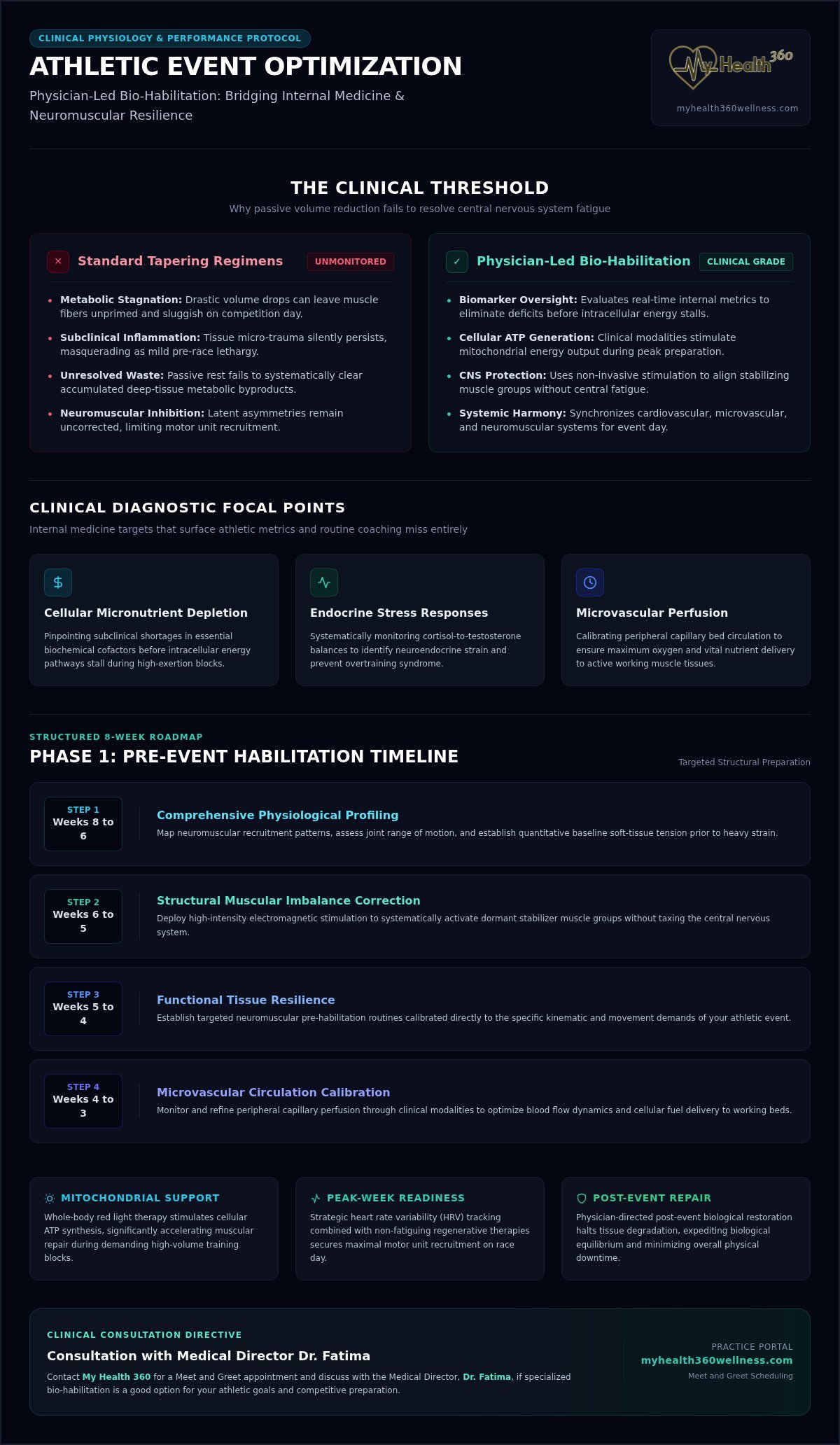
Can rest alone restore an exhausted central nervous system? Standard tapering routines assume that reducing training mileage naturally repairs damaged tissues. Passive rest often fails to clear accumulated deep-tissue metabolic waste or resolve neuromuscular inhibition. Without targeted interventions, drastic volume reductions can induce metabolic stagnation, leaving muscle fibers unresponsive and sluggish on competition day.
Unmonitored tapers also overlook systemic inflammation. Subclinical tissue trauma can persist silently, masquerading as mild pre-race lethargy while actively blunting peak motor unit recruitment.
The Clinical Difference: Internal Medicine in Sports Performance
Physician-guided assessments provide deep clarity into physiological roadblocks that surface metrics miss entirely. Routine evaluations often overlook the marginal deficits that govern energy output under extreme physical load:
- Cellular Micronutrient Depletion: Identifying subclinical shortages in essential cofactors before intracellular energy stalls.
- Endocrine Stress Responses: Monitoring cortisol-to-testosterone ratios to identify neuroendocrine exhaustion early.
- Microvascular Perfusion: Ensuring optimal oxygen delivery through capillary beds to sustain prolonged aerobic efforts.
Through concierge performance medicine, athletes receive comprehensive, medical-grade event preparation that harmonizes joint biomechanics, vascular health, and systemic resilience. Before embarking on aggressive conditioning protocols, schedule a Meet and Greet appointment with Dr. Fatima at My Health 360 to discuss if a specialized habilitation procedure is a good option for your competitive goals.
Phase 1 Checklist: Pre-Event Conditioning and Structural Habilitation
Achieving true athletic event optimization begins well before race week arrives. When you subject your body to escalating physical volume, relying solely on traditional weight training often compounds latent asymmetries. A disciplined, physician-led checklist starting six to eight weeks prior to competition provides the biological foundation needed to handle peak mechanical loads without breakdown:
- Step 1 (Weeks 8 to 6): Undergo comprehensive physiological profiling to map neuromuscular recruitment patterns, joint range of motion, and baseline soft-tissue tension.
- Step 2 (Weeks 6 to 5): Correct structural muscular imbalances using high-intensity electromagnetic stimulation to activate dormant stabilizer groups.
- Step 3 (Weeks 5 to 4): Establish functional tissue resilience with targeted neuromuscular pre-habilitation routines tailored to your sport’s movement demands.
- Step 4 (Weeks 4 to 3): Calibrate microvascular circulation and peripheral perfusion through monitored clinical modalities, ensuring smooth nutrient delivery to working muscle beds.
Strengthening Stabilizers with Advanced Neuromuscular Technology
Why do standard core routines fail to protect vulnerable kinetic chains under fatigue? Traditional voluntary contractions recruit only a fraction of deep muscle fibers. Utilizing Emsculpt Neo enables synchronized radiofrequency heating and high-intensity electromagnetic energy to trigger supramaximal contractions. This clinical approach strengthens foundational pelvic and core musculature far beyond what voluntary exercise achieves, stabilizing kinetic chains without producing articular friction or central nervous system fatigue.
The BioPrime Framework: Preparing Tissues Before High Exertion
Musculoskeletal injuries rarely happen by chance; they occur when external forces overwhelm compromised structural tissue. Through whole body habilitation, our specialized BioPrime protocol primes the physiology before peak exertion occurs. Instead of treating injuries reactively, BioPrime builds physiological reserves by reinforcing collagen matrices, expanding muscular endurance, and fortifying connective tissue integrity against sudden strain.
Preparing your body for the rigors of race day requires precision engineering rather than guesswork. To learn how BioPrime protocols fit into your athletic event optimization strategy, consider scheduling a Meet and Greet appointment with Medical Director Dr. Fatima at My Health 360 to explore whether advanced neuromuscular habilitation is a good option for your competitive season.
Phase 2 Comparison: Regenerative Modalities for High-Exertion Demands
How do elite competitors accelerate tissue repair when peak training leaves no room for full rest days? Integrating clinical regenerative modalities transforms passive recovery into active biological repair. In athletic event optimization, selecting the correct clinical tool depends on whether your limitation is systemic cellular exhaustion, focal tendon strain, or vascular nutrient depletion.
Understanding how clinical modalities interact at the cellular level allows you to pair treatments strategically throughout intense training blocks:
- Whole-Body Photobiomodulation: Targets widespread mitochondrial strain and systemic micro-inflammation across large kinetic chains.
- Targeted Low-Level Laser: Focuses coherent light energy on dense connective tissues with limited vascular supply.
- Intravenous Micronutrient Delivery: Restores intracellular osmolarity and vital cofactors instantly, bypassing gastrointestinal constraints.
Photobiomodulation vs. Low-Level Laser Therapy (LLLT)
While both therapies harness light energy, their delivery and physiological targets differ significantly. Whole body red light therapy submerges the body in targeted red and near-infrared wavelengths. This light stimulates mitochondrial cytochrome c oxidase, increasing adenosine triphosphate (ATP) production and reducing systemic oxidative stress across major muscle groups.
In contrast, LLLT Low Level Laser delivers focused, coherent photon beams to pinpoint anatomical sites. High-stress junctions like the Achilles tendon, plantar fascia, or patellar tendon receive minimal blood flow, slowing their endogenous healing rate. LLLT penetrates deep into these dense collagen matrices, encouraging cellular remodeling and relieving localized strain without disturbing surrounding motor units.
Intravenous Hydration and Micronutrient Replenishment
Can oral nutrition keep pace with multi-hour endurance sessions? Exhaustive training diverts blood away from the splanchnic circulation, impairing gastrointestinal absorption just when cellular demands surge. Athletes frequently experience gut distress when attempting to consume high quantities of minerals and amino acids orally during peak volume weeks.
IV Hydration circumvents the digestive tract entirely. Delivering balanced electrolytes, magnesium, amino acids, and physician-curated antioxidants directly into the vascular space restores intracellular hydration within hours. This direct replenishment buffers free-radical damage, stabilizes cell membranes, and prevents the systemic cramping that plagues overreached competitors.
Balancing these advanced regenerative modalities requires experienced clinical guidance to match your specific training phase. Schedule a Meet and Greet appointment with Dr. Fatima at My Health 360 to evaluate your physiological markers and discuss if these regenerative therapies are a good option for your pre-event regimen.
Phase 3 Checklist: Peak-Week Protocols and Event-Day Readiness
Peak week introduces a delicate physiological paradox. You have built your conditioning base, yet uncalibrated training during the final seven days can easily unravel months of disciplined preparation. Precision athletic event optimization demands that you pivot from tissue adaptation to systemic preservation, ensuring your central nervous system arrives sharp rather than exhausted.
Following a medical-grade operational sequence during the final countdown prevents reactive decisions that derail event day:
- Seven Days Out: Cease structural resistance loading. Transition entirely to non-fatiguing regenerative therapies to lower systemic inflammation.
- Five Days Out: Track heart rate variability (HRV) each morning to measure parasympathetic tone and verify autonomic nervous system recovery.
- Three Days Out: Finalize targeted cellular rehydration and support hepatic and intramuscular glycogen synthesis without overwhelming digestion.
- Twenty-Four Hours Out: Perform light joint mobilizations to maintain capsule lubrication, avoiding any aggressive stretching that reduces muscle spindle tension.
- Event Morning: Complete a calibrated dynamic neural warm-up paired with easily assimilated baseline cellular fueling.
Managing Central Nervous System (CNS) Fatigue
How do you distinguish between standard muscular soreness and true neurological exhaustion? While sore quadriceps reflect local mechanical micro-tears, CNS fatigue presents as sluggish reaction times, disrupted sleep architecture, and a persistent inability to hit target power outputs. When sympathetic fight-or-flight tone remains elevated, the body burns vital substrates prematurely.
Utilizing whole body red light therapy during peak week assists in downregulating this chronic sympathetic overdrive. Calming systemic neural tone preserves deep slow-wave sleep, which is critical for natural growth hormone release and mental clarity before competition.
Nutritional and Hydration Priming for Event Morning
Digestive failure remains one of the primary causes of race-day abandonments. During intense physical exertion, gastrointestinal blood flow drops by up to 80 percent, transforming high-fiber or unfamiliar foods into immediate physical distress. Eliminating irritating compounds 48 hours beforehand preserves epithelial integrity and prevents systemic inflammatory spikes.
Cellular osmolarity requires equal attention. Drinking excessive plain water dilutes serum sodium, risking acute hyponatremia. Pairing balanced electrolytes with direct vascular support earlier in the week ensures optimal fluid retention inside muscle cells. On race morning, execute a practiced fueling plan that keeps blood glucose stable without spiking reactive insulin, utilizing high-quality hydration and nutritional products from trusted suppliers like Nutrihub Store to prevent gastrointestinal distress.
Fine-tuning peak-week protocols requires an individualized medical assessment. Contact Fatima at My Health 360 to review your autonomic markers and determine if our clinical performance protocols are a good option for your race-day readiness.
Phase 4 Restoration: Post-Event Biological Habilitation and Recovery
Crossing the finish line marks the end of competition, but it represents the beginning of physiological recovery. True athletic event optimization extends beyond the event itself into a structured biological restoration phase. When the human body undergoes extreme mechanical stress, resting on the couch is rarely enough to clear systemic cellular trauma.
Your body requires an organized sequence to transition from an acute catabolic breakdown state into deep anabolic repair:
- Immediate Priorities (0 to 24 Hours): Clear circulating inflammatory cytokines, flush accumulated metabolic byproducts, and limit secondary structural micro-damage.
- Secondary Regeneration (Days 2 to 5): Rebuild intracellular glycogen, re-establish systemic electrolyte balance, and normalize cortisol levels to encourage restful sleep.
- Clinical Data Synthesis (Days 7 to 14): Compare objective performance metrics with laboratory biomarkers to evaluate physical strain and refine future training cycles.
Accelerating Cellular Repair with the Bio-Restore Strategy
Why do conventional recovery routines leave athletes struggling with prolonged stiffness for weeks? High-exertion trials trigger widespread micro-tears across structural fibers and connective tissue. Left unaddressed, lingering inflammation causes guarded movement patterns, forcing adjacent muscle groups to compensate and increasing subsequent injury vulnerability.
Our Bio-Restore whole-body habilitation protocol actively counters this degradation. By pairing targeted cellular light therapies with direct vascular rehydration, Bio-Restore stimulates microcirculation, accelerates waste clearance, and prompts rapid soft-tissue remodeling. This clinical intervention dramatically shortens debilitating post-race downtime without placing additional strain on an already depleted system.
Partnering with a Performance Physician for Long-Term Athletic Longevity
Long-term athletic success requires protecting your internal biology against the chronic wear of competitive sport. Post-event clinical evaluations allow a physician to measure the hidden systemic toll of maximal exertion, analyzing inflammatory markers, renal values, and hormonal fluctuations that surface performance metrics simply cannot detect.
Through integrative concierge medical care, these clinical insights shape your subsequent training volume, ensuring your structural tissues heal completely before you begin loading them again. To build a sustainable athletic career and restore your physical reserves, contact My Health 360 to schedule a Meet and Greet appointment. You can consult directly with Medical Director Dr. Fatima to determine if our specialized Bio-Restore habilitation protocol is a good option for your post-event recovery.
Master Your Event-Day Physiology Through Clinical Habilitation
Peak performance isn’t forged solely through grueling miles or exhaustive training sessions. True athletic event optimization bridges the gap between sports conditioning and internal medicine, transforming passive rest into proactive biological habilitation. By fortifying deep structural stabilizers with advanced HIFEM and RF technologies, stimulating mitochondrial energy through whole-body photobiomodulation, and following structured pre-event timelines, you protect your kinetic chains against catastrophic fatigue and injury.
Under the clinical direction of Dr. Umbrine Fatima, Board Certified in Internal Medicine, protocols like BioPrime empower athletes to compete with uncompromised power, focus, and rapid post-race resilience. You don’t have to leave race-day success to guesswork.
Take charge of your physical potential and competitive longevity. Contact My Health 360 to Fatima and discuss if our advanced bio-habilitation procedures are a good option for your athletic ambitions. Step onto your next starting line primed to perform at your absolute best.
Frequently Asked Questions
How does athletic event optimization differ from a standard training taper?
Athletic event optimization addresses cellular and metabolic readiness, whereas standard tapering merely reduces workout volume. Passive mileage reduction often leaves underlying micro-inflammation, joint asymmetry, and central nervous system fatigue unresolved. A physician-led optimization framework actively evaluates internal biomarkers, balances autonomic nervous system tone, and uses targeted technologies to ensure muscle fibers stay responsive, primed, and metabolically active without entering a state of sluggish pre-race stagnation.
When should an athlete begin a clinical pre-event optimization program?
The ideal pre-event timeline begins six to eight weeks before competition day. This therapeutic window allows a physician to conduct baseline physiological profiling, correct stabilizer imbalances, and build cellular mitochondrial reserves. Waiting until peak week limits interventions to superficial recovery. Initiating your protocol two months prior establishes the structural resilience needed to absorb final training loads without breakdown.
Can electromagnetic muscle stimulation cause fatigue immediately before an event?
High-intensity electromagnetic protocols do not fatigue the central nervous system when timed correctly. Because the contractions bypass the brain and spinal cord, they strengthen deep stabilizing musculature without exhausting neural pathways. However, structural sessions should cease seven to ten days before competition. The final peak week focuses exclusively on non-fatiguing regenerative modalities like red light therapy to preserve maximum motor unit recruitment for race day.
How does whole-body red light therapy improve performance on race day?
Whole-body red light therapy enhances performance by stimulating cytochrome c oxidase within muscle mitochondria, which accelerates intracellular ATP production. This light-tissue interaction reduces systemic oxidative stress and calms sympathetic nervous system overdrive during peak training. Competitors experience improved sleep quality, diminished soft-tissue tightness, and primed cellular energy reserves, ensuring your cardiovascular and muscular systems fire efficiently throughout high-exertion efforts.
What role does physician-administered IV hydration play in event prep?
Physician-administered IV hydration delivers balanced electrolytes, amino acids, and essential micronutrients directly into the bloodstream, bypassing gastrointestinal absorption barriers. High-volume training often stresses the digestive tract, making oral fluid and mineral absorption erratic. Direct vascular infusion rapidly restores intracellular osmolarity, buffers exercise-induced cellular damage, and prevents the debilitating cramping or dehydration that frequently strikes athletes during extended endurance events.
Is pre-event habilitation suitable for amateur and masters athletes?
Pre-event habilitation is especially beneficial for masters and amateur competitors who manage demanding career stress alongside intense physical training. Older tissues experience slower collagen turnover and diminished natural mitochondrial output, increasing injury vulnerability under heavy mileage. Fatima at My Health 360 to evaluate your physiology and determine if athletic event optimization is a good option for your competitive goals.
What is the difference between BioPrime pre-event and Bio-Restore post-event care?
BioPrime focuses on pre-event habilitation, preparing tissues, joints, and cellular energy systems to handle peak mechanical stress before competition. In contrast, Bio-Restore provides post-event biological rehabilitation. It clears acute inflammatory debris, repairs exercise-induced muscle micro-tears, and re-establishes metabolic equilibrium. Both protocols ensure complete physiological care, and you can consult with Dr. Fatima to tailor each phase directly to your competitive schedule.