
What if the most effective way to restore your facial contours wasn’t to pull the skin, but to rebuild the architecture beneath it? For many individuals, the mirror reveals a subtle shift in the mid-face and jawline that traditional topicals simply cannot reach. You likely want to reclaim that defined silhouette without the invasive nature or the “overdone” aesthetic of a surgical facelift. It’s a common concern to seek visible results while prioritizing a natural appearance and minimal recovery time.
At My Health 360, we view the PDO thread lift not merely as a cosmetic fix, but as a sophisticated form of biological scaffolding. Under the expert guidance of Dr. Umbrine Fatima, this procedure provides an immediate, mechanical elevation while simultaneously triggering your body’s natural regenerative response. In this comprehensive guide, you’ll discover how these medical-grade filaments offer a dual-action solution for structural lifting and cellular skin restoration. We will explore the clinical science behind polydioxanone threads, their role in long-term collagen synthesis, and why physician-supervised care is the essential foundation for achieving a balanced, harmonious result in 2026.
Key Takeaways
- Understand how polydioxanone serves as a biological scaffold, triggering a regenerative healing response that strengthens the skin’s dermal matrix from within.
- Distinguish between Mono, Screw, and Cog thread varieties to determine which structural filaments best address your specific needs for texture, volume, or elevation.
- Compare the clinical outcomes of a PDO thread lift against traditional surgical options, focusing on the balance between natural-looking results and a rapid 48-hour recovery window.
- Gain insight into the physician-led procedure experience, from precise vector mapping to advanced comfort techniques that ensure a seamless patient journey.
- Explore how structural rejuvenation integrates into a holistic longevity plan, combining aesthetic precision with the principles of performance medicine.
Biological Scaffolding: The Mechanism of Polydioxanone Rejuvenation
How does a material originally designed for delicate cardiovascular sutures translate to sophisticated facial rejuvenation? Polydioxanone (PDO) is a medical-grade, synthetic absorbable polymer that has been a staple in high-stakes surgeries for over 30 years. In the context of a PDO thread lift, we repurpose this material to act as an internal biological scaffold. While traditional surgery physically removes excess skin, this method works in harmony with your body’s innate healing mechanisms to restore structure from within.
The procedure operates through a controlled “foreign body response.” When the thread is inserted into the subdermal layers, the body recognizes it as a structure that requires attention. This isn’t a negative reaction; instead, it’s a beneficial trigger that initiates a targeted repair cascade. While the threads provide an immediate mechanical lift by repositioning sagging tissue, the true value lies in the cellular rehabilitation that follows. Physician oversight is paramount in this phase. Achieving facial symmetry and ensuring threads are placed at the precise dermal depth requires the deep anatomical expertise of a medical doctor like Dr. Umbrine Fatima, ensuring the procedure remains safe and the results look entirely natural.
Neocollagenesis: How Your Body Rebuilds the Dermal Matrix
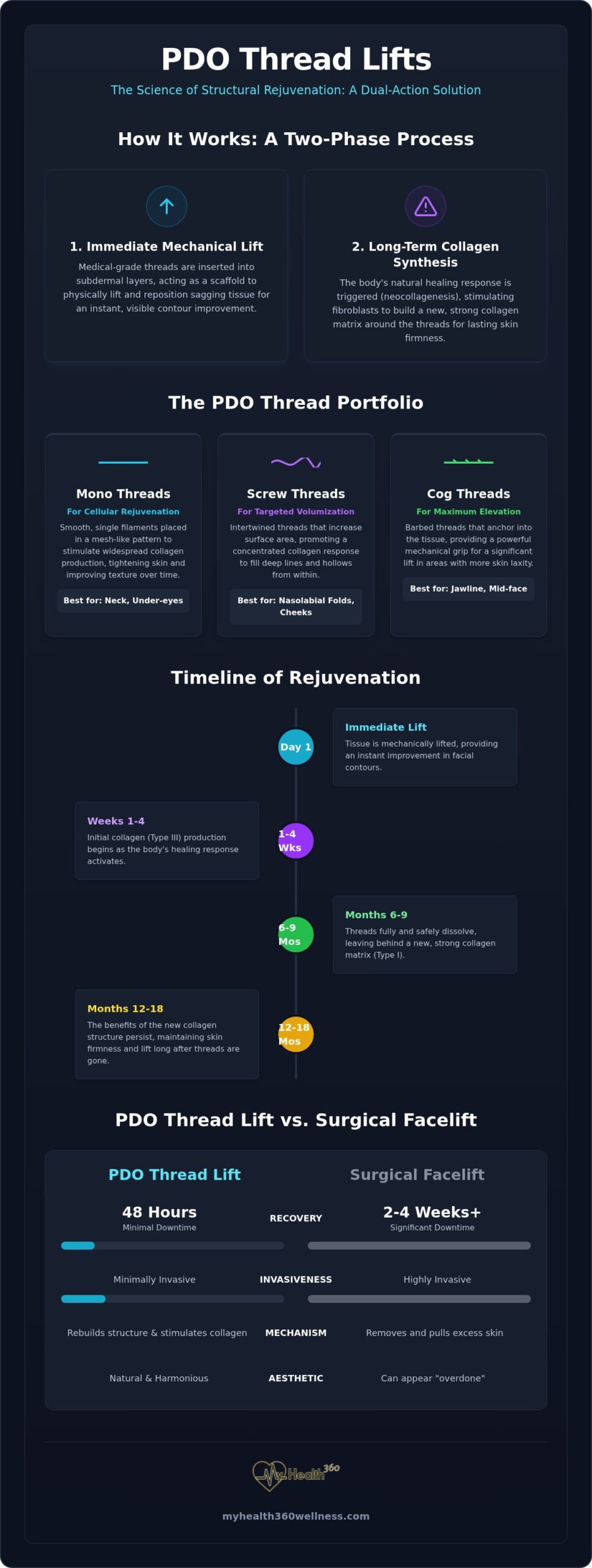
The presence of the thread stimulates fibroblasts, which are the primary cells responsible for collagen production. Initially, the body produces Type III collagen, which is eventually replaced by the stronger, more structural Type I collagen. The thread serves as a physical guide, ensuring that new tissue grows in a specific, organized vector rather than in a random pattern. Neocollagenesis is the body’s natural process of creating new collagen fibers around the PDO scaffold. This biological reinforcement significantly thickens the skin and improves its overall resilience, creating a firmer foundation that resists future sagging.
The Longevity of Absorbable Sutures
A common question involves how a temporary material can provide lasting results. The threads undergo hydrolysis, a chemical process where they safely dissolve into water and carbon dioxide over several months. While the physical thread typically disappears within six to nine months, the structural benefits often persist for 12 to 18 months because the newly formed collagen matrix remains in place. Unlike a traditional Thread lift or more invasive surgical interventions, this approach treats the skin as a living, renewable organ. By fostering a healthy dermal environment, we shift the focus from a temporary aesthetic fix to a long-term strategy for skin health and longevity.
The PDO Thread Portfolio: Mono, Screw, and Cog Varieties
Precision in aesthetic medicine requires a diverse toolkit. Selecting the appropriate filament for a PDO thread lift isn’t a matter of preference; it’s a matter of anatomical necessity. Each thread type serves a distinct purpose, from refining surface texture to providing the mechanical force needed to counteract gravity. To further address your skin’s surface needs, you can discover Skin Spa New York for customized facial services that complement structural rejuvenation. A physician-led approach ensures that the selection of gauge, length, and texture is tailored to your unique facial structure and tissue density. Without this clinical oversight, there’s a risk of using a tool that’s either too aggressive for delicate areas or insufficient for heavy lifting.
For areas requiring localized volumization, such as the nasolabial folds or the “hollows” of the cheeks, Screw threads provide an elegant solution. These consist of one or two threads intertwined around the insertion needle. This design increases the surface area in contact with the tissue, promoting a more concentrated collagen response that effectively “fills” deep lines from the inside out. By strategically selecting these varieties based on skin laxity and anatomical depth, we can create a customized map of rejuvenation that addresses both fine lines and structural deficits.
Mono threads are smooth, single filaments that don’t possess a mechanical “grip.” Instead, they’re primarily utilized for their ability to stimulate neocollagenesis on a broad scale. Often placed in a mesh-like pattern, they create a foundational support layer that tightens the skin over time. This technique is exceptionally effective for the delicate skin of the neck and under-eye areas, where fine lines often first appear. This targeted approach is a cornerstone of skin rejuvenation, providing a smooth canvas and improved dermal thickness without altering the underlying facial shape.
Cog and Barb Threads for Structural Elevation
When the goal is to physically reposition sagging tissue, Cog threads are the gold standard. These filaments feature microscopic barbs or “cogs” that provide a mechanical grip on the subcutaneous fat layers. By anchoring into the tissue, they allow for a “Vector Lift,” where the practitioner can physically elevate the mid-face or jawline to a more youthful position. According to the American Society of Plastic Surgeons on thread lifts, the success of this technique relies heavily on the practitioner’s understanding of facial vectors. High precision is required during insertion to avoid issues like skin puckering or thread visibility. Dr. Umbrine Fatima’s clinical expertise ensures that each thread is placed at the exact depth required for harmony. If you’re ready to see which combination fits your goals, you can explore a personalized consultation to map your rejuvenation path.
PDO Thread Lifts vs. Surgical Facelifts: A Comparison Framework
When considering facial rejuvenation, the decision often hinges on a fundamental question: do you need to remove skin, or do you need to reposition it? A traditional surgical facelift is a definitive intervention that involves excising excess tissue and tightening the underlying musculature. In contrast, a PDO thread lift focuses on structural elevation and biological restoration. While surgery offers a dramatic transformation, it also comes with the inherent risk of an “overdone” or “pulled” appearance. Threads provide a more subtle, harmonious result by utilizing your body’s own collagen to support the new contours, ensuring you look like a refreshed version of yourself rather than a different person entirely.
For patients in the “pre-surgical” aging bracket, typically those in their late 30s to early 50s, the cost-to-value ratio of threads is exceptionally high. You aren’t just paying for a temporary lift; you’re investing in the long-term thickness and health of your dermis. The recovery timeline is perhaps the most compelling differentiator. While a surgical procedure requires two to four weeks of significant downtime, most thread patients return to their normal activities within 48 hours. This efficiency makes it an ideal choice for high-performing individuals who cannot afford lengthy absences from their professional or personal lives.
Invasiveness and Anesthesia Profiles
The safety profile of these two approaches varies significantly. Surgery necessitates general anesthesia, which carries its own set of systemic risks, along with the potential for permanent scarring and nerve damage. A PDO thread lift is performed under local numbing, keeping you fully awake and comfortable throughout the process. It’s truly a “walk-in, walk-out” procedure. Because there are no large incisions, the risk of infection and visible scarring is virtually eliminated, making it a much more accessible option for those with busy schedules or a lower tolerance for invasive medical procedures.
Duration of Efficacy and Maintenance Cycles
It’s a fact that surgery offers greater longevity, with results often lasting up to a decade. However, the 18-month lifecycle of a thread treatment shouldn’t be viewed as a drawback. Instead, it allows for a dynamic approach to aging. As your facial structure changes over time, we can adjust the placement and type of threads used. This strategy is a key component of a physician-guided longevity plan designed to delay the need for surgery indefinitely. By undergoing repeated, minimally invasive treatments, you benefit from a cumulative increase in dermal collagen, which maintains skin quality far more effectively than a single, aggressive surgical event.
The Procedure Experience: Precision, Comfort, and Aftercare
The transition from clinical theory to physical results begins with a meticulous consultation and anatomical mapping session. We don’t simply insert filaments. Instead, we identify the specific structural vectors that will most effectively counteract tissue descent. This mapping phase is critical. It ensures that the PDO thread lift aligns with your natural facial expressions. Once the plan is established, we utilize advanced local numbing techniques to prioritize your comfort, followed by the precise deployment of threads via a sterile cannula. Because Dr. Umbrine Fatima is a board-certified physician, she possesses the specialized knowledge required to navigate the complex subcutaneous layers. She ensures each thread is anchored with clinical accuracy. The session concludes with a comprehensive symmetry check to verify the immediate mechanical elevation and the initiation of a personalized aftercare protocol designed to maximize your regenerative outcome.
Navigating the First 72 Hours
Your recovery begins the moment you leave our facility. The first three days are vital for thread stability. You’ll likely experience a sensation of “tightness” in the treated areas. This isn’t a cause for concern. It’s a tangible sign that the mechanical lift is holding the tissue in its new, elevated position. To protect the integrity of the threads, we advise sleeping on your back and avoiding exaggerated facial movements like shouting or yawning. It’s also necessary to pause strenuous exercise and postpone any dental work for at least two weeks to prevent thread displacement. These precautions are essential during the initial phase when the “cogs” or “barbs” are integrating with your subcutaneous fat layers. Adhering to these protocols ensures the internal scaffolding remains secure as the body begins its long-term regenerative work.
Long-Term Recovery and Optimization
While the mechanical lift is visible immediately, the true “collagen glow” typically manifests between 6 and 12 weeks as neocollagenesis peaks. This phase is where the skin’s texture and thickness visibly improve. To maximize these results, we often integrate the PDO thread lift with whole body habilitation, ensuring your system has the nutritional and physiological support needed for optimal tissue repair. This holistic approach addresses the cellular environment, providing the building blocks for high-quality collagen synthesis. Patients should avoid high-heat treatments like saunas, steam rooms, or aggressive laser therapies for 4 weeks post-procedure to ensure thread stability. If you’re ready to experience a physician-led transformation that prioritizes both precision and performance, schedule your structural mapping session today to begin your journey toward lasting rejuvenation.
The My Health 360 Advantage: Physician-Led Aesthetic Integration
Why settle for isolated cosmetic treatments when you can benefit from an integrated medical ecosystem? At My Health 360, we don’t view the PDO thread lift as a standalone service. Instead, it is a vital component of a comprehensive longevity strategy. Dr. Umbrine Fatima leverages her background in board-certified internal medicine to ensure that every structural intervention is supported by your body’s internal physiology. This physician-led approach provides a level of safety and precision that exceeds the standard med spa experience, focusing on how your overall health impacts your aesthetic outcomes.
Our facility is designed for whole-body habilitation, meaning we prioritize your recovery as much as the procedure itself. We understand that the success of biological scaffolding depends on the body’s ability to repair tissue efficiently. By integrating IV hydration and medical gym memberships into your care plan, we optimize your cellular environment. Proper hydration and metabolic health ensure that your fibroblasts have the resources necessary to produce high-quality collagen, effectively enhancing the longevity and quality of your results.
Synergistic Modalities: Threads and Morpheus8
How do we achieve a truly transformative result? We often utilize a “sandwich” technique that combines the internal lifting of threads with the external resurfacing of a Morpheus8 treatment. While the threads provide the underlying scaffold, the radiofrequency microneedling addresses skin laxity and texture on the surface. This combination requires precise clinical timing. We typically space these treatments to allow the initial inflammatory response to stabilize, ensuring the skin is resilient enough to handle both modalities. This synergy results in a more comprehensive rejuvenation than either treatment could provide in isolation.
Concierge Care for Performance and Vitality
Beyond radiofrequency, other precision tools like the plasma technology found at jettmedical.ca can be used alongside threads to address fine lines in delicate areas, offering a truly comprehensive approach to non-surgical rejuvenation.
Aesthetic goals are rarely isolated from a desire for peak performance. Our commitment to concierge performance medicine means we view your appearance through the lens of your entire longevity trajectory. We don’t just aim for a lifted jawline; we aim for a version of you that feels as vital as they look. This patient-first philosophy governs every decision we make, from the initial vector mapping to the long-term maintenance of your results. When you choose My Health 360, you’re choosing a partner dedicated to your health, performance, and aesthetic harmony in 2026 and beyond.
Advancing Your Longevity with Structural Precision
The journey to a more youthful silhouette doesn’t require invasive surgery or long periods of isolation. By choosing a PDO thread lift, you’re opting for a sophisticated method of biological scaffolding that works with your body’s natural regenerative cycles. We’ve explored how these medical-grade filaments provide an immediate lift while fostering long-term neocollagenesis, ensuring your results remain balanced and harmonious.
At My Health 360, this procedure is more than a cosmetic enhancement; it’s a precise medical intervention. Under the board-certified physician oversight of Dr. Umbrine Fatima, every vector is mapped with clinical accuracy to ensure sophisticated structural rejuvenation that respects your unique anatomy. As an advanced integrative longevity center, we provide the holistic support needed to sustain these results through optimized recovery and performance medicine.
Are you ready to redefine your aging trajectory with science-backed precision? Schedule Your Physician-Led PDO Thread Consultation at My Health 360. We look forward to helping you achieve a refreshed, vibrant appearance that reflects your internal vitality.
Frequently Asked Questions
Is a PDO thread lift painful during or after the procedure?
Most patients experience minimal discomfort due to advanced local numbing techniques applied before the procedure begins. During the session, you might feel a slight pressure or a tugging sensation as the threads are positioned within the subcutaneous layers. Post-procedure, mild soreness or a feeling of tightness is normal for several days. We manage this with specific aftercare protocols to ensure your recovery is as comfortable as possible while the structural elevation takes hold.
How soon will I see the lifting results from my PDO threads?
You will notice an immediate mechanical lift as soon as the threads are deployed and anchored by the practitioner. However, the full aesthetic benefit evolves over the following six to twelve weeks as the body initiates neocollagenesis. This secondary phase improves skin texture and thickness through cellular repair. While the initial elevation is gratifying, the peak collagen glow and structural refinement typically reach their maximum impact approximately three months after your session.
Can PDO threads be used to lift the eyebrows or create a ‘fox eye’ look?
Yes, PDO threads are highly effective for elevating the lateral brow to create a more open, refreshed appearance or a fox eye aesthetic. By placing threads along specific structural vectors, we can subtly reposition the brow tail and tighten the surrounding temporal tissue. This technique requires extreme precision to maintain facial harmony. Dr. Fatima ensures the lift appears natural and aligns with your overall facial proportions rather than looking overdone or artificial.
What is the difference between PDO, PLA, and PCA threads?
The primary difference lies in the material composition and the longevity of the clinical results. Polydioxanone (PDO) threads are the industry standard, dissolving in about six months and focusing heavily on collagen stimulation. Polylactic acid (PLA) threads often last slightly longer and utilize cones for anchoring. Polycaprolactone (PCA) threads are the newest generation, potentially lasting up to 24 months. We prioritize the PDO thread lift for its proven safety profile and predictable biological response.
Are there any significant risks or side effects associated with thread lifts?
While the procedure is minimally invasive, potential side effects include temporary bruising, swelling, or mild asymmetry during the initial healing phase. More significant risks, such as thread migration, infection, or visible dimpling, are rare when the procedure is performed by a board-certified physician. Choosing a clinical environment like My Health 360 minimizes these concerns. We utilize sterile techniques and precise anatomical mapping to ensure threads are placed at the correct depth for optimal safety.
How many threads are typically required for a full face and neck lift?
The number of threads varies based on your tissue laxity and specific structural goals identified during your consultation. A standard mid-face and jawline lift might require four to eight Cog threads for elevation, while a full face and neck rejuvenation could involve twenty or more Mono threads to improve skin density. During your clinical mapping, we determine the exact quantity and variety of filaments needed to create a robust biological scaffold tailored to your anatomy.
Can I combine a PDO thread lift with dermal fillers or Botox?
Combining modalities is often the best way to achieve a comprehensive, 360-degree rejuvenation of the face and neck. While threads provide structural elevation, Botox can relax dynamic wrinkles, and dermal fillers can restore lost volume. We frequently integrate these treatments to address multiple layers of aging simultaneously. However, we carefully time these interventions to ensure tissue stability. We may recommend waiting several weeks between a PDO thread lift and certain injectable treatments for optimal healing.
What happens if I am not happy with the results of my thread lift?
Because PDO threads are absorbable and non-permanent, any unwanted effects will naturally resolve as the body metabolizes the material over several months. In the rare event of minor asymmetry or visible dimpling shortly after the procedure, manual adjustments can often be made by the physician. If you are dissatisfied with the degree of lift, additional threads can be placed to reinforce the scaffold. Our physician-led approach prioritizes open communication to ensure your aesthetic expectations are met.