
What should you do before surgery, and when should you begin? An optimized pre-surgery recovery plan can feel difficult to define when online advice conflicts or a wellness service may not fit your surgical instructions. The most useful place to start is with your procedure and the clinicians responsible for your care.
Pre-surgery preparation is not a universal protocol or a replacement for medical clearance and guidance from your surgical team. Its purpose is to help you understand what may be relevant to your health and procedure, clarify instructions, and discuss whether additional support fits your care plan. Recommendations should be individualized, and a preparation plan cannot promise a particular outcome.
This guide explains prehabilitation, how to organize a conversation with your care team, and what to ask when considering recovery support. My Health 360 offers BioPrime pre-operative whole-body habilitation as an option to discuss, not a substitute for surgical care. To explore whether it may be a good option for you, contact My Health 360 to arrange a Meet and Greet with Medical Director Dr. Fatima.
Key Takeaways
- An optimized pre-surgery recovery plan is individualized preparation coordinated with your surgical team, not a universal checklist or promise of a particular outcome.
- Begin by confirming which procedure is planned, gathering relevant health information, and asking your care team which instructions apply to you.
- Before adding wellness or habilitation support, check that it fits your surgical team’s guidance and clarify who will coordinate communication.
- Keep confirmed instructions separate from questions that still need answers, and follow up with your treating team before acting on general advice.
- Contact My Health 360 for a Meet and Greet with Medical Director Dr. Fatima to discuss whether BioPrime pre-operative whole-body habilitation may be a good option for you.
What a Pre-Surgery Recovery Plan Can and Cannot Do
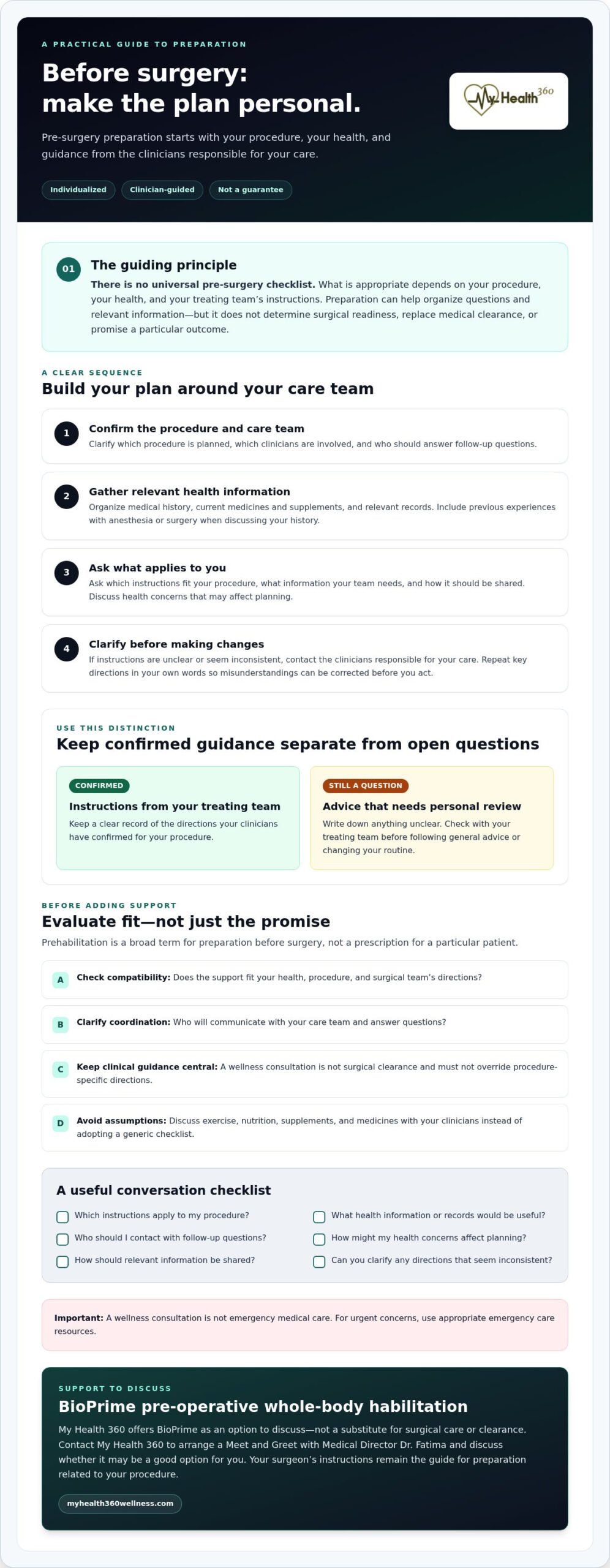
It is understandable to feel uncertain about what to do before surgery. Online recommendations may sound definitive, but what is appropriate can depend on the procedure, your health, and your treating team’s instructions. An optimized pre-surgery recovery plan is not a universal checklist. It is an individualized discussion about preparation, coordinated with the clinicians responsible for your surgical care.
A pre-surgery recovery plan is individualized preparation discussed with your care team to help organize appropriate support before a procedure. You may encounter the term Prehabilitation for preparation before surgery. It describes a broad concept, not a prescription for a particular patient. Planning can help you organize questions, share relevant health information, and clarify which recommendations apply. It cannot guarantee a result, determine surgical readiness on its own, or replace instructions from your surgeon.
What does pre-surgery recovery planning mean?
In practical terms, planning means making sure the right people understand your situation and that you know which instructions to follow. A conversation may cover the planned procedure, your health history, current medicines and supplements, and concerns you want to raise with your clinicians. It is not a reason to adopt a generic exercise, nutrition, fasting, or supplement checklist. Ask your treating team before changing your routine or following advice that might conflict with its directions.
Who should guide an individual plan?
Your treating surgeon and relevant clinicians should provide procedure-specific instructions. Share pertinent health information, including conditions, medicines, supplements, and previous experiences with anesthesia or surgery. Ask who will coordinate questions across your care team. If instructions are unclear or seem inconsistent, contact the clinicians responsible for your care and ask which direction applies to you.
A wellness consultation may give you an opportunity to discuss whether additional preparation support is appropriate. It is not surgical clearance and does not replace care from your surgical team. A wellness provider should not override procedure-specific directions. A consultation is not emergency medical care; for urgent concerns, use the appropriate emergency care resources.
My Health 360 offers BioPrime pre-operative whole-body habilitation as an option to discuss, not a substitute for surgical care or clearance. Contact My Health 360 to arrange a Meet and Greet with Medical Director Dr. Fatima and discuss whether this support may be a good option for you. Your surgeon’s instructions remain the guide for preparation related to your procedure.
Building a Pre-Surgery Plan for Your Procedure and Health
Once a procedure is planned, turn uncertainty into a focused conversation. Confirm what procedure is planned and which clinicians are involved. Then gather relevant health information, write down your questions, and keep a record of the instructions your treating team confirms.
Preparation should be individualized to your health and procedure, then coordinated with the clinicians directing your care. Advice that seems sensible in a general online checklist may not fit your circumstances or your surgical team’s plan. Exercise, nutrition, supplements, and medication all call for individualized discussion rather than assumptions.
What information should you bring to a planning conversation?
Organize relevant medical history, a current list of medications and supplements, and available health records for clinician review. Rather than guessing which tests or documents are required, ask your care team what information would be useful for your specific procedure and how it should be shared. An overview of Surgical prehabilitation can provide background, but it is not a personal protocol or a substitute for clinical direction.
Which questions help clarify your preparation?
Ask which instructions apply to your procedure, who should answer follow-up questions, and how existing health concerns may affect planning. If guidance is unclear, request clarification before making a change. You can also repeat key instructions back in your own words. This gives your care team a chance to correct misunderstandings before you act.
Use this worksheet during your conversation. Complete it with your clinicians rather than filling gaps with assumptions:
- Procedure: What procedure is planned, and which clinicians are involved?
- Health information: What history, medication list, or available records should I share?
- Questions: Which existing health concerns should I raise, and what should I clarify before acting?
- Contacts: Who is my contact for procedure-specific instructions and follow-up questions?
- Confirmed instructions: What directions has my treating team given, and what remains uncertain?
Keep confirmed instructions distinct from questions still awaiting an answer. If advice from an outside source differs from what your surgical team told you, check with the team before acting on it. This simple distinction can make it easier to see what has been decided and what needs follow-up.
If you are considering additional preparation support, contact My Health 360 for a Meet and Greet with Medical Director Dr. Fatima to discuss whether BioPrime pre-operative whole-body habilitation may be a good option for you. The conversation does not replace your surgical team’s instructions or clearance. Learn more about My Health 360’s pre-operative habilitation.
How to Evaluate Recovery Support Without Assuming Every Option Fits
Different members of your care network may offer different kinds of support, but their roles are not interchangeable. An optimized pre-surgery recovery plan should help you decide which support is relevant to your situation, not encourage you to collect services or assume every option is appropriate. For procedure-specific care, your surgical team’s instructions remain the reference point.
| Type of support | Purpose | Responsible clinician | Coordination needs | Questions to ask |
|---|---|---|---|---|
| Surgeon-directed care | Provides guidance specific to the planned procedure. | Your surgeon and relevant treating clinicians. | Confirm instructions and clarify who handles follow-up questions. | Which directions apply to me, and whom should I contact if something is unclear? |
| General wellness support | Addresses a wellness goal outside procedure-specific medical direction. | The professional providing that support. | Tell your surgical team what you are considering and ask whether it fits their plan. | What does the service involve, and should my treating team review it first? |
| Physician-guided habilitation | Offers a setting to discuss whole-body preparation before surgery. | The physician guiding the habilitation discussion, in coordination with your treating team. | Share relevant directions from your surgical team and clarify how communication will occur. | How will suitability be assessed, and how will this be coordinated with my surgeon? |
What should you ask before considering an additional service?
Ask for a plain-language explanation of what the service involves, how a physician assesses whether it suits your circumstances, and how it will be coordinated with your surgical plan. Share the procedure-specific instructions you have received. Ask whether anything needs to be clarified with your treating team before you proceed. Optional support is not automatically necessary, and a general wellness recommendation does not replace surgical guidance.
Pause if you hear guaranteed outcome claims or cannot get clear answers about the service, clinical oversight, or coordination. You can discuss your questions with your surgeon before deciding.
How can physician-led whole-body habilitation fit into the discussion?
Pre-operative whole-body habilitation is an option to discuss, not a required step or a substitute for surgical care. My Health 360 offers BioPrime for pre-operative whole-body habilitation. Share the option with your treating team and ask whether it fits your individual plan. You can also contact My Health 360 for a Meet and Greet with Medical Director Dr. Fatima to discuss whether it may be a good option for you.
What to Confirm With Your Surgical Team Before Acting on a Plan
Before changing your routine or adding a service, make sure you understand which instructions come from the clinicians responsible for your procedure. An optimized pre-surgery recovery plan depends on clear communication, not on combining advice from multiple sources and hoping it fits. Online articles and wellness providers can offer general information, but they do not override your treating team’s directions.
A practical check-in checklist
Use these prompts to organize what you need to confirm. Write down the answers and follow up on anything that remains unclear.
- Instructions: Which recommendations apply to my specific procedure and health situation?
- Uncertainty: Which directions need clarification before I act on them?
- Contacts: Whom should I contact with questions, and how should I reach that clinician?
- Coordination: If I am considering additional support, should my surgical team review it first, and how should the clinicians communicate?
- Changes in health: Who should I contact if I develop new symptoms or my health changes before surgery?
Keep the checklist and any written instructions together so you can refer to what your care team confirmed. If instructions appear to conflict, do not try to reconcile them by combining recommendations from unrelated sources. Contact the treating team, explain what you have been told, and ask which direction applies to you. This keeps decisions connected to your procedure and clinical context rather than a generic rule.
For new symptoms or urgent concerns, contact the appropriate clinical team or emergency care resource, as warranted. This article can help you prepare questions, but it cannot assess symptoms or provide urgent medical care.
Assessing physician-led care
If you are considering a procedure or physician-guided service, ask who will perform it and discuss that physician’s experience. Ask how suitability will be assessed for your circumstances, what the service involves, and how your treating team’s instructions will be respected. Clear answers help you make an informed decision. A service is not automatically appropriate just because it is described as supportive.
Only seek treatment if performed by an experienced physician. Avoid places where procedures are performed by mid-level providers under physician supervision.
For a physician-led discussion about My Health 360’s pre-operative whole-body habilitation offering, contact My Health 360 for a Meet and Greet with Medical Director Dr. Fatima to discuss whether it may be a good option for you. This conversation does not replace your surgeon’s instructions or clearance.
Discuss an Optimized Pre-Surgery Recovery Plan With My Health 360
A useful next step is to start with the procedure you are planning, follow your surgical team’s instructions, and consider additional support only if it is appropriate for your circumstances. An optimized pre-surgery recovery plan should complement, not replace, care coordinated by the clinicians responsible for your surgery.
My Health 360 offers BioPrime, a pre-operative whole-body habilitation program. It is an option to discuss, not a required step or a promise of a particular result. The center is owned and operated by Dr. Umbrine Fatima, an American Board Certified Internal Medicine specialist. Any consideration of additional support should take your individual context into account, and your treating team should know about services you are considering.
What happens in an initial Meet and Greet?
A Meet and Greet with Medical Director Dr. Fatima gives you an opportunity to discuss your goals, questions, and whether a procedure or pre-operative support may be a good option for you. It is not a promise of diagnosis, surgical clearance, a particular treatment, or an outcome.
To make the conversation useful, bring questions about the support you are considering and share relevant context about your planned procedure and the instructions you have received. Ask what further discussion may be needed with your surgical team. If you are unsure whether a detail is relevant, raise it rather than trying to decide its importance on your own.
How can readers take the next step thoughtfully?
Keep your surgeon informed about any additional service you are considering, and ask whether it fits the procedure-specific plan. A wellness or habilitation conversation does not supersede that guidance. If you would like to learn more about the general approach, explore My Health 360’s physician-guided whole-body habilitation information and bring any questions it raises to your care team.
For a personal discussion, contact My Health 360 to arrange a Meet and Greet with Dr. Fatima. You can talk through your questions and explore whether BioPrime pre-operative whole-body habilitation may be a good option for you, while keeping your surgical team’s direction at the center of your planning.
Take Your Next Step With a Plan Built Around You
A thoughtful optimized pre-surgery recovery plan starts with your procedure and health context, with your surgical team’s instructions at the center. Preparation can help organize questions and clarify what support may be appropriate, but it cannot promise a particular outcome or replace procedure-specific care.
Additional support is an option to explore, not a requirement. My Health 360 is a physician-owned center operated by Dr. Umbrine Fatima, an American Board Certified Internal Medicine specialist. Its offerings include pre-operative whole-body habilitation and integrative concierge medical care, which you can discuss alongside, not instead of, surgical care.
If you would like to explore whether BioPrime pre-operative whole-body habilitation may be suitable for you, contact My Health 360 to schedule a Meet and Greet with Dr. Fatima. Bring your questions and relevant context to discuss whether this support may be a good option for you. Contact My Health 360 to take that next step and arrange a conversation.
Frequently Asked Questions
What is an optimized pre-surgery recovery plan?
An optimized pre-surgery recovery plan is individualized preparation coordinated with the clinicians responsible for your surgical care. It helps organize questions, relevant health information, and support that may be appropriate for your procedure and circumstances. It is not a universal checklist, a guarantee of a particular outcome, or a substitute for your surgeon’s instructions. Procedure-specific recommendations should come from your treating team, especially if general advice you have found online seems different.
How do I create a pre-surgery recovery plan?
Start by confirming what procedure is planned and which clinicians are involved. Organize relevant medical history, a current medication and supplement list, and available records, then ask your care team what information it needs. Clarify which instructions apply to you, who handles follow-up questions, and how to coordinate any additional support you are considering. If your care team recommends preparing post-operative recovery aids or home health items in advance, you can check out USA Medical and Surgical Supplies to find appropriate supplies. Record confirmed directions separately from unanswered questions, and check uncertainties with your treating clinicians before acting.
When should I start preparing for surgery?
Ask your surgical team when to begin, because appropriate timing depends on your procedure, health, and clinical instructions. Once surgery is planned, you can organize records and write down questions without changing your routine based on a generic timeline. If you are considering additional support, raise it with the provider and your treating team so you can clarify whether it fits your care plan.
Can a wellness program replace instructions from my surgeon?
No. A wellness program cannot replace or override your surgeon’s procedure-specific instructions, surgical clearance, or care from the clinicians treating you. Before starting an additional service or changing your routine, tell your surgical team what you are considering and ask whether it fits their guidance. If advice from a wellness provider or online article conflicts with your instructions, contact your treating team for clarification rather than combining recommendations on your own.
What should I ask before choosing physician-guided recovery support?
Ask what the service involves, how a physician determines whether it is appropriate for your circumstances, and how it will be coordinated with your surgeon’s plan. Clarify who is responsible for answering questions and who performs any procedure involved. Discuss the physician’s experience, and pause if you hear guaranteed outcome claims or cannot get clear answers. Share relevant instructions from your surgical team before deciding whether to proceed.
Is pre-operative whole-body habilitation appropriate for everyone?
No. Pre-operative whole-body habilitation is not automatically appropriate or necessary for every patient. Suitability depends on your individual context and should be discussed with your treating team and the physician guiding the habilitation conversation. My Health 360 offers BioPrime pre-operative whole-body habilitation. To explore whether it may be a good option for you, contact My Health 360 for a Meet and Greet with Medical Director Dr. Fatima. This conversation does not replace your surgeon’s guidance.