

What if the most thoughtful step before surgery is not adding more wellness advice, but checking that each step fits your care plan? It’s understandable to want to do everything possible to prepare while feeling unsure which changes are appropriate for your procedure. Enhanced surgical outcome preparation is individualized and should be coordinated with the clinicians responsible for your care, not treated as a one-size-fits-all checklist.
This guide explains how to organize questions for your surgical team, discuss medications, activity, nutrition, and other personal considerations, and evaluate optional support without mistaking it for a promise of better results. Your surgeon’s and other clinicians’ instructions remain central. A whole-body habilitation program should not replace or conflict with them.
My Health 360 offers BioPrime, a pre-operative and pre-event whole-body habilitation program. If you’re considering it, contact My Health 360 for a Meet and Greet to discuss with Medical Director Dr. Fatima whether it may be suitable for your procedure. The goal is an informed conversation grounded in your circumstances and your care team’s plan.
Key Takeaways
- Enhanced surgical outcome preparation is a planning process, not a promise of a particular result. Start with the instructions specific to your procedure.
- Make a list of questions for your surgical team. Confirm any changes involving medication, activity, nutrition, or other health considerations with your clinicians.
- Distinguish required surgical guidance from optional whole-body habilitation. Optional support should never override or delay your care team’s instructions.
- When evaluating a treatment, ask who will perform it and clarify the physician’s role before proceeding.
- Consider BioPrime as an option to discuss, not a guaranteed route to better outcomes. Contact My Health 360 for a Meet and Greet with Medical Director Dr. Fatima to discuss whether it may be suitable for your procedure.
What Does Enhanced Surgical Outcome Preparation Actually Mean?
Enhanced surgical outcome preparation is the individualized planning a person does before surgery, in coordination with their clinicians, without any promise of a particular result. It helps you identify which steps apply to your procedure and clarify questions before the operation. It isn’t a universal wellness checklist, and preparation alone can’t guarantee how surgery or recovery will go.
Preoperative care broadly refers to care and planning before an operation. Your surgeon’s procedure-specific instructions are distinct from optional wellness support. For example, if you’re considering a change to your activity or nutrition, or have a question about a medication, ask your care team whether it is appropriate for your procedure and health context before making a change.
How does preparation relate to surgical outcomes?
Preparation is a way to make decisions with relevant information, not a standalone method for changing or predicting a surgical outcome. Appropriate steps may vary according to the operation, your health history, current medications, and your clinical team’s instructions. Ask your surgeon, “Which preparation steps apply to my procedure, and which should I avoid?” Treat claims that a particular program or action improves outcomes as claims to assess with reliable evidence and your clinicians’ advice.
Who should guide a pre-operative preparation plan?
Your treating surgeon and the clinicians responsible for your care should guide procedure-specific instructions. Share questions about medicines, activity, food and fluids, or other health considerations with them rather than relying on general advice. Optional whole-body habilitation is a separate consideration. Discuss its suitability with an appropriate physician, and don’t use it as a substitute for clinical evaluation or surgical care.
My Health 360 offers BioPrime, a pre-operative and pre-event whole-body habilitation program. Its role and suitability for a specific procedure should be discussed with a physician, not assumed. If you’re considering it, contact My Health 360 for a Meet and Greet appointment with Medical Director Dr. Fatima. Ask whether it may be an appropriate option for you, and keep your surgical team’s plan as the reference point for preparation.
How to Build a Physician-Guided Preparation Plan Before Surgery
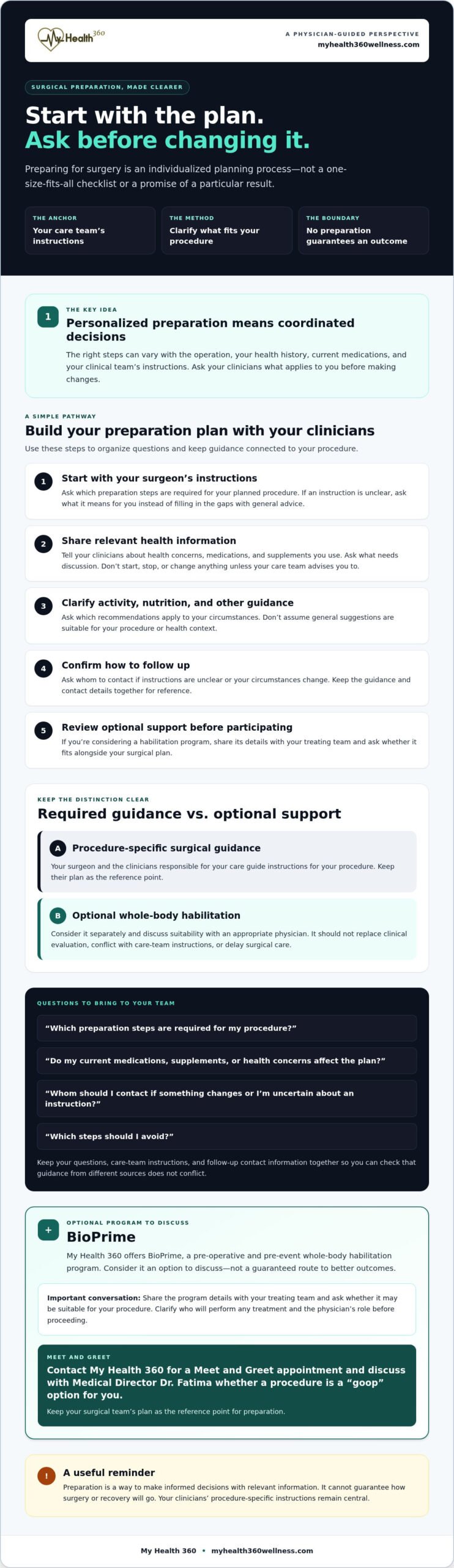
A clear plan begins with the instructions for your specific procedure, not a generic wellness checklist. Use these steps to organize the conversation and keep decisions with the clinicians responsible for your care.
- 1. Start with your surgeon’s instructions. Ask which preparation steps are required for the planned procedure. If an instruction is unclear, ask what it means for you rather than filling in the gaps with general advice.
- 2. Bring relevant health information. Tell your clinicians about health concerns and the medications and supplements you use. Ask which ones need discussion. Don’t start, stop, or change anything unless your care team advises you to.
- 3. Clarify activity, nutrition, and other guidance. Ask which recommendations apply to your circumstances. Don’t assume general suggestions are suitable for your procedure or health context.
- 4. Confirm how to follow up. Ask whom to contact if instructions aren’t clear or your circumstances change. Keep the guidance and contact details together so you can refer to them when questions come up.
- 5. Review optional support before participating. If you’re considering a habilitation program, share its details with your treating team and ask whether it fits alongside your surgical plan.
What should you ask your surgical team?
Keep questions direct and practical: “Which preparation steps are required for my procedure?” “Do my current medications, supplements, or health concerns affect the plan?” “Whom should I contact if something changes or I’m uncertain about an instruction?” These questions help distinguish procedure-specific direction from optional support. They also make it easier to check that advice from different sources does not conflict.
How can you keep preparation coordinated?
Use one note or document to collect your questions, care-team instructions, and follow-up contact information. Bring it to relevant appointments or refer to it when speaking with your clinicians. If you’re exploring Prehabilitation, the American College of Surgeons offers background on the concept. Discuss any participation with your treating team, and avoid adding activities or making changes based on general information alone.
Before considering a treatment, clarify who will perform it and their role. To discuss whether BioPrime may be suitable for your procedure, contact My Health 360 for a Meet and Greet with Medical Director Dr. Fatima. Share the plan with your surgical team before deciding whether to proceed.
Standard Surgical Instructions vs. Optional Whole-Body Habilitation
Enhanced surgical outcome preparation may involve both procedure-specific instructions and optional support, but they have different roles. Your surgical team’s guidance is the reference point for decisions about your care. Optional habilitation should be considered separately and must not override or delay those instructions.
| Consideration | Care-team instructions | Optional whole-body habilitation |
|---|---|---|
| Purpose | Provide guidance specific to your planned procedure and health context. | Offer a separate form of pre-operative and pre-event whole-body habilitation. |
| Oversight | Come from your treating surgeon and the clinicians responsible for your care. | Discuss with an appropriate physician and your treating team to clarify suitability. |
| How to use it | Follow the instructions you receive, and seek clarification if anything is unclear. | Consider only if it fits alongside your care team’s plan. Don’t substitute it for clinical care. |
What is the role of BioPrime in pre-operative preparation?
My Health 360 describes BioPrime as a pre-operative and pre-event whole-body habilitation program. That description doesn’t establish whether it is appropriate for a particular procedure or patient, or what clinical results to expect. Discuss participation with Medical Director Dr. Fatima and your treating team before making a decision. Your surgeon’s instructions remain the guide for procedure-specific preparation.
How should you assess claims about enhanced outcomes?
A service description tells you what a program is called, not whether it improves a clinical outcome. If a program or provider makes an outcome claim, ask what evidence supports it and whether that evidence relates to your planned procedure and health circumstances. Don’t treat preliminary, indirect, or unverified findings as a promise. Ask your clinicians to help assess whether the information is relevant to your care.
How to Reduce Confusion and Manage Safety Questions Before Surgery
When advice comes from more than one source, it can be difficult to know what applies. Keep your treating surgeon and the clinicians responsible for your care at the center of preparation decisions. Enhanced surgical outcome preparation should reflect your procedure and health context, not a universal set of steps assembled from general advice.
Reminder: Optional support never replaces or overrides the directions of your surgical team. If guidance seems inconsistent, pause and ask the clinicians managing your care to clarify it before proceeding. This includes proposed changes to medication, activity, nutrition, or participation in a wellness service.
What safety questions should you raise before participating?
Before considering a treatment or optional program, ask who will perform it, who will provide medical oversight, and how the service will coordinate with the clinician managing your surgery. Share the details with your treating team so they can advise whether participation fits your care plan. Don’t assume a service is appropriate simply because it is described as supportive or pre-operative.
Clarify provider qualifications and responsibilities before making a decision. Only seek treatment if performed by an experienced physician. Specialized surgical practices, such as MG Plastic Surgery, emphasize that pre-operative evaluations and procedures should be guided directly by qualified physicians to maintain patient safety.
How can you recognize a provider setting to avoid?
Ask clearly who performs procedures and what role the physician has. Don’t rely on vague descriptions of supervision. Request an explanation of the provider’s qualifications and responsibilities. Avoid places where procedures are performed by mid-level providers under physician supervision. If you can’t establish who will perform the procedure, don’t proceed until your questions are answered.
Keep the conversation practical. You might ask your surgeon, “Does this proposed service fit with my procedure-specific instructions?” Ask the provider, “Who performs the treatment, and how will my surgical team’s guidance be considered?” If answers conflict or remain unclear, bring the issue back to the clinicians responsible for your surgical care. These are general safety questions, not individualized medical advice. Your team should guide decisions for your circumstances.
If you’re considering My Health 360’s BioPrime pre-operative and pre-event whole-body habilitation program, contact My Health 360 for a Meet and Greet with Medical Director Dr. Fatima. Discuss whether BioPrime may be suitable for your procedure, and confirm any decision with your treating team.
Next Steps: Discuss Surgical Preparation and BioPrime With a Physician
You don’t need to decide on every form of support at once. Begin with the clinicians responsible for your surgery, clarify their instructions, and then evaluate any optional service in light of that plan. Enhanced surgical outcome preparation is most useful as a careful conversation, not a promise about what your results will be.
What should you bring to a preparation conversation?
Bring the procedure context, instructions or questions from your treating team, and information about relevant health concerns. If you’re considering optional support, explain what you’re evaluating and ask how the decision can be coordinated with your surgical care. Useful questions include:
- What is known about this option, and what remains uncertain?
- Does it appear suitable for my circumstances and planned procedure?
- How should I share the details with the clinicians managing my surgery?
These questions help separate a service’s description from evidence for a clinical benefit. They also give your clinicians an opportunity to consider the option in the context of your care rather than relying on general claims.
How can My Health 360 help you explore the option?
The program’s description alone doesn’t establish suitability or guarantee an outcome. Discuss it with the Medical Director and your treating team before deciding whether it belongs in your preparation plan. My Health 360 is physician-owned and operated by Dr. Umbrine Fatima, an American Board Certified Internal Medicine specialist.
For additional context on whole-body habilitation, look for Whole Body Habilitation: A Physician-Led Guide to Longevity and Performance. Bring any questions it raises to your clinicians, and keep your surgical team’s directions as the basis for procedure-specific decisions.
To explore BioPrime, contact My Health 360 to arrange a Meet and Greet and discuss with Medical Director Dr. Fatima whether the program may be a suitable option for you. Consider it alongside your care team’s guidance, not as a substitute for surgical care or a guaranteed route to better outcomes.
Prepare for Surgery With Clarity and Confidence
Enhanced surgical outcome preparation begins with your treating team’s procedure-specific instructions. Clarify questions about medications, activity, nutrition, or health concerns with the clinicians responsible for your care. Assess optional support only after you understand how it fits with their guidance.
BioPrime is My Health 360’s pre-operative and pre-event whole-body habilitation program, not a guarantee of a particular result or a substitute for surgical care. My Health 360 is physician-owned and operated by Dr. Umbrine Fatima, an American Board Certified Internal Medicine specialist. Whether BioPrime is suitable for your procedure is a question to discuss with a physician and your surgical team.
Keep your care team’s plan at the center of each decision. For a physician-led conversation, contact My Health 360 to arrange a Meet and Greet with Medical Director Dr. Fatima and discuss whether BioPrime may be a suitable option for you.
Frequently Asked Questions
Can preparation before surgery improve the outcome?
Preparation can help you plan and clarify which steps are appropriate, but no preparation program should be presented as a promise of a better surgical result. Enhanced surgical outcome preparation is not the same as evidence that a particular service changes clinical outcomes. Ask your surgeon which steps apply to your planned procedure, and discuss any optional service with the clinicians managing your care. Claims about clinical benefits should be supported by reliable medical evidence relevant to your circumstances.
What should I do before surgery to prepare?
Start with the instructions from the clinicians responsible for your procedure. Ask them to explain anything that’s unclear, and share relevant health information, including concerns about medications or supplements. Don’t use general online advice to make changes that conflict with your care team’s directions. Your clinicians can tell you what applies to your procedure and circumstances, including guidance about medication, activity, nutrition, or timing.
What is pre-operative whole-body habilitation?
Pre-operative whole-body habilitation describes an approach to preparation before a procedure. Its name alone doesn’t establish a particular protocol or clinical benefit. My Health 360 identifies BioPrime as a pre-operative and pre-event whole-body habilitation program. Discuss whether it may be suitable with a physician, and coordinate any optional service with your surgical team. To explore the option, contact My Health 360 for a Meet and Greet with Medical Director Dr. Fatima.
Is a pre-operative wellness program a substitute for my surgeon’s instructions?
No. Optional wellness support isn’t a replacement for instructions from the clinicians managing your procedure, and it shouldn’t override or delay their guidance. If you’re considering a program, tell your surgical team and ask whether it fits your care plan. A program description doesn’t establish that it’s appropriate for you or guarantee a particular surgical outcome.
How do I assess claims that a preparation program enhances surgical outcomes?
Ask what specific outcome is being claimed, what evidence supports the claim, and whether that evidence applies to your planned procedure and personal circumstances. A description of a service is not proof of a clinical benefit. Be cautious about promises or statistics that aren’t supported by verifiable evidence. Bring claims that interest or concern you to your treating clinicians, who can help you consider them in the context of your care.
Who should perform a treatment I am considering before surgery?
Clarify who will perform the treatment and discuss the decision with the clinicians managing your surgery. Only seek treatment if performed by an experienced physician. Avoid places where procedures are performed by mid-level providers under physician supervision. Ask direct questions about provider qualifications and responsibilities before proceeding. If you can’t get clear answers, pause and consult your treating team before making a decision.