
What if the right pelvic floor exercise isn’t another set of Kegels, but a clearer understanding of what your body needs? Pelvic floor strengthening for women can involve self-guided exercises, support from a pelvic floor physical therapist, or technology-based approaches. The right fit depends on your symptoms, goals, and ability to perform the exercises correctly.
It’s understandable to wonder whether you’re engaging the right muscles, how to recognize progress, or when symptoms call for professional guidance. There isn’t one approach that suits every woman, and doing more repetitions doesn’t necessarily mean better results. A thoughtful plan starts with understanding the options and what each can, and can’t, tell you about progress.
This article compares common strengthening approaches, offers questions to help you track changes, and explains when a clinician’s input may help you choose a next step. You’ll also learn how to discuss your goals and symptoms so decisions can be guided by your needs rather than unsupported promises.
Key Takeaways
- Pelvic floor strengthening for women is not one-size-fits-all; goals and suitable approaches vary from person to person.
- Exercise quality matters. A written guide can explain technique, but it can’t confirm your movement or diagnose the cause of symptoms.
- Self-guided exercises, pelvic floor therapy, and physician-guided procedures differ in purpose and level of personalization.
- Discuss potential benefits, risks, and how progress and lasting effects may vary for the approach you’re considering.
- Contact My Health 360 for a Meet and Greet to discuss your goals with Medical Director Dr. Fatima and whether a procedure may be a good option for you.
What Does Pelvic Floor Strengthening for Women Involve?
Pelvic floor strengthening focuses on awareness and control of the muscles at the base of the pelvis. Exercises or other approaches should be considered in light of an individual’s needs. The aim isn’t simply to do more repetitions: coordination, the ability to contract and relax, and the reason for seeking guidance can all shape an appropriate plan. Pelvic floor strengthening targets muscles beneath the pelvis; general abdominal exercise alone doesn’t necessarily train those muscles.
Some women start asking questions during pregnancy or after childbirth. Others become curious after menopause, surgery, or a change in exercise habits. These experiences may prompt questions, but they don’t by themselves establish the cause of a symptom or mean that treatment is needed. Pelvic floor strengthening for women is best understood as an individualized area of health, not a single routine prescribed for everyone.
What muscles does pelvic floor strengthening target?
The pelvic floor is a group of muscles and connective tissues at the bottom of the pelvis. It helps support pelvic organs, including the bladder, bowel, and uterus, and contributes to functions such as bladder and bowel control. These muscles are part of the broader core system, which also includes the abdominal, back, and breathing muscles. The systems work together, but a plank or abdominal exercise isn’t automatically a pelvic floor exercise.
Kegel exercises are one familiar approach. They involve intentionally contracting and releasing pelvic floor muscles. The term describes an exercise method, not a diagnosis or a complete plan for every person. Understanding the intended movement can be a starting point, but written instructions alone can’t confirm whether you’re performing it effectively.
Who may want to learn about pelvic floor strengthening?
Women may have questions about pelvic floor function during pregnancy, while recovering after childbirth or surgery, around menopause, or after changing their physical activity. These are reasons to seek information, not proof that the muscles are weak or that a particular condition is present. Age alone doesn’t determine whether someone needs treatment.
If a concern or uncertainty is affecting daily activities, a qualified clinician can help assess what may be relevant and discuss whether guidance is appropriate. Describe what you’ve noticed, when it occurs, and how it affects your routine. You don’t need to arrive with a diagnosis. To discuss your goals and whether a procedure may be a good option, contact My Health 360 to arrange a Meet and Greet appointment with Medical Director Dr. Fatima.
How Do Pelvic Floor Strengthening Exercises and Treatment Work?
Pelvic floor exercises involve learning to contract and release the intended muscles with control. A generic repetition target can’t account for differences in muscle coordination, symptoms, or goals. Technique matters: repeatedly squeezing without knowing whether you’re using the intended muscles, or whether you can relax them afterward, may not address your particular concern.
An individualized assessment can help shape an exercise or treatment plan around your symptoms, goals, and how your pelvic floor muscles function. An article can explain concepts, but it can’t observe your movement, confirm your technique, or diagnose the reason for symptoms. If you’re unsure how to identify the muscles, the NIDDK’s guidance on how to do Kegel exercises offers a useful starting point. It doesn’t replace individualized assessment when you need help applying instructions.
What should readers understand before trying pelvic floor exercises?
If you’re uncertain about technique, qualified guidance can help you understand how to contract and release the pelvic floor rather than relying on guesswork. Don’t treat a repetition count or schedule as a universal prescription; appropriate instructions depend on your circumstances. Pay attention to how your body responds. If an exercise causes concern or your symptoms worsen, pause and seek clinical guidance rather than pushing through.
How can guided options fit into a strengthening plan?
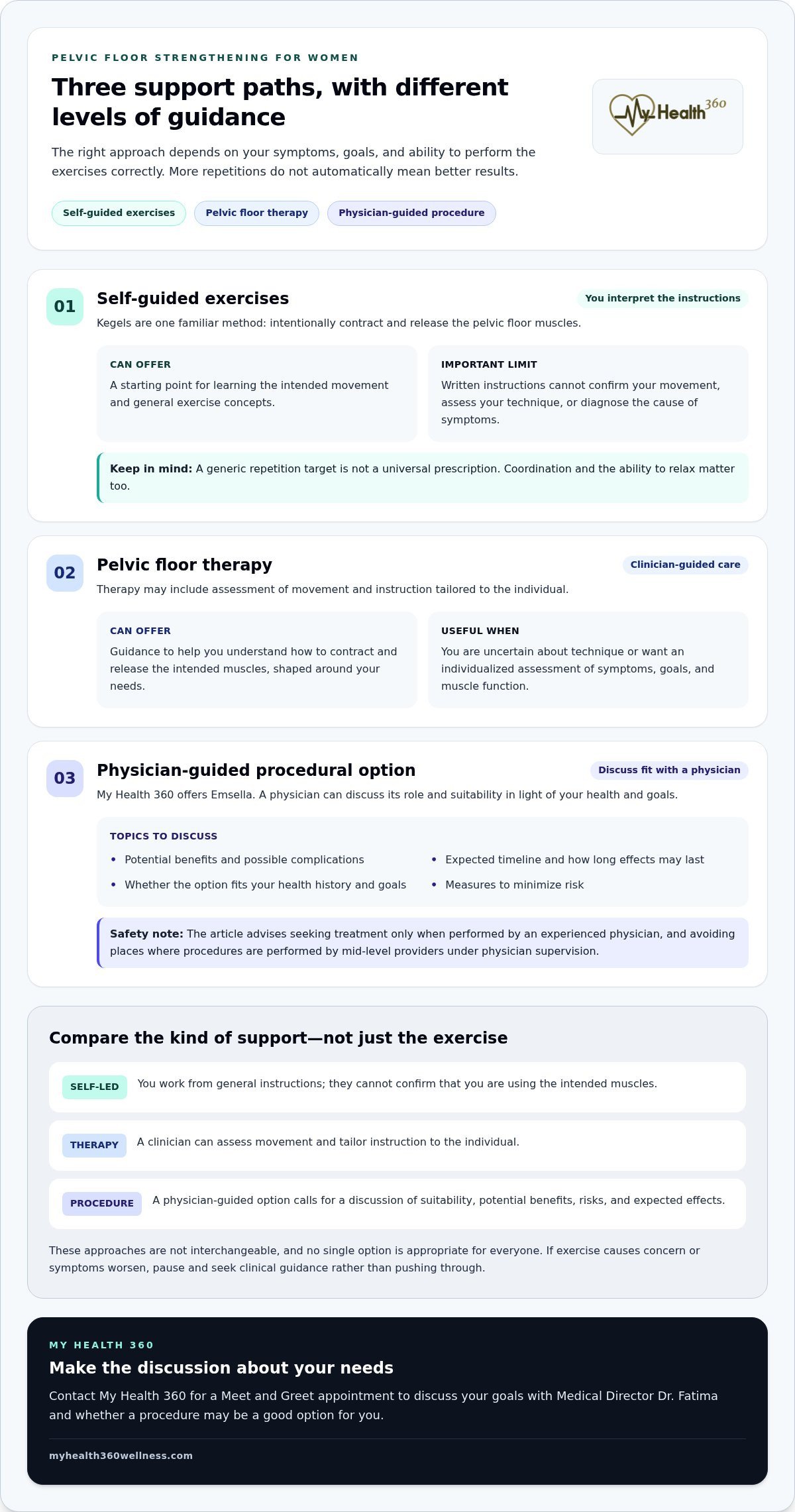
Self-directed exercise relies on your own interpretation of instructions. Pelvic floor therapy, by contrast, is clinician-guided care that may include assessing movement and tailoring instruction to the individual. Technology-based options are another category. Discuss the option’s purpose and suitability in the context of your health and goals. These approaches aren’t interchangeable, and no single option is appropriate for everyone.
My Health 360 offers Emsella. Discuss its role and suitability with a physician, along with potential benefits, expected timeline, how long any effects may last, possible complications, and measures to minimize risk. Don’t assume a particular result or timeline applies to you. Only seek treatment if performed by an experienced physician. Avoid places where procedures are performed by mid-level providers under physician supervision.
If you’re considering a procedure or want to understand your options, contact My Health 360 for a Meet and Greet appointment to discuss your goals with Medical Director Dr. Fatima and whether a procedure may be a good option for you.
How Do Pelvic Floor Strengthening Options Compare?
Each approach offers a different kind of support. Self-guided exercises can introduce general concepts. Pelvic floor therapy adds clinician-guided evaluation and instruction. A physician-guided procedural option involves discussing whether a procedure fits your health history and goals. No single pelvic floor strengthening option is right for every woman. Compare options by their purpose, the guidance involved, and how they relate to your needs, rather than ranking them by a universal measure of effectiveness.
| Approach | Purpose and guidance | Personalization and questions |
|---|---|---|
| Self-guided exercises | Provide an educational starting point using written or other general instructions. | Ask whether you understand the technique and whether the approach suits your goals. Instructions alone can’t assess your muscles or diagnose a condition. |
| Pelvic floor therapy | Offers clinician-guided evaluation and exercise instruction. | Discuss your history, concerns, and how guidance may be tailored to you. Ask how progress will be reviewed. |
| Physician-guided procedural options | Involve a clinician’s discussion of a procedure as a possible option. | Review suitability, potential benefits and limitations, expected timeline, how long effects may last, possible complications, and ways to minimize risk. |
When might self-guided exercise or pelvic floor therapy be considered?
Self-guided learning may help you become familiar with exercise concepts, but it isn’t a substitute for individualized assessment if you’re uncertain about technique or have concerns. Pelvic floor therapy may provide direct evaluation and instruction that general materials can’t offer. Neither approach guarantees a particular result. The goal is to choose guidance that makes sense for your circumstances and discuss adjustments with a clinician as needed.
What should readers know when considering Emsella?
Emsella is available through My Health 360 as an option to discuss with a physician. Before making a decision, talk with Dr. Fatima about whether it may be appropriate for you. Ask about potential benefits, limitations, timeline, duration of effects, complications, and measures to minimize risk. For additional background on topics sometimes considered in pelvic floor care, see Harvard Health’s overview of the benefits of pelvic floor exercises.
Only seek treatment if performed by an experienced physician. Avoid places where procedures are performed by mid-level providers under physician supervision. Contact My Health 360 for a Meet and Greet appointment to discuss your goals with Medical Director Dr. Fatima and whether a procedure is a good option for you.
What Progress, Benefits, and Risks Should Women Discuss?
Progress is best understood in relation to your starting point and the approach being considered. Rather than expecting a specific outcome, identify what you hope to understand or improve and ask how that change will be assessed. For example, you might discuss whether your goal relates to confidence with exercise, daily activities, or a symptom you’ve noticed. These are conversation prompts, not guaranteed benefits of any exercise or procedure.
Pelvic floor strengthening for women can involve distinct approaches, so questions about progress, persistence, and possible risks should be specific to the plan being considered. An exercise program and a procedure don’t necessarily follow the same course. Information about one shouldn’t automatically be applied to another.
What timeline and lasting effects should readers expect?
For exercises, ask how you and your clinician will recognize progress, when to review your technique, and what to do if your concerns don’t change or become more noticeable. For a procedure, ask when any potential benefit might be assessed, how long effects may last, and whether ongoing care or follow-up may be relevant. Without treatment-specific evidence and an individual assessment, a fixed timeline or duration shouldn’t be promised.
Agree on how progress will be reviewed. It may help to describe changes in your own words and note whether they affect activities that matter to you. Your clinician can explain what those observations may mean for the plan.
What complications and precautions should be discussed?
Possible complications depend on the particular intervention. Ask the treating physician to explain relevant risks, suitability, aftercare, and which warning signs should prompt follow-up. Don’t assume a procedure is risk-free or appropriate for everyone. Share relevant medical history and current concerns, follow the clinician’s instructions, and raise unexpected changes or questions rather than disregarding them.
This safeguard doesn’t replace a discussion of the specific treatment and your individual health history.
For a physician-led conversation about your goals and whether a procedure may be a good option for you, contact My Health 360 to arrange a Meet and Greet with Medical Director Dr. Fatima. Discuss expected benefits, timing, duration, potential complications, and how follow-up would be approached before deciding on a next step.
How Can Women Choose a Pelvic Floor Strengthening Next Step?
A useful next step begins with what you’ve noticed and what you hope to address, not with a diagnosis you’ve made on your own. Pelvic floor strengthening for women can include different forms of guidance and care. A clear conversation can help narrow the options without assuming one approach suits everyone.
This article is educational and can’t diagnose a pelvic floor condition. Use this sequence to prepare for a discussion with a clinician:
- Describe your concerns. Explain what you’ve noticed, when it occurs, and whether it affects exercise or daily activities.
- Clarify your goals. Share what you hope to understand or change, even if you’re unsure what may be causing the concern.
- Review relevant history. Mention health conditions, medications, pregnancy or postpartum experiences, surgery, and prior care that may matter to the discussion.
- Compare options. Ask how self-guided exercise, clinician-guided therapy, or a procedure differs in purpose and personalization.
- Agree on follow-up. Clarify how suitability and progress will be reviewed, and when to reconnect if concerns persist or change.
What questions can help prepare for a clinical discussion?
Bring questions that help you understand both the plan and how it will be evaluated. You might ask: What potential benefits relate to my goals? What timeline should I expect, and how long might effects last? What complications or limitations should I understand? What can help minimize risk, and how will you assess whether this option is suitable for me? Also clarify what progress to track and when it will be reviewed.
When is a physician-led Meet and Greet a useful next step?
A physician-led conversation can help you discuss your goals, relevant history, and whether a procedure may be an appropriate option. It doesn’t guarantee candidacy or results. It gives you space to consider your circumstances and ask informed questions before deciding what to do next.
Contact My Health 360 to arrange a Meet and Greet appointment with Medical Director Dr. Fatima. Discuss your goals and whether a procedure is a good option for you.
Take a Thoughtful Next Step for Your Pelvic Health
Pelvic floor strengthening for women isn’t a one-size-fits-all routine. Exercise technique, personal goals, and health history can all inform which approach may be suitable. Self-guided learning can introduce the basics, while clinical guidance can help address questions about technique, progress, and whether a procedure is worth discussing.
My Health 360 is physician-owned and operated by Dr. Umbrine Fatima, an American Board Certified Internal Medicine specialist. Women’s health and Emsella are among the offerings available to discuss in the context of your individual goals. A physician-led conversation can help you review potential benefits, limitations, timing, and risks without assuming a particular option is right for you.
Contact My Health 360 to schedule a Meet and Greet with Medical Director Dr. Fatima and discuss whether a procedure may be a good option for you. You don’t need to arrive with all the answers. A considered conversation is a constructive place to begin.
Frequently Asked Questions
Can pelvic floor exercises help women strengthen their pelvic floor?
Pelvic floor exercises may help train the muscles, but the right approach depends on the person and the goal. Effective practice involves learning to contract and release the intended muscles, not simply increasing repetitions. If you’re unsure about your technique, or exercise causes concern, seek qualified clinical guidance. A written explanation can introduce the basics, but it can’t assess your movement or determine what’s causing symptoms.
How long does pelvic floor strengthening take to work?
There isn’t one timeline that applies to everyone. Progress with exercises can depend on the plan, technique, consistency, and individual circumstances. Procedures have their own treatment-specific timelines and shouldn’t be assumed to work like exercise. Ask a clinician what changes to track, when progress should be reviewed, and how long any potential effects may last for the option you’re considering. Avoid relying on a fixed promise without individualized guidance.
What happens if pelvic floor exercises do not seem to help?
If exercises don’t seem to help, don’t assume you’re doing them incorrectly or that you need to do more. Technique, the ability to relax the muscles, and the reason for your concern may all warrant discussion. Pause if an exercise causes concern or symptoms worsen, and seek clinical assessment. Describe what you’ve tried and what you’ve noticed; a clinician can help consider whether another form of guidance or a different next step is appropriate.
Is pelvic floor therapy different from doing exercises at home?
Yes. Home exercises are self-directed, so you interpret the instructions and monitor your practice yourself. Pelvic floor therapy provides clinician-guided evaluation and instruction, which may help address questions about technique and how exercises relate to your individual goals. Neither approach guarantees a particular result. If you’re uncertain about the movement, have symptoms, or want a more tailored plan, discuss your situation with a qualified clinician.
Can Emsella be an option for pelvic floor strengthening?
Emsella is an option offered at My Health 360, but whether it’s appropriate depends on individual assessment. Don’t assume a particular mechanism, outcome, treatment timeline, or lasting effect applies to you without discussing it with a physician. Contact My Health 360 for a Meet and Greet appointment with Medical Director Dr. Fatima to review your goals and discuss whether a procedure may be a good option for you.
What complications should women ask about before a pelvic floor procedure?
Ask the treating physician to explain complications associated with the specific procedure being considered, along with its limitations and suitability for your health history. Discuss what to expect during recovery, what aftercare involves, and which warning signs should prompt follow-up. Risks vary by intervention, so general information about another treatment may not apply. Understanding potential benefits and risks can help you make a considered decision.
How can I reduce the risk of complications from a pelvic floor procedure?
Share relevant health history, follow the treating physician’s instructions, and report concerns or unexpected changes. Ask how suitability is assessed, what aftercare is recommended, and which warning signs require follow-up. These precautions support an informed discussion, but no procedure should be assumed risk-free or right for everyone.