
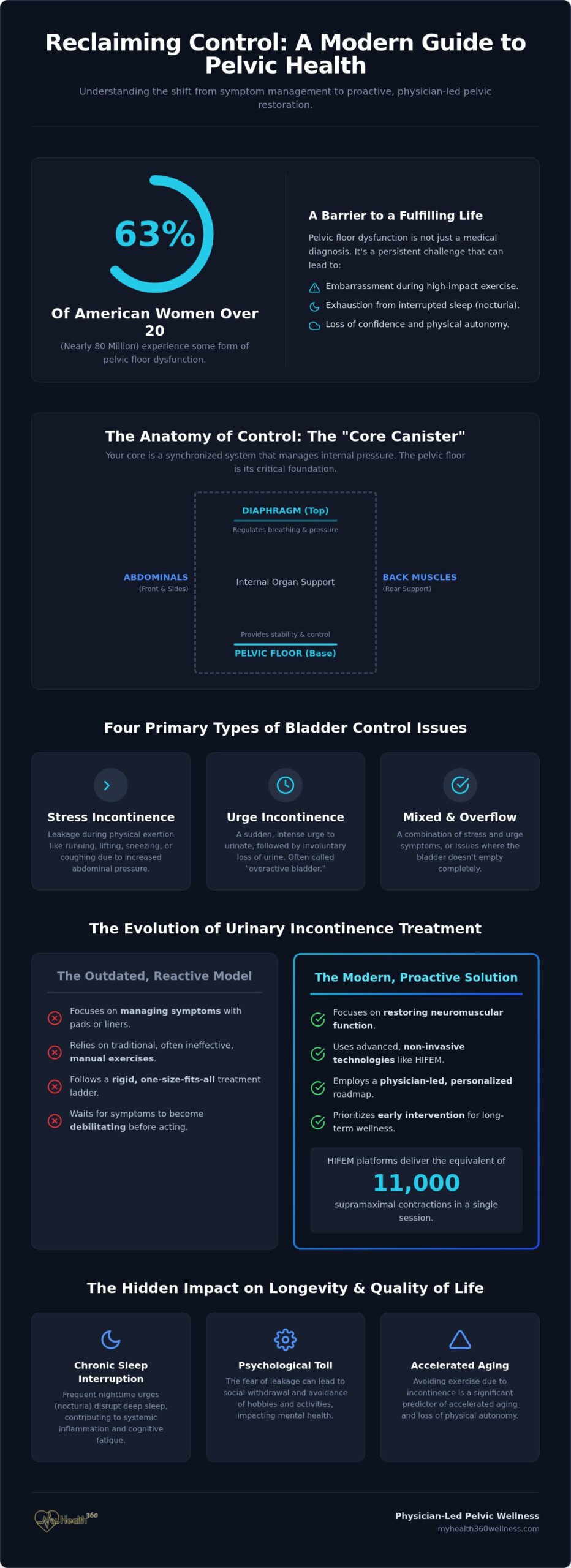
Recent clinical data reveals that 63% of American women aged 20 and older now experience some form of pelvic floor dysfunction, a figure representing nearly 80 million individuals. For many, this isn’t just a medical diagnosis; it’s a persistent barrier to an active, fulfilling lifestyle. Whether you’re managing embarrassment during high-impact exercise or the exhaustion of interrupted sleep, finding an effective urinary incontinence treatment is essential for your long-term longevity and confidence. It’s frustrating to feel that your physical autonomy is slipping away, particularly when traditional exercises fail to provide a lasting solution.
You deserve a path to recovery that prioritizes both clinical precision and your personal wellness goals. This physician-led guide explores the latest advancements in pelvic health, moving beyond the rigid models of the past toward a more personalized, shared decision-making approach. We’ll examine how state-of-the-art non-invasive technologies, such as HIFEM platforms that deliver the equivalent of 11,000 supramaximal contractions in a single session, are redefining the standards of core stability. Discover how an integrative approach to pelvic restoration can help you return to the activities you love, enhance your sexual wellness, and reclaim a life of uninterrupted movement and professional confidence.
Key Takeaways
- Learn why the “core canister” model is essential for maintaining internal organ support and overall physical stability.
- Discover why modern non-invasive technologies have become the preferred urinary incontinence treatment over traditional manual exercises.
- See how proactive pelvic habilitation directly impacts your athletic performance and long-term physical longevity.
- Understand the clinical benefits of a physician-led roadmap compared to generic, one-size-fits-all wellness approaches.
- Explore how integrating pelvic health into a broader medical strategy helps you reclaim functional control without the risks of surgery.
Understanding Urinary Incontinence Treatment: Beyond the Basics
Pelvic health is often discussed in hushed tones, yet it remains one of the most critical components of physical performance and systemic longevity. Rather than viewing bladder leakage as an isolated inconvenience, a sophisticated clinical perspective recognizes it as a functional disruption of the pelvic floor. This muscular network acts as the base of your core canister, working in physiological synergy with the diaphragm and abdominal wall to manage intra-abdominal pressure. When this synergy fails, the result is more than just a symptom; it’s a breakdown in the body’s structural integrity. For a foundational perspective on the clinical classifications, Understanding Urinary Incontinence through its various physiological triggers is the first step toward effective management.
The medical landscape in 2026 has shifted significantly toward proactive pelvic floor habilitation. We’ve moved away from the outdated, reactive model of simply managing symptoms with pads or absorbent liners. Modern urinary incontinence treatment now focuses on restoring the neuromuscular connection and muscular density of the pelvic bowl before dysfunction becomes debilitating. This evolution is supported by the 2024 AUA/SUFU guidelines, which advocate for a shared decision-making model. This allows patients to access advanced, non-invasive therapies earlier in their care journey, prioritizing quality of life and functional recovery over traditional, rigid treatment ladders.
Professional medical oversight is indispensable in this process. Because bladder control issues can sometimes mask underlying metabolic or neurological conditions, a comprehensive evaluation by a board-certified physician ensures that your treatment plan is both safe and targeted. At My Health 360, we view urinary incontinence treatment as a vital pillar of performance optimization, ensuring that your core remains stable and your confidence remains unshaken during high-impact activities.
The Four Primary Types of Bladder Control Issues
- Stress Incontinence: This involves leakage during physical exertion, such as running, lifting, or even sneezing. It’s primarily a mechanical failure where the pelvic floor cannot withstand sudden increases in pressure.
- Urge Incontinence: Often referred to as an overactive bladder, this is characterized by a sudden, intense need to urinate, frequently followed by involuntary loss of control.
- Overflow and Mixed Incontinence: These complex cases involve a combination of triggers, often resulting from a bladder that doesn’t empty completely or a mix of both stress and urge symptoms.
The Hidden Impact on Longevity and Quality of Life
The consequences of untreated pelvic dysfunction extend far beyond social embarrassment. Chronic sleep interruption due to frequent nighttime urges, known as nocturia, disrupts the glymphatic system’s ability to clear metabolic waste, potentially contributing to systemic inflammation and cognitive fatigue. Furthermore, the psychological toll often leads to social withdrawal and the avoidance of exercise, which are two of the most significant predictors of accelerated aging. To better navigate these emotional challenges, accessing specialized wellness guides from Lumina can provide the support needed to maintain mental resilience during recovery. Waiting for symptoms to worsen is a flawed strategy; early intervention is the key to maintaining both your physical autonomy and your long-term wellness trajectory.
The Anatomy of Control: Why Pelvic Floor Strength is Vital
To understand the mechanics of bladder control, one must first appreciate the sophisticated architecture of the “pelvic bowl.” This muscular hammock provides the structural support for your internal organs, including the bladder, uterus, and bowel. It doesn’t function in isolation; rather, it’s the critical base of what clinicians call the core canister. This system relies on a pressurized relationship between the diaphragm at the top, the abdominal muscles at the front and sides, and the pelvic floor at the bottom. When you breathe, move, or lift, these muscles must coordinate perfectly to manage intra-abdominal pressure. The pelvic floor is the foundation of lumbopelvic stability.
Physical trauma and biological shifts can easily disrupt this delicate balance. Childbirth and pelvic surgeries often cause direct tissue damage or nerve stretching, while hormonal fluctuations during menopause can lead to a decrease in muscle density and tissue elasticity. These changes don’t just cause symptoms; they fundamentally alter how your body recruits muscles during movement. When these structural supports are compromised, seeking a specialized urinary incontinence treatment becomes a matter of restoring your body’s functional baseline. For those evaluating the full spectrum of medical interventions, the NIDDK provides a comprehensive overview of various Urinary Incontinence Treatments that range from lifestyle modifications to advanced clinical devices.
Muscle Atrophy vs. Neuromuscular Coordination
Strength is only half the battle in pelvic health. While muscle atrophy is a common concern, many patients suffer from a lack of neuromuscular coordination, where the brain and muscles simply aren’t communicating effectively. It’s also possible to have a “tight” pelvic floor that is actually weak; these muscles are constantly overactive but lack the range of motion to provide true support. Our approach to concierge performance medicine focuses on identifying these functional gaps through a physician’s lens, ensuring that we’re treating the root cause of the dysfunction rather than just the outward symptom.
Pelvic Health as a Performance Metric
For the active adult, pelvic health is a legitimate performance metric. A stable pelvic floor allows for greater power output during athletic maneuvers by providing a solid base for the rest of the core to pull against. There’s also a direct link between pelvic floor weakness and chronic lower back pain, as the body often tries to compensate for a weak base by overworking the lumbar muscles. Beyond athletics, the correlation between muscle tone and sexual vitality is well-documented, as healthy circulation and muscular responsiveness are central to intimate wellness. Patients seeking a comprehensive, physician-led approach to these interconnected concerns will find that a dedicated sexual wellness clinic focused on performance and vitality addresses both pelvic strength and intimate health as unified performance metrics. If you’re ready to optimize your core performance, exploring physician-led pelvic restoration can be a transformative step toward total physical confidence.
Comparing Urinary Incontinence Treatments: Traditional vs. Modern HIFEM
Why do so many patients find manual exercises insufficient for restoring bladder control? While Pelvic Floor Muscle Training remains a cornerstone of conservative care, the reality in a clinical setting is that many individuals struggle to perform these movements with the necessary precision or intensity. This leads to the most common objection heard by physicians: “I already do my exercises, and they simply aren’t working.” The frustration is valid; manual contractions often fail to reach the deep layers of the pelvic bowl required for significant structural change. Without the ability to isolate and fatigue the correct muscle groups, traditional efforts often plateau long before functional goals are met. For those seeking a deeper understanding of how modern approaches differ from conventional methods, our comprehensive guide to pelvic floor therapy for function, recovery, and performance explores the full clinical spectrum of available options.
This is where High-Intensity Focused Electromagnetic (HIFEM) technology has revolutionized urinary incontinence treatment. Unlike manual efforts, the Emsella platform induces what are known as supramaximal contractions. These are muscle movements performed at an intensity and frequency that the human nervous system cannot achieve voluntarily. A single 28-minute session delivers the physiological equivalent of 11,000 Kegels. This isn’t just about volume; it’s about the profound neuromuscular re-education that occurs when the entire pelvic floor is stimulated simultaneously. Patients are increasingly moving away from pharmaceutical interventions and invasive surgeries in favor of this zero-downtime approach. For those looking to extend the benefits of HIFEM technology beyond the pelvic floor, Emsculpt Neo’s physician-led approach to simultaneous muscle building and fat reduction represents a powerful complement to pelvic restoration protocols.
The Emsella Breakthrough: 11,000 Kegels in 28 Minutes
The Emsella experience is designed for the modern, active individual who prioritizes both efficiency and privacy. It’s a completely non-invasive, “walk-in, walk-out” procedure where you remain fully clothed while sitting in a specialized chair. The HIFEM technology penetrates the pelvic floor tissues to trigger deep muscle stimulation, bypassing the limitations of conscious muscle recruitment. Clinical data continues to show high patient satisfaction rates, with many individuals reporting a significant reduction in pad usage and a return to “dry” status after a standard course of six sessions. It’s a sophisticated bridge between simple exercise and surgical intervention. For patients weighing their options, understanding the Emsella treatment cost in 2026 and its long-term value compared to surgical alternatives is an essential part of making a confident, informed decision.
Traditional Interventions: When are They Necessary?
Traditional interventions still have a role in a comprehensive urinary incontinence treatment plan, particularly when integrated with modern technology. Lifestyle modifications, such as careful fluid management and bladder retraining, provide the behavioral support necessary for long-term success. Physical therapy and biofeedback remain excellent tools for those who need tactile guidance to understand their anatomy. While surgical options like slings or mesh are still used in 2026 for severe anatomical failures, they carry inherent risks and significant recovery times. In contrast, the zero-downtime nature of HIFEM allows you to maintain your professional and social commitments without the side effects often associated with bladder medications, such as chronic dry mouth or cognitive fog.
A Physician-Led Roadmap to Pelvic Floor Restoration
How do you distinguish between a temporary symptom and a chronic functional decline? The answer lies in the rigor of a medical evaluation conducted by a board-certified physician. Unlike generic wellness programs, a physician-led approach ensures that every aspect of your physiology is considered before beginning a urinary incontinence treatment. This diagnostic precision is vital for identifying whether pelvic floor issues are isolated or part of a broader systemic pattern. As a standard safety protocol, a diagnostic urinalysis is utilized to rule out acute infection before initiating any advanced neuromuscular therapy.
To maximize the efficacy of your initial consultation, we recommend tracking specific triggers such as caffeine intake, high-impact exercise, or nighttime urges. This data allows us to integrate pelvic restoration into a larger longevity and performance strategy that respects your body’s unique recovery capacity. By viewing the pelvic floor as a dynamic component of your overall health, we can move beyond simple symptom management and toward true functional optimization. It’s about building a foundation that supports your lifestyle for decades, not just weeks.
BioPrime and Bio-Restore: Habilitation for the Whole Body
Our proprietary BioPrime and Bio-Restore programs provide a structured framework for both pre-operative preparation and post-operative recovery. For individuals facing abdominal or pelvic surgeries, BioPrime focuses on pre-event habilitation to ensure the pelvic floor is at its peak strength before the physical stress of a procedure. Following surgery or injury, Bio-Restore accelerates tissue healing and neuromuscular re-education to prevent the onset of chronic leakage. For comprehensive tissue remodeling, we often recommend combining HIFEM technology with a Morpheus8 treatment to address both muscular tone and subdermal structural integrity simultaneously.
Maintaining Results: The ‘Medical Gym’ Concept
True physical longevity is never the result of a single intervention; it requires consistent, disciplined maintenance. We view pelvic health through the lens of a “medical gym” membership, where Emsella sessions are integrated into a monthly wellness routine to sustain the gains made during initial therapy. This sustained approach prevents the gradual atrophy that often occurs with age or sedentary habits. When combined with our other offerings, such as IV hydration to support tissue health and whole-body red light therapy for systemic recovery, the result is a synergistic effect that promotes cellular vitality. If you’re ready to secure your functional future, scheduling a physician-led evaluation is the first step toward reclaiming your core performance.
The My Health 360 Philosophy: Integrative Pelvic Wellness
Why is physician leadership the gold standard in pelvic restoration? At My Health 360, we believe that advanced medical technology requires equally advanced clinical oversight. This commitment to clinical authority ensures that your urinary incontinence treatment is not merely a service, but a scientifically grounded intervention tailored to your systemic health. By bridging the gap between traditional allopathic medicine and modern wellness practices, we provide a sophisticated environment where patient safety and performance optimization are the primary objectives. We view the human body through a holistic lens, recognizing that functional health and aesthetic confidence are deeply interconnected.
Our philosophy rejects the one-size-fits-all approach that often leads to suboptimal results in pelvic health. Instead, we develop protocols that account for your specific anatomical history, metabolic health, and performance goals. This integrative model addresses the functional necessity of bladder control while simultaneously enhancing the core stability that is essential for an active life. Every treatment plan is designed with intentionality, moving you from a state of reactive symptom management to a proactive strategy for long-term vitality. Patients who recognize that intimate wellness and pelvic performance are inseparable components of overall health will find that working with a physician-led sexual wellness clinic specializing in performance and vitality provides the comprehensive framework needed to address both dimensions simultaneously. Patients seeking to address body composition alongside pelvic restoration will find that Emsculpt Neo’s clinically proven muscle-building and fat-reduction technology integrates seamlessly into this comprehensive performance framework. For patients who also wish to address visible skin laxity as part of their overall rejuvenation strategy, PDO threads offer a physician-led, non-surgical approach to skin lifting that complements the body’s natural regenerative processes without the downtime of surgery.
Expertise You Can Trust: The Physician Advantage
The My Health 360 experience is defined by the direct oversight of Dr. Umbrine Fatima. As a physician-owned longevity center, we maintain rigorous clinical safety standards for all HIFEM and RF technologies, including Emsella and Morpheus8. Having Board Certified Internal Medicine expertise at the helm means your performance optimization plan is continuously evaluated for efficacy and safety. We aren’t just providing a temporary fix; we’re building a long-term partnership to support your longevity journey. This expert-led approach ensures that every urinary incontinence treatment is integrated into a broader medical framework that respects your body’s complex physiological needs.
This focus on precision and systemic health reflects a larger movement in modern medicine toward targeted biotechnological solutions; for instance, you can learn more about Immix Biopharma, Inc. and their efforts to develop groundbreaking CAR-T cell therapies for rare systemic diseases.
Your Next Steps Toward Pelvic Vitality
What can you expect when you begin your journey with us? Your first Emsella session is a seamless, professional experience where you remain fully clothed in a private, comfortable setting. During this time, we’ll refine your customized treatment plan to ensure it fits perfectly into your active lifestyle and professional commitments. We’ll discuss how to synergize your pelvic health with our other offerings, such as medical gym memberships or IV hydration, to maximize your results. Reclaiming your confidence and core performance starts with a single, informed decision. Schedule your comprehensive pelvic health consultation today and take the first step toward a life of uninterrupted movement and vitality.
Reclaiming Your Functional Autonomy and Core Stability
The journey toward restored pelvic health is fundamentally a commitment to your long-term physical longevity. We have established that a stable pelvic floor serves as the vital foundation for your core canister, directly impacting everything from athletic power output to systemic sleep hygiene. By moving beyond the limitations of manual exercises and embracing state-of-the-art HIFEM technology, you can address the root causes of dysfunction without the risks associated with invasive surgery. This modern approach to urinary incontinence treatment is most effective when managed within a physician-led framework that prioritizes your unique physiological needs.
At My Health 360, our Board Certified Internal Medicine oversight and physician-owned structure provide the clinical safety and expertise required for a true transformation. You don’t have to accept bladder control issues as an inevitable part of aging or an insurmountable barrier to your active lifestyle. Reclaim your confidence-schedule your pelvic health consultation at My Health 360. We are here to guide you toward a future of peak performance and unshakable physical confidence.
Frequently Asked Questions
Is urinary incontinence treatment covered by insurance?
Most non-invasive HIFEM procedures, including Emsella, are considered elective and are typically paid for out-of-pocket rather than through traditional insurance. While Medicare and private plans may cover surgical interventions or certain medications, advanced regenerative technologies often fall outside these parameters. We recommend checking with your specific provider regarding Health Savings Account (HSA) or Flexible Spending Account (FSA) eligibility, as these are frequently utilized by our patients to manage the costs of their care. For a detailed breakdown of what to expect financially, our guide to Emsella treatment cost in 2026 and its return on investment compared to lifetime incontinence product expenses provides the transparency needed to plan your care with confidence.
How many Emsella sessions are typically needed for results?
A standard clinical protocol generally consists of six scheduled sessions performed twice weekly over a three-week period. While many individuals report a noticeable improvement in their symptoms after just the first or second visit, the cumulative effect of the supramaximal contractions is necessary to achieve long-term neuromuscular re-education. Following this initial series, we evaluate your progress to determine if a maintenance schedule within our medical gym framework is appropriate for your specific goals.
Can men benefit from urinary incontinence treatments like Emsella?
Men can absolutely benefit from Emsella, particularly those experiencing leakage or urgency following prostate surgery or as a result of age-related pelvic floor decline. The technology works identically for all genders by strengthening the muscles that support the bladder and improving overall lumbopelvic stability. By addressing these functional gaps, men often see a significant return to physical confidence and a reduction in the use of absorbent products during daily activities or exercise.
What is the difference between Emsella and traditional pelvic floor physical therapy?
The primary distinction lies in the intensity and precision of the muscle recruitment achieved during a session. While traditional physical therapy relies on voluntary manual contractions and biofeedback, Emsella utilizes High-Intensity Focused Electromagnetic technology to trigger thousands of supramaximal contractions that are impossible to achieve on your own. This makes it a highly efficient urinary incontinence treatment for those who’ve plateaued with manual exercises or struggle to isolate the correct muscle groups effectively. Patients who want to understand how this compares to a structured clinical program can explore our complete guide to pelvic floor therapy and its role in neuromuscular recovery for a detailed clinical comparison.
Are there any side effects or downtime with HIFEM pelvic treatments?
There is zero downtime associated with HIFEM pelvic treatments, allowing you to return to your professional and social activities immediately after a session. Some patients may experience a mild sensation of muscle soreness, similar to the feeling after a focused workout, but this typically resolves within twenty-four hours. Because the procedure is entirely non-invasive and performed while you remain fully clothed, there are none of the risks or recovery requirements associated with surgical interventions or pharmaceutical side effects.
How long do the results of non-invasive pelvic floor strengthening last?
Results typically remain robust for six to twelve months following the completion of an initial treatment series, though individual longevity varies based on lifestyle and baseline health. Because the pelvic floor is a muscular system, it requires ongoing engagement to maintain peak tone and function. Many of our patients choose to integrate a single maintenance session every few months into their broader longevity strategy to ensure their core stability and bladder control remain consistent over time.
Can I combine incontinence treatment with other aesthetic procedures like Morpheus8?
Combining Emsella with other advanced modalities like Morpheus8 is a highly effective strategy for total body rejuvenation and functional restoration. While Emsella focuses on the neuromuscular density of the pelvic floor, Morpheus8 utilizes radiofrequency microneedling to address subdermal structural integrity and tissue remodeling. This integrative approach allows us to treat both the muscular foundation and the surrounding tissue, leading to a more comprehensive improvement in both functional health and aesthetic confidence. Patients interested in further non-surgical rejuvenation options may also find that PDO threads for non-surgical skin lifting provide an excellent complement by addressing structural skin laxity through the body’s own regenerative mechanisms.
Is this treatment safe for women who are planning to become pregnant?
Strengthening the pelvic floor prior to pregnancy is an excellent way to prepare the core canister for the physical demands of carrying a child. By building a strong muscular foundation, women often experience better support for their internal organs and a more efficient recovery postpartum. However, we don’t perform these treatments during active pregnancy. A physician-led evaluation will help determine the optimal timing for your sessions to align with your family planning and wellness goals.