

Could the most visible treatment be the wrong first step for your postpartum symptoms? If you’re unsure whether leakage, pelvic pressure, discomfort, or changes in bowel habits deserve attention, it’s understandable to have questions. Postpartum pelvic health solutions vary because recovery, symptoms, and goals do, too.
A useful next step is to describe what you’re experiencing rather than assume one approach suits everyone. This guide explains broad categories of pelvic health support, including pelvic floor physical therapy and Emsella, an option offered at My Health 360. You’ll also find questions to raise with a physician about suitability, safety, and realistic expectations.
At My Health 360, a physician-led conversation can help you consider your goals and whether a procedure may be appropriate. Contact My Health 360 to arrange a Meet and Greet and discuss your options with Medical Director Dr. Fatima. Only seek treatment if performed by an experienced physician. Avoid places where procedures are performed by mid-level providers under physician supervision.
Key Takeaways
- Postpartum symptoms and recovery vary; note what you experience and how it affects daily life to guide a clinical discussion.
- Postpartum pelvic health solutions differ in purpose and format, so compare approaches in light of your concerns and goals.
- Pelvic floor physical therapy and Emsella are distinct options to discuss, not interchangeable or universally suitable approaches.
- Prepare for a physician conversation by outlining your symptoms, priorities, relevant health history, and questions about suitability.
- A physician-led discussion can help clarify whether Emsella may be appropriate for your individual goals.
Postpartum Pelvic Health: What Symptoms Can Prompt a Closer Look?
Postpartum recovery is different for everyone. Changes in comfort, bladder control, or pelvic function can raise questions, and those questions deserve thoughtful attention rather than comparison with someone else’s experience. You don’t need to know the cause of a symptom before bringing it up in a clinical conversation.
Postpartum pelvic health is the function and comfort of the pelvic region after childbirth, considered in the context of an individual’s symptoms, health, and goals. For broader background on physical changes during this period, see Understanding the Postpartum Period. General information can help you describe a concern, but it can’t determine what’s happening in your individual case.
Which postpartum concerns may lead someone to seek support?
Bladder-control changes, such as urine leakage during activity or difficulty managing urgency, may be a reason to ask for an assessment. Other concerns can include pressure or heaviness, discomfort in the pelvic area, pain during intimacy, or changes in bowel movements. These experiences are not diagnoses by themselves. The same symptom does not point to the same explanation or next step for everyone.
Describe what you notice in your own words. Think about when the concern occurs, which activities it affects, and what you hope to do more comfortably. For example, you might explain that leakage occurs during a particular movement or that pressure makes daily tasks uncomfortable. You don’t need technical terms; clear, specific observations give a clinician useful context.
Why does an individualized assessment matter?
Similar concerns can arise in different circumstances, and people may have different priorities even when their symptoms sound alike. One person may want to return to exercise, while another hopes to feel more comfortable during daily activities. Health history and the details of each concern matter, too. General guidance can introduce possible approaches, but it can’t establish which option is appropriate for you.
A useful discussion starts with your symptoms and goals, then considers relevant health context before exploring possible next steps. Before the conversation, note what you’ve experienced, how it affects your routine, and what you want to ask. If you’re considering a procedure, contact My Health 360 to arrange a Meet and Greet and discuss with Medical Director Dr. Fatima whether it may be a good option for you. Only seek treatment if performed by an experienced physician. Avoid places where procedures are performed by mid-level providers under physician supervision.
Postpartum pelvic health solutions are not interchangeable, and no single approach is right for everyone. An individualized physician discussion can connect the concern you want to address with options that take your health and priorities into account.
Postpartum Pelvic Health Solutions: How the Main Approaches Differ
Once you’ve identified what you want help with, consider how different types of care are structured. Pelvic floor physical therapy is a distinct clinical care category. Emsella is a device-based option offered at My Health 360 that you can discuss with a physician. These approaches are not interchangeable. Comparing their purpose and format can help you ask more focused questions.
The overview below is for education. It can help frame a conversation, but it can’t assess your health or determine which option is suitable for you.
| Approach | General purpose | Format | Questions to discuss |
|---|---|---|---|
| Pelvic floor physical therapy | Individualized care focused on pelvic floor function and related concerns. | Care is provided by a physical therapist, with the approach informed by the person’s assessment and goals. | What would an assessment involve? How would care relate to the concerns I’ve described? |
| Physician discussion of Emsella | A device-based option that may be considered in a conversation about pelvic health goals. | Discussed with a physician as one possible option; this overview does not specify a treatment protocol. | Could it be appropriate in my individual context? What should I understand about suitability and expectations? |
| Further clinical discussion | Clarifies concerns, priorities, and relevant health context before considering next steps. | A conversation with a physician about the individual situation and possible options. | What information about my health history or symptoms may be relevant? |
How does pelvic floor physical therapy differ from device-based care?
Physical therapy follows a therapist-led process, while device-based care involves technology as part of the approach. The formats differ, as do the questions you may want to explore. Rather than assuming one replaces the other, consider what you hope to address and discuss how your concerns and clinical context inform the options. A general comparison can’t establish your specific care or expected outcomes.
Where may Emsella fit into a postpartum discussion?
Emsella is offered at My Health 360 and can be discussed with a physician; it isn’t a universal recommendation. The fact that an option is available does not establish whether it’s appropriate for a particular person. A physician can discuss your goals, relevant health context, and questions about suitability without promising a specific result. To explore whether it may be a good option for you, contact My Health 360 to arrange a Meet and Greet and speak with Medical Director Dr. Fatima.
Choosing a Postpartum Pelvic Health Approach Without Assuming One Solution Fits All
Comparing care approaches is less about finding a universally “best” option and more about understanding what each involves. Pelvic floor physical therapy is clinician-guided care; Emsella is a device-based option to discuss with a physician. Since the formats differ, consider how each relates to your concern, preferences, and comfort rather than assuming they offer the same experience or results.
A non-invasive label, by itself, doesn’t establish that an option is appropriate for everyone. Suitability depends on an individual clinical assessment, not a label or general description. Use the table to organize questions, not as a recommendation or prediction of outcomes.
| Approach | Potential advantages to consider | Questions or limitations to consider |
|---|---|---|
| Pelvic floor physical therapy | Clinician-guided care can be discussed in relation to the concerns and goals you describe. | Ask what the assessment and care format involve, and how they relate to your priorities. This description alone can’t establish what your care would include. |
| Device-based option such as Emsella | Provides a different format to discuss with a physician as part of a consideration of pelvic health goals. | A device-based format doesn’t determine personal suitability or expected results. Discuss relevant health context and what the option may involve. |
| Physician assessment | Creates space to consider symptoms, goals, and relevant history together before discussing next steps. | A conversation is individual, not a guarantee that a particular procedure is suitable or will achieve a specific outcome. |
What should readers compare between care approaches?
Start with practical distinctions: who guides the approach, what format it takes, and how it connects with the concern you want to address. Consider what feels comfortable, what you want to know about the process, and whether your priorities relate to function, comfort, or both. These are useful discussion points, not a way to diagnose yourself or rank approaches by presumed results.
Why is a physician’s assessment important before considering a procedure?
Choosing a procedure based only on a description or preference skips the individual clinical discussion needed to consider suitability. Share your concerns and goals, and discuss relevant health history with a physician before deciding whether to proceed. A measured conversation can clarify what is known, what remains uncertain, and whether the option aligns with your situation.
Suitability depends on an individual physician assessment because symptoms, health context, and goals differ from person to person. To explore whether a procedure may be a good option for you, contact My Health 360 to arrange a Meet and Greet and discuss it with Medical Director Dr. Fatima. Avoid places where procedures are performed by mid-level providers under physician supervision.
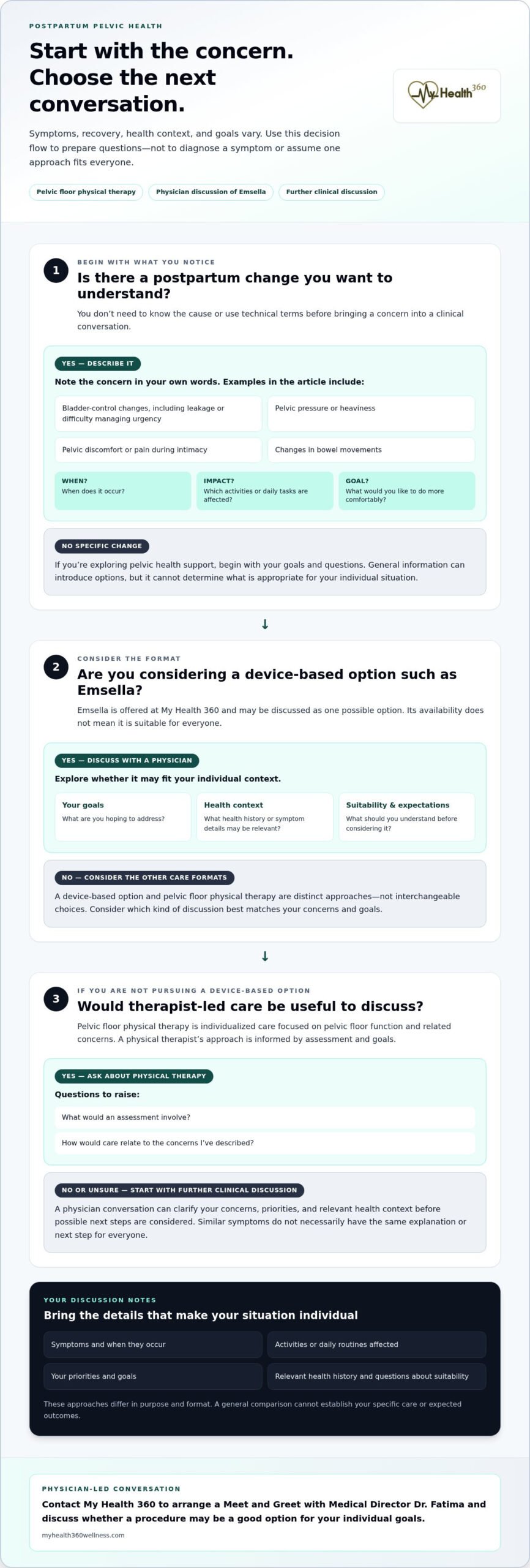
Preparing for a Postpartum Pelvic Health Discussion
A little preparation can make a clinical conversation more focused. You don’t need to arrive with a diagnosis or a preferred treatment. Start with what you’ve noticed, what you’d like help with, and the questions you want answered. The physician can discuss your concerns and whether a procedure or another approach may be appropriate for your situation.
What information can help make the conversation useful?
Use your own words. A short note on your phone or paper can help you explain what concerns you and what you hope to change. Share relevant health context directly with the physician, including information you feel may relate to the concern. The aim is to give the physician context for a thoughtful conversation.
Before the appointment, consider organizing your thoughts in this order:
- Describe your concern. Explain what you’ve noticed and the situations in which it matters to you.
- Clarify your goal. For example, say whether you want to feel more comfortable with a particular activity or better understand your options.
- Discuss relevant health context. Share information you believe may be important, and let the physician guide any follow-up questions.
- Ask about suitability. If you’re considering a procedure, ask how your concerns and circumstances will inform whether it may be appropriate.
This sequence isn’t a test or a checklist you must complete. It’s a simple way to keep your priorities in view, especially if you feel unsure how to begin.
What questions can help clarify suitability and expectations?
Write down a few questions that matter to you. You might ask:
- What is the purpose of this option, and what concerns is it intended to address?
- What limitations should I understand before considering it?
- How will you assess whether it’s suitable for me?
- What risks or alternatives should we discuss?
- What expectations are realistic for my individual circumstances?
These questions encourage a clear explanation without assuming that a procedure is the right answer. A physician can discuss the option in the context of your health, goals, and preferences. You can also ask for more information before making a decision; understanding the discussion is part of choosing a considered next step.
At My Health 360, a Meet and Greet with Medical Director Dr. Fatima gives you an opportunity to discuss your priorities and whether a procedure may be a good option for you. If you’re considering Postpartum pelvic health solutions, contact My Health 360 to arrange a Meet and Greet and discuss suitability directly with Dr. Fatima.
Discussing Postpartum Pelvic Health Solutions with My Health 360
Considering a procedure is a personal decision, not a conclusion to reach from a general description alone. My Health 360 is physician-owned and operated and offers women’s health services and Emsella. Emsella may be one option to consider, but its availability doesn’t make it suitable for everyone or guarantee a particular outcome.
What can readers expect from a physician-led discussion?
A physician-led conversation gives you space to explain what you want help with and what matters most to you. Dr. Umbrine Fatima, Medical Director at My Health 360, is an American Board Certified Internal Medicine specialist. She can discuss your concerns, goals, and questions in the context of your individual circumstances, including whether a procedure may be appropriate. The discussion focuses on suitability, not an automatic recommendation to proceed.
You can also use the conversation to understand what an option can and cannot address. If you’re considering Emsella, for example, ask how the physician will consider it in relation to the goal you bring forward. A clear discussion should help you understand the reasoning behind a next step, or why more consideration may be needed, without treating general information as a personal assessment.
How can readers take the next step with My Health 360?
Before contacting the center, you may want to note the main concern you hope to discuss. You don’t need to settle on a procedure in advance. Use the Meet and Greet to raise your priorities, hear how a physician considers the options, and ask how suitability will be discussed.
Questions can be direct and practical:
- How might this procedure relate to the concern I want to address?
- What limitations, risks, or alternatives should I understand?
- How will my individual health context inform whether it is a suitable option?
- What should I consider before deciding on a next step?
These questions can keep the conversation centered on your circumstances rather than generalized promises. Postpartum pelvic health solutions should be considered with attention to individual goals and physician assessment. Contact My Health 360 to arrange a Meet and Greet and discuss with Medical Director Dr. Fatima whether a procedure may be a good option for you.
Avoid places where procedures are performed by mid-level providers under physician supervision.
Take Your Next Step with Confidence
You don’t need to have every answer before beginning a conversation about your health. A clear account of what matters to you can be a useful starting point, even if you’re still deciding what kind of support feels right. Let your priorities guide the discussion rather than feeling pressured to choose a procedure in advance.
Postpartum pelvic health solutions should be considered in the context of your individual concerns and goals. If you’re ready to explore a possible next step, contact My Health 360 to arrange a Meet and Greet with Dr. Fatima. Discuss whether a procedure may be a good option for you and raise the questions that will help you make an informed decision.
Give yourself room to ask, reflect, and choose thoughtfully. A physician-guided conversation can help you move forward with greater clarity.
Frequently Asked Questions
Can postpartum pelvic floor concerns be different from person to person?
Yes. People can have different symptoms, priorities, and health contexts after childbirth, so the same description won’t necessarily mean the same thing for everyone. For example, note whether a concern arises during a specific activity or affects your comfort in daily routines. Postpartum pelvic health solutions should be discussed in light of your own experience, since general information can’t explain an individual symptom.
Is Emsella automatically appropriate for postpartum pelvic health concerns?
No. An offering isn’t a personal recommendation, and a general description can’t establish whether Emsella is appropriate for you. Consider what you hope to address, then ask the Medical Director how your goals and relevant health context inform suitability. You can also ask what the option is intended to address and what limitations or uncertainties to understand before considering a decision.
Can Emsella replace pelvic floor physical therapy?
These are different care categories, so Emsella shouldn’t be treated as a direct replacement for pelvic floor physical therapy. Discuss what each approach involves and how its format relates to your concerns. If you’re considering both, ask the physician how to think about their distinct purposes in your circumstances. General information can’t determine an individual plan or establish that one option is better.
When after childbirth should someone discuss pelvic health concerns with a physician?
There isn’t a single timetable in this guidance that applies to everyone. If a concern is on your mind, you can raise it in a clinical conversation and explain how it affects you, rather than trying to match your experience to someone else’s recovery. Share relevant context and ask whether further assessment or a discussion of options is appropriate for your situation.
What should I ask before considering a postpartum pelvic health procedure?
Ask what concern the procedure is intended to address, how your suitability will be assessed, what limitations apply, and what risks and alternatives should be discussed. Bring up your goals and relevant health context so the physician can respond to your situation, not just a general description. Avoid places where procedures are performed by mid-level providers under physician supervision.
How can I discuss postpartum pelvic health options with My Health 360?
Contact My Health 360 to arrange a Meet and Greet appointment and discuss your concerns and goals with Medical Director Dr. Umbrine Fatima. You can ask whether a procedure may be a good option for you; Emsella is one offering that may be part of that individualized conversation. The discussion is a place to consider suitability, not a promise that a particular approach will be recommended or produce a specific result.