
Your health insurance is a sophisticated financial safety net for medical catastrophes, yet it was never engineered to help you achieve peak physical performance. You’ve likely felt the friction of the traditional system through rushed fifteen-minute appointments, hidden co-pays, and a reactive “sick-care” philosophy that only addresses problems once they’ve surfaced. When evaluating direct primary care vs insurance, it’s essential to understand that the latter is a tool for managing illness, while the former is a clinical strategy for longevity.
At My Health 360, we believe your medical care should be as precise and proactive as your professional life. With the 2026 implementation of the “One Big Beautiful Bill Act,” which allows HSA funds to cover membership fees up to $150 per month for individuals, the financial barriers to high-level care have finally started to dissolve. You’ll discover how bypassing insurance-driven administrative burdens allows for an integrative concierge model focused on performance optimization and holistic health. This article examines the structural differences between these two paths and how a membership-based approach provides the unlimited access and transparent pricing necessary for a truly personalized longevity plan.
Key Takeaways
- Traditional insurance often operates on a “sick-care” model, where profit is tied to reactive treatment rather than the preservation of your long-term vitality.
- When comparing direct primary care vs insurance, the primary advantage lies in removing third-party interference to allow for direct physician access and deeply personalized clinical attention.
- A strategic hybrid model combines the proactive benefits of a DPC membership with a high-deductible health plan to ensure you’re covered for both daily optimization and rare catastrophic events.
- Recent 2026 legislative changes mean you can now use HSA funds to pay for DPC memberships, providing a tax-advantaged pathway to elite medical care.
- An integrative concierge model goes beyond basic primary care by incorporating advanced performance tools such as Emsculpt Neo and IV hydration into a single cohesive longevity plan.
The Hidden Cost of Insurance-Based Primary Care
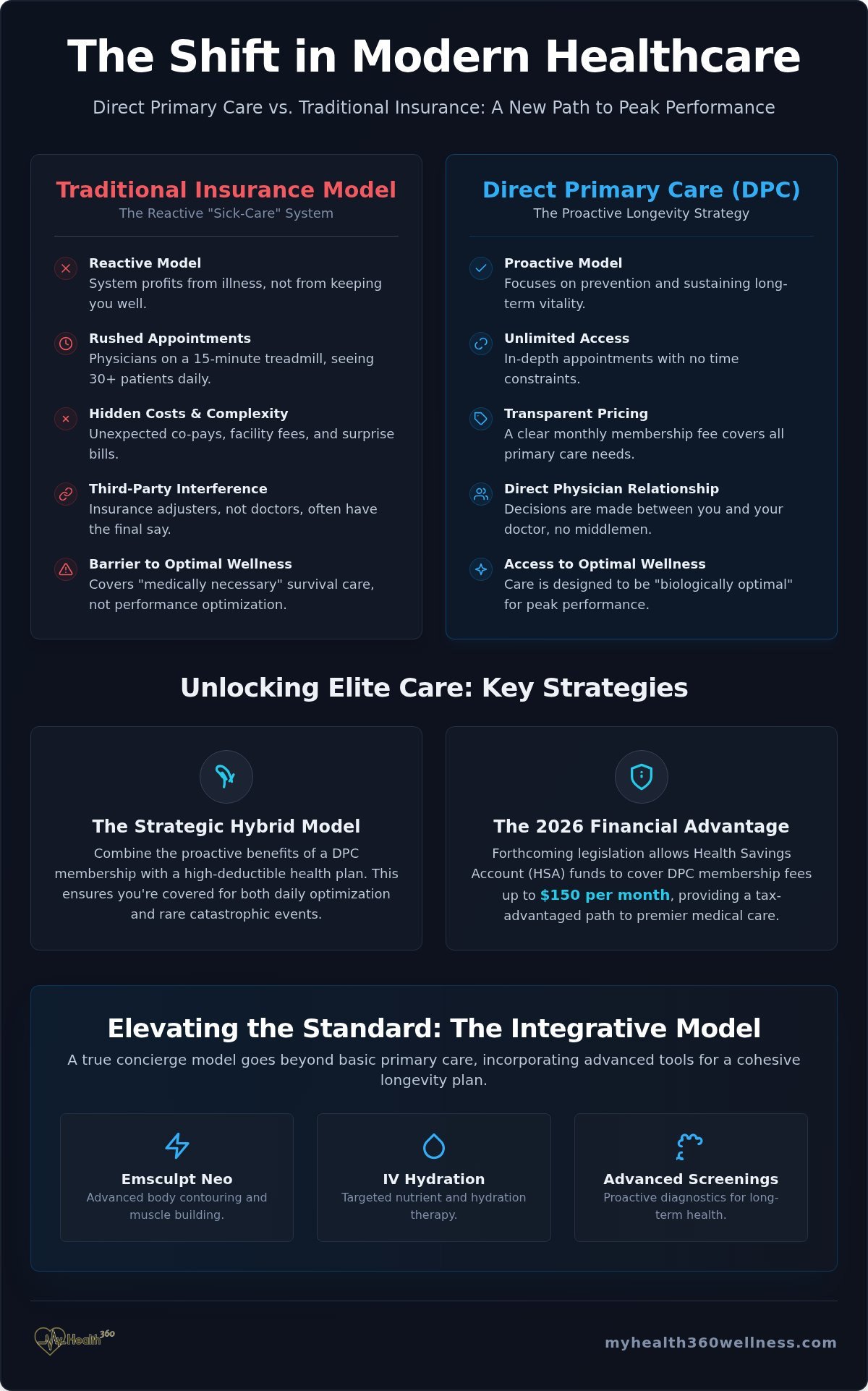
Why does it feel like your physician is always in a hurry? The answer lies in the structural design of the traditional healthcare system. In the conventional model, insurance companies and large health networks prioritize patient throughput over clinical depth. This creates what we call the “sick-care” paradox. In this environment, the system generates revenue only when you are ill, undergoing diagnostic tests, or receiving interventions. It does not financially reward the physician for your continued wellness or the successful prevention of chronic decline. When evaluating direct primary care vs insurance, it’s clear that the latter operates as a volume-based business rather than a value-based clinical practice.
Physicians in insurance-based systems are often trapped on a 15-minute treadmill, forced to see 30 or more patients every day just to cover their administrative overhead. Much of their time is consumed by the friction of third-party interference. They spend hours navigating prior authorizations and selecting specific billing codes to ensure reimbursement, rather than focusing on your unique physiology. This administrative burden leads to hidden financial drains for the patient. Even with “good” coverage, you may encounter unexpected co-pays, facility fees, and surprise lab bills that arrive months after your visit. These costs accumulate, yet they rarely buy you more time or better access to your doctor.
The Erosion of the Patient-Physician Relationship
The presence of a middleman inevitably interrupts the sanctity of clinical decision-making. When an insurance adjuster has the final say on which screenings or treatments are “covered,” the physician’s expertise is sidelined. This dynamic has a measurable psychological impact on patient trust. You may feel like just another number in a crowded waiting room, leading to a sense of alienation from your own healthcare journey. Because these appointments are so rushed, traditional primary care often misses the subtle, early markers of chronic issues. By the time a problem is large enough to be caught in a ten-minute check-up, the window for easy intervention has often closed.
When Insurance Becomes a Barrier to Wellness
If your goal is peak performance rather than just the absence of disease, the traditional model will likely fail you. Insurance companies are designed to cover “medically necessary” care, which is a standard based on the average person’s survival. They rarely cover advanced longevity screenings or performance-optimizing treatments that fall outside their narrow definitions. The Direct Primary Care model removes these barriers by allowing for a direct contract between you and your doctor. There is a profound distinction between care that is “medically necessary” to avoid acute disease and care that is “biologically optimal” to sustain long-term vitality. In a traditional network, you’re often paying for a system that prevents you from accessing the very tools you need to thrive.
What is Direct Primary Care (DPC)? A High-Performance Alternative
What exactly is this model that is disrupting the traditional medical hierarchy? At its core, What is Direct Primary Care? It is a simplified, direct contract between you and your physician that completely eliminates the third-party insurance intermediary. By removing the administrative layers that typically dictate care, physicians can return to a patient-centered philosophy where clinical decisions are based on your specific health goals rather than an insurance company’s bottom line. When evaluating direct primary care vs insurance, the most striking difference is the restoration of the physician’s autonomy to practice medicine with precision and depth.
The membership structure is elegantly straightforward. Instead of navigating complex co-pays and deductibles, you pay a transparent monthly fee that covers all your primary care needs. This model has gained significant traction in 2026, particularly as federal laws now recognize DPC fees as HSA-eligible expenses up to $150 per month. Beyond the membership, DPC practices leverage their independence to secure wholesale pricing for their patients. It is common for members to save 80% or 90% on laboratory work and generic medications because the practice passes the direct costs to you without the steep markups typically found in hospital-owned systems. This transparency transforms healthcare from a source of financial stress into a predictable, high-value investment in your performance.
DPC vs. Concierge Medicine: Clearing the Confusion
While often grouped together, DPC and traditional concierge medicine have distinct differences. Concierge practices often charge a high annual fee and still bill your insurance for every visit, essentially “double-dipping” into your wallet. DPC is generally more accessible and completely bypasses the insurance billing cycle for primary services. At My Health 360, we utilize an “Integrative Concierge” model. This approach combines the accessibility of DPC with the high-end, specialized longevity technologies typically reserved for elite concierge circles, creating a comprehensive foundation for Integrative Concierge Medical Care that prioritizes long-term vitality.
The Clinical Advantages of Direct Access
The most valuable asset in modern medicine is time. In a DPC environment, the 15-minute rushed visit is replaced by extended consultations lasting 30 to 60 minutes. This allows an Internal Medicine specialist to conduct a deep dive into your metabolic health, hormonal balance, and lifestyle factors. You gain same-day or next-day appointment availability, ensuring that acute concerns are addressed before they escalate. Furthermore, direct messaging and telehealth options mean your healthcare team is available at the speed of your life. This level of access ensures that your longevity plan is a living, breathing strategy rather than a forgotten file in a cabinet. For those who value this level of responsiveness in their primary care, you can discover Family Doctor to find accessible services designed around the patient.
Direct Primary Care vs. Insurance: A Value Comparison
How do you quantify the worth of immediate clinical access? When we weigh the merits of direct primary care vs insurance, the most immediate discrepancy is found in the calendar. The national average wait time for a primary care appointment in a traditional insurance-based network often stretches to three weeks. In contrast, the DPC model is built for 24-hour access, ensuring that your health concerns are addressed with the same urgency they would receive in a high-performance professional environment. This shift transforms your physician from a distant stranger into a dedicated performance partner who understands your baseline and your long-term objectives.
The administrative complexity of traditional insurance often results in “Explanation of Benefits” (EOB) statements that are nearly impossible to decipher. These documents frequently reveal hidden facility fees and variable laboratory costs that were never disclosed upfront. DPC replaces this opacity with absolute cost transparency. By paying a simple monthly membership, you eliminate the friction of the billing office. While many traditional practices rely on specialized firms like HPC Healthcare Partners to manage their complex billing cycles, the DPC model simplifies the financial relationship for both patient and physician. The treatment focus also shifts fundamentally; while insurance-based care is often restricted to symptom suppression and “patching” acute issues, DPC facilitates root-cause resolution and proactive health optimization.
Financial Breakdown: The ROI of DPC
Determining the return on investment for a DPC membership requires looking beyond the monthly fee. The “break-even” point is often reached quickly through the significant savings on ancillary services. For example, a comprehensive longevity lab panel that often costs $1,200 when processed through insurance-based billing can frequently be obtained for roughly $150 within a DPC framework. Beyond these immediate savings, the true financial value lies in the “preventative catch.” By identifying early markers of metabolic dysfunction or cardiovascular risk, you can avoid the $50,000 hospital stay that often follows a late-stage diagnosis. Investing in your health today is a sophisticated strategy to mitigate the astronomical costs of reactive crisis management later.
Quality of Care and Health Outcomes
Clinical data consistently indicates that patients in direct access models experience lower rates of emergency room visits and hospitalizations. This isn’t a coincidence; it’s the result of continuous, informed oversight. Because we aren’t limited by what a third-party payer deems “medically necessary,” we can tailor habilitation programs like BioPrime to your specific physiology. This allows for a deeper focus on metabolic and hormonal optimization, ensuring your body functions at its biological peak. In this model, longevity isn’t just about living longer; it’s about maintaining a high level of physical and cognitive performance throughout your entire lifespan.
The Hybrid Strategy: Pairing DPC with High-Deductible Health Plans
The most effective way to utilize the modern healthcare system is to treat insurance like any other form of coverage: as a safeguard against the improbable. When comparing direct primary care vs insurance, many people mistakenly assume they must choose one or the other. In reality, the most sophisticated clinical strategy involves a hybrid approach. This involves pairing a low-premium, High-Deductible Health Plan (HDHP) with a Direct Primary Care membership. The HDHP serves as your financial safety net for catastrophic events, such as major surgeries or emergency hospitalizations, while the DPC handles your daily health, preventative screenings, and performance optimization.
The synergy between these two models has been significantly enhanced by the 2026 regulatory landscape. Following the “One Big Beautiful Bill Act” signed in 2025, DPC membership fees are now officially recognized as qualified medical expenses. This means you can use pre-tax HSA funds to pay your monthly fees, with current limits set at $150 for individuals and $300 for families. This tax advantage extends to other performance-driven treatments. You can often use pre-tax dollars for specialized laboratory work, generic medications, and even certain wellness habilitation programs, provided they’re part of a documented clinical plan.
Navigating the 2026 Regulatory Environment
Coordination is key when navigating specialist care within a hybrid system. Your DPC physician acts as a knowledgeable advocate, ensuring that any referrals to specialists are necessary and high-quality. While health sharing ministries remain an insurance alternative for some, the most robust protection for those pursuing longevity is the combination of an HDHP and an integrative medical center. As of January 1, 2026, the permanent status of telemedicine coverage in HDHPs further supports this remote-access model, allowing for seamless communication regardless of your location.
Designing Your Personal Health Ecosystem
Constructing a proactive health strategy requires a methodical progression. You don’t have to leave your health to chance. Follow these steps to secure your future:
- Step 1: Secure a low-premium, high-deductible plan to cover emergencies and catastrophic events.
- Step 2: Join a physician-owned DPC practice to establish a foundation for daily health and performance optimization.
- Step 3: Integrate advanced longevity treatments such as IV Hydration and Bio-Restore to maintain peak biological function.
To begin building this foundation for your long-term performance, you can explore our Integrative Concierge Medical Care options and discover how a personalized plan can transform your health trajectory.
Elevating the Standard: The My Health 360 Integrative Model
While standard Direct Primary Care offers a significant upgrade over traditional systems, the My Health 360 model represents the next evolution in longevity medicine. Most patients evaluating direct primary care vs insurance are seeking more than just shorter wait times; they’re looking for a physician who understands the intricate relationship between functional health and physical performance. Led by Dr. Umbrine Fatima, an American Board Certified Internal Medicine specialist, our center bridges the gap between high-level allopathic medicine and the cutting edge of wellness technology. This isn’t merely about treating symptoms. It’s about achieving a state of biological excellence.
Our approach views the human body through the “Art of Symmetry,” where clinical health and aesthetic excellence are treated as two sides of the same coin. A strong metabolic foundation is the prerequisite for any aesthetic or performance goal. By integrating advanced technologies like Emsculpt Neo for muscle building and Morpheus8 for tissue remodeling, we provide a comprehensive suite of tools that traditional primary care offices simply cannot offer. These treatments aren’t isolated services; they’re integrated components of a broader longevity strategy designed to help you look, feel, and perform at your absolute peak. For a deeper understanding of how this physician-led approach elevates your healthspan, explore our guide to concierge performance medicine and the science behind optimizing your biological potential.
For the modern high-performer, we offer specialized habilitation programs such as BioPrime and Bio-Restore. These protocols are engineered for whole-body optimization, whether you are preparing for a major physical event or recovering from an injury. Unlike the reactive “sick-care” found in insurance networks, these programs are proactive and disciplined. They utilize evidence-based methodologies to ensure your body remains resilient against the stresses of high-performance living.
A Performance-First Philosophy
How do you move from “not sick” to “optimized”? Dr. Fatima’s expertise allows for a nuanced interpretation of your clinical data, moving beyond standard reference ranges to identify your unique performance thresholds. Our Medical Gym Membership further supports this disciplined approach to longevity, providing a structured environment where your physical progress is overseen with clinical precision. This model replaces the generic “well-visit” with a continuous, data-driven dialogue about your health trajectory.
Your Next Step Toward Optimal Health
The transition away from the “middleman” model is a decisive step toward reclaiming your medical autonomy. The traditional insurance system was never designed to facilitate longevity; it was built to manage the costs of decline. By choosing a physician-owned, integrative center, you’re investing in a partnership that prioritizes your long-term vitality over administrative quotas. Your journey begins with a comprehensive performance roadmap, where we analyze your metabolic markers, lifestyle goals, and aesthetic aspirations to build a truly personalized plan.
The barriers of the old system don’t have to define your health in 2026. If you’re ready to experience a standard of care that matches your own professional rigor, Schedule your Integrative Concierge Medical consultation today and begin your path to sustained performance.
Securing Your Biological Future in a New Era of Medicine
The choice between direct primary care vs insurance is ultimately a decision between managing disease and optimizing vitality. By pairing a high-deductible safety net with a membership-based clinical partnership, you reclaim the time and specialized attention necessary for true longevity. Recent legislative changes in 2026 have made this path more accessible than ever, allowing you to leverage tax-advantaged funds to prioritize your daily performance. This transition ensures that your medical care moves at the speed of your life rather than the pace of a billing office.
At My Health 360, we elevate this model further. As a leading physician-owned Longevity and Performance Center, we provide an integrative environment led by American Board Certified Internal Medicine specialist Dr. Umbrine Fatima. We don’t just bridge the gap between traditional medicine and modern wellness; we redefine it through the strategic integration of advanced technologies like Emsculpt Neo and Morpheus8. Your health journey deserves more than a fifteen-minute consultation. It requires a disciplined, data-driven roadmap tailored to your unique physiology.
Discover the Future of Your Health at My Health 360. You have the power to define your health trajectory, and we’re here to provide the expert guidance and precision tools needed to sustain your peak performance for decades to come.
Frequently Asked Questions
Is Direct Primary Care considered health insurance?
No, Direct Primary Care is not health insurance. It is a contractual service agreement between you and your physician for the delivery of primary medical services. While it covers your essential clinical needs and preventative care, it does not provide the indemnity coverage required for major medical events. Understanding the nuances of direct primary care vs insurance allows you to build a more resilient health ecosystem that prioritizes proactive optimization over reactive crisis management.
Can I use my Health Savings Account (HSA) to pay for a DPC membership in 2026?
Yes, the regulatory landscape has shifted significantly in your favor. As of January 1, 2026, federal law permits the use of HSA funds for DPC membership fees. The “One Big Beautiful Bill Act” established monthly caps of $150 for individuals and $300 for families. This change empowers you to use pre-tax dollars for your foundational medical care, enhancing the overall value of your performance-focused health strategy.
Do I still need a traditional insurance plan if I join My Health 360?
We strongly advise maintaining a high-deductible health plan alongside your membership. While My Health 360 provides comprehensive daily care and performance optimization, traditional insurance is necessary for catastrophic events like major surgery or trauma. This hybrid approach ensures you have elite clinical access for longevity while remaining financially protected against unpredictable, high-cost medical emergencies that occur outside our center.
What happens if I need a specialist or have to go to the hospital?
Your physician serves as a dedicated advocate and coordinator for your external medical needs. If you require a specialist or hospital admission, we manage the referral process and provide the clinical context necessary for high-quality care. Your insurance plan would cover those external facilities and specialists, while we continue to oversee your broader health strategy and coordinate your recovery and follow-up care upon discharge.
How does DPC save me money if I’m already paying an insurance premium?
Cost efficiency is achieved through transparent pricing and the avoidance of insurance-driven markups. Members often save substantially on ancillary services, such as laboratory panels and generic medications, which we provide at wholesale costs. Many individuals find that switching to a lower-premium high-deductible plan more than offsets the cost of the membership. Proactive management also prevents the expensive chronic complications that often arise in reactive systems.
Can I join a DPC if I have a pre-existing condition?
Absolutely. We welcome patients with pre-existing conditions and find that our model is actually superior for managing chronic health issues. It allows for the extended, 30 to 60-minute appointments necessary for deep clinical analysis and metabolic optimization. We focus on stabilizing your physiology and providing a level of personalized attention that is simply impossible to achieve in the rushed, volume-heavy environment of traditional insurance-based practices.
Is Direct Primary Care the same as Concierge Medicine?
They share a focus on enhanced access, but their financial structures differ. Concierge medicine often involves a high annual fee on top of traditional insurance billing, essentially maintaining the middleman’s presence in your care. Direct Primary Care removes the insurance intermediary entirely for primary services. My Health 360 offers an integrative concierge model, providing the high-touch access of concierge care with the clinical freedom and transparent pricing of the DPC framework.
What services are typically included in a My Health 360 membership?
Our membership provides the clinical foundation for your longevity, including Integrative Concierge Medical Care and specialized women’s health. It includes direct physician access and the oversight of whole-body habilitation programs like BioPrime and Bio-Restore. While advanced technologies such as Emsculpt Neo or Morpheus8 are separate clinical services, your membership ensures these treatments are professionally integrated into a comprehensive, physician-led roadmap for your long-term performance.