
The treatment that sounds most appealing may not be the one that best fits your symptoms. Bladder control improvement non-surgical approaches can include pelvic floor exercises, lifestyle adjustments, devices, or in-office procedures. The right path depends on what’s causing leakage and when it occurs. It’s understandable to want an option that fits your daily life, especially when the choices and their limitations aren’t always clear.
This guide compares common non-surgical approaches and explains what to consider about expectations and safety. We’ll look at conservative strategies alongside options such as neuromodulation and Emsella, without treating any one approach as a universal solution. A physician can consider your symptom pattern, health history, and goals when discussing what may be appropriate. If you’re considering a procedure, contact My Health 360 to arrange a Meet and Greet and discuss with Medical Director Dr. Umbrine Fatima whether it may be a good option for you.
Key Takeaways
- Bladder leakage is a reason to speak with a clinician, not something to feel ashamed of.
- Bladder control improvement non-surgical options vary. Consider when symptoms occur and what each approach involves.
- Compare clinician-guided pelvic floor strategies with device-based or other procedure options without assuming one is right for everyone.
- Note when leakage happens and how it affects your activities to help guide a physician-led assessment.
- Contact My Health 360 for a Meet and Greet to discuss with Medical Director Dr. Umbrine Fatima whether Emsella may be a suitable option for you.
What Can Non-Surgical Bladder Control Improvement Address?
Bladder leakage can feel private or frustrating, but it’s a valid concern to discuss with a clinician, not a reason for shame. Non-surgical bladder control improvement refers to approaches intended to address leakage or related bladder symptoms without an operation. The approaches vary, and improvement isn’t guaranteed or the same for everyone.
Bladder control improvement non-surgical means exploring non-operative approaches in light of a person’s symptoms, health history, and goals, rather than assuming one treatment fits all. Leakage patterns can help guide a clinical conversation, but symptoms alone can’t establish a diagnosis or identify the right treatment. A clinician can assess what may be contributing and whether further evaluation is appropriate.
How do different bladder leakage patterns feel?
Some people notice leakage when they cough, sneeze, laugh, lift something, or exert themselves. Others experience a sudden, strong need to urinate and leak before reaching a bathroom. These are descriptions of symptom patterns, not diagnoses. Some people experience both patterns, or find that symptoms vary in different situations. Sharing what happens and when can help a clinician decide what assessment may be useful.
Why does identifying the pattern matter?
The pattern is one part of the picture. A treatment discussion may also depend on when symptoms began, how often they occur, relevant health history, and what you hope to change in daily life. Similar experiences can have different contributors, so choosing an approach based on one symptom may miss important context. An assessment helps make the discussion more specific and supports realistic expectations about possible next steps.
Before an appointment, consider noting when leakage happens, such as during exertion or after a sudden urge, and how it affects routines, sleep, exercise, or confidence. You don’t need to interpret the pattern yourself. A clinician can ask follow-up questions and help determine what the symptoms may indicate. The Urinary Incontinence Overview offers broader background on symptom types and evaluation, while a physician-led urinary incontinence treatment guide can help frame questions about care.
For a personalized conversation about a procedure, contact My Health 360 to arrange a Meet and Greet and discuss with Medical Director Dr. Umbrine Fatima whether it may be an appropriate option for you. Start by describing the concern, then consider care in context.
Which Non-Surgical Bladder Control Approaches Can You Compare?
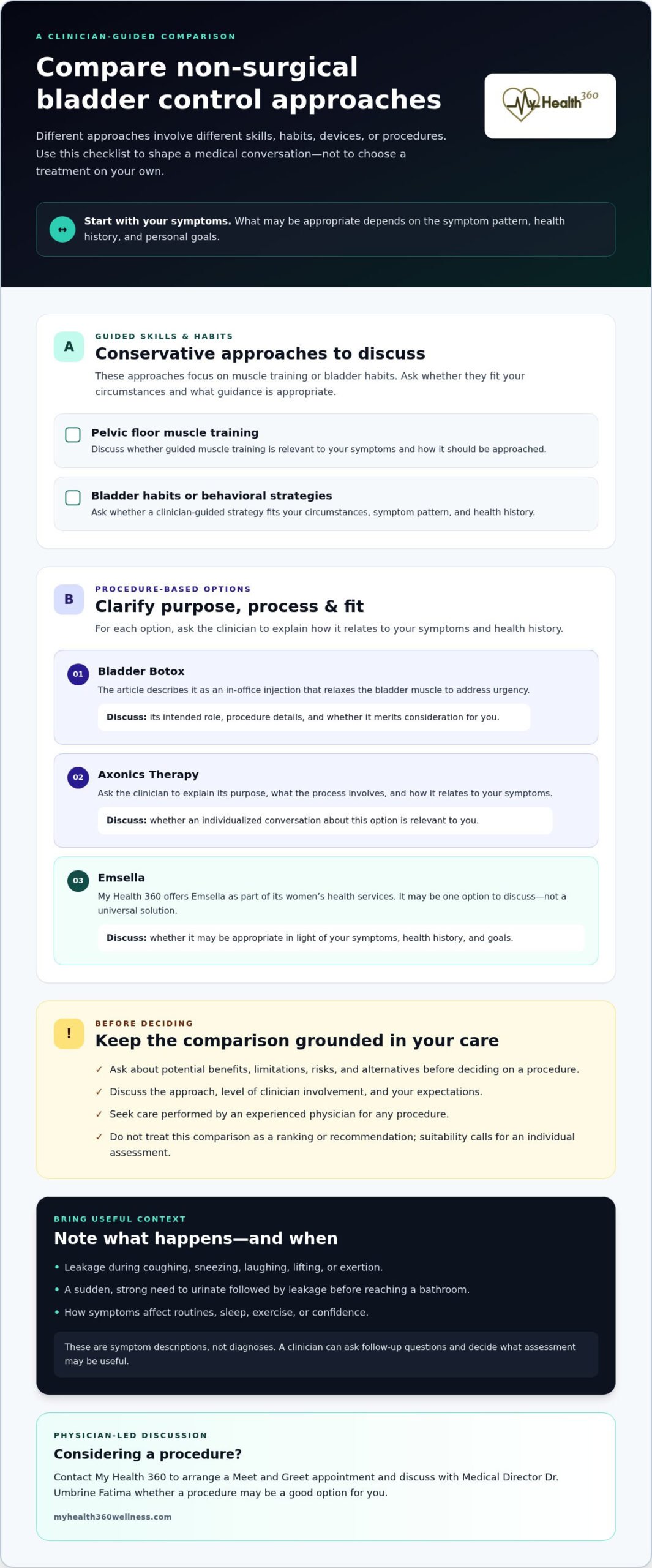
Options differ in what they involve and what a clinician needs to consider. Some focus on guided skills or bladder habits; others involve a device or an in-office procedure. Use this comparison to prepare for a medical conversation, not as a ranking or recommendation. Bladder control improvement non-surgical is not one treatment, and suitability depends on an individual assessment of symptoms, health history, and goals.
What role can conservative approaches play?
Pelvic floor muscle training is one topic to raise with a clinician, who can discuss whether it fits your symptoms and how to approach it. Bladder training or other behavioral strategies may also be part of a care discussion, with guidance suited to your circumstances. The National Institute of Diabetes and Digestive and Kidney Diseases outlines approaches such as these in its NIDDK Bladder Control Treatments resource. If symptoms persist or change, self-management shouldn’t replace clinical evaluation.
How should readers compare procedure-based options?
Bladder Botox and Axonics Therapy are examples of procedures that may come up in bladder-control discussions. The information here doesn’t support ranking or recommending either one. Ask the clinician to explain each option’s intended purpose, what the procedure involves, and how it relates to your symptoms and health history.
| Approach | What to discuss | Individual assessment |
|---|---|---|
| Pelvic floor muscle training | Whether guided muscle training is relevant and how it should be approached | Discuss symptoms and suitable guidance with a clinician |
| Bladder habits or behavioral strategies | Whether a clinician-guided strategy fits your circumstances | Consider symptom pattern and health history |
| Bladder Botox | It’s an in-office injection that relaxes the bladder muscle to address urgency; discuss its intended role and procedure details | A clinician can assess whether it merits discussion for you |
| Axonics Therapy | Ask the clinician to explain its purpose, process, and relevance to your symptoms | Requires an individualized conversation |
Use the table to prepare focused questions, not to select a treatment on your own. For any procedure, seek care performed by an experienced physician, and discuss potential benefits, limitations, risks, and alternatives before deciding. Your preferences matter too: the nature of the approach, the level of clinician involvement, and your expectations can all shape the conversation.
If you’re considering a procedure, contact My Health 360 to arrange a Meet and Greet and discuss with Medical Director Dr. Umbrine Fatima whether it may be an appropriate option for you.
Emsella and Other Options: What Should You Weigh Before Deciding?
Once you’ve described your symptoms, consider how an option fits your priorities and what a clinician can explain about it. My Health 360 offers Emsella as part of its women’s health services. It may be one option to discuss, not a universal solution or a substitute for assessing bladder symptoms.
What can readers consider when discussing Emsella?
Start with your symptom pattern and what you’d like to address. Ask the physician to explain how Emsella is intended to work, what the experience involves, what outcomes are realistic, and what limitations or risks apply to your circumstances. The discussion should be based on clinical information and your individual assessment, not assumptions drawn from a treatment name or general description. Suitability and anticipated results require a physician-led discussion.
How can a comparison stay realistic?
Separate general education about a treatment from evidence supporting specific claims and details about how care is delivered. A description of a device or procedure doesn’t predict an individual result. The non-invasive pelvic health guide to Emsella can provide context, while questions about your candidacy and expectations belong in a conversation with a physician.
| Option to discuss | Practical consideration | What needs individual review |
|---|---|---|
| Emsella | A women’s health service offered by My Health 360 | Mechanism, treatment experience, suitability, expected outcomes, and limitations require physician review before being applied to an individual |
| Clinician-guided pelvic floor strategies | Whether guided training aligns with your symptoms and preferences | Appropriate instruction and relevance to your specific concerns |
| Bladder Botox or Axonics Therapy | How a clinician explains the purpose and process of each procedure | Potential benefits, risks, candidacy, and alternatives in your case |
This table is a discussion aid, not a ranking. It doesn’t establish that the options are interchangeable, equally appropriate, or supported by the same evidence. For each procedure, ask what is known, what remains uncertain, and how the explanation applies to your symptoms. Consider your comfort with the process, the involvement required, and whether the approach aligns with your goals.
Bladder control improvement non-surgical should be considered through this individualized lens: your symptoms, preferences, and physician assessment all matter. If you’re considering a procedure, contact My Health 360 for a Meet and Greet appointment to discuss with Medical Director Dr. Umbrine Fatima whether it may be a good option for you. Seek procedures performed by an experienced physician.
How to Prepare for a Physician-Led Bladder Control Assessment
A little preparation can make an appointment more focused. You don’t need to arrive with a diagnosis or know which treatment you want. Bring observations about what you experience, what you’d like help with, and the questions you need answered. The clinician can review your health history and decide whether further assessment is appropriate before discussing next steps.
What information may help the discussion?
Describe leakage and urgency in your own words. Note what was happening when symptoms occurred, whether you felt a sudden need to urinate, and how the issue affected activities such as exercise, work, sleep, or travel. These notes are observations, not a way to diagnose the cause. Include relevant health-history details and your current concerns.
You can make a brief record as symptoms arise. For example, note whether leakage occurred during exertion or while trying to reach a bathroom, along with any effect on your plans. Consider what you most want to change, such as feeling more confident during a particular activity. Sharing your priorities helps the physician understand what matters to you.
What questions can clarify a treatment option?
If a procedure or other approach comes up, ask for a clear explanation before deciding. You might ask:
- What symptoms is this approach intended to address?
- What evidence supports its use, and what is still uncertain?
- What limitations, possible complications, or follow-up considerations should I understand?
- How will you assess whether it fits my symptoms, health history, and goals?
Answers should distinguish general information about a treatment from what the physician can reasonably anticipate in your case. If something is unclear, ask for a plain-language explanation. A considered discussion gives you room to weigh your preferences and expectations alongside the clinician’s assessment, rather than feeling rushed toward a choice.
Use these notes as a starting point, not a checklist you must complete perfectly. Bladder control improvement non-surgical options involve different levels of clinician guidance and intervention, so the assessment should connect your concerns with a relevant discussion. Further evaluation may be considered if the physician needs more information before discussing a procedure.
Only seek treatment if performed by an experienced physician. Avoid places where procedures are performed by mid-level providers under physician supervision.
For a physician-led conversation about your concerns and whether a procedure may suit your goals, contact My Health 360 to arrange a Meet and Greet and discuss your options with Medical Director Dr. Umbrine Fatima.
Explore Physician-Led Emsella Care at My Health 360
Choosing an approach begins with understanding your symptoms, comparing options, and discussing your circumstances with a physician. My Health 360 offers Emsella and women’s health services. Emsella may be one option to discuss, but its presence on a treatment menu doesn’t establish that it’s suitable for every person or symptom pattern.
What does a Meet and Greet help you discuss?
A Meet and Greet gives you an opportunity to share your concerns with Medical Director Dr. Umbrine Fatima and discuss whether a procedure may be a good option for you. The conversation can clarify what you hope to address and what information the physician needs to consider before discussing suitability. It doesn’t mean a treatment will necessarily be recommended.
Consider bringing a few questions that matter to you. For example:
- How does the physician assess whether this option may fit my symptoms and goals?
- What are the intended purpose and limits of the procedure?
- What possible risks, complications, or follow-up considerations should I understand?
- What information supports the approach, and what should I avoid assuming about results?
These questions can help distinguish general information from guidance related to your health history. They also create space to discuss your preferences and expectations, including any concerns about the procedure itself. A thoughtful conversation can identify what needs clarification before you decide.
What should readers take away before choosing?
Non-surgical approaches differ in what they involve and in what a physician needs to consider. General descriptions can help you prepare, but they can’t predict your experience or establish that a treatment is right for you. Bladder control improvement non-surgical care should be considered in the context of your symptoms, priorities, health history, and a physician’s guidance, without promises of improvement or a substitute for clinical assessment.
Take time to understand the proposed approach, its known limitations, and relevant safety considerations. If details about Emsella or another procedure are unclear, raise them with the physician before deciding. The goal is an informed conversation, not pressure to proceed.
To discuss your concerns and whether Emsella or another procedure may be a good option for you, contact My Health 360 to schedule a Meet and Greet with Dr. Fatima. A physician-led discussion can help you consider next steps with individualized guidance.
Take Your Next Step With a Clearer Plan
Your next step doesn’t need to be choosing a procedure on your own. Use what you’ve noticed about your symptoms to begin a conversation about your priorities, relevant options, and whether further assessment might be needed. Bladder control improvement non-surgical is a personal consideration, not a promise of a particular result. Informed decisions start with questions and individualized physician guidance.
My Health 360 is physician-owned and led by Medical Director Dr. Umbrine Fatima, and Emsella is offered as part of its women’s health services. A Meet and Greet gives you an opportunity to discuss your concerns with Dr. Fatima and whether a procedure may be a good option for you. No particular treatment is assumed or guaranteed.
Arrange a Meet and Greet with Dr. Fatima at My Health 360 to talk through your questions and consider an appropriate next step.
Frequently Asked Questions
Can bladder leakage be a sign of another health condition?
Yes, leakage can sometimes be related to an underlying health issue, medication, or changes affecting bladder or pelvic function. That doesn’t mean leakage automatically signals a serious condition, but it’s useful to share when symptoms began and whether they changed alongside other health concerns. A clinician can consider the broader context and determine whether further assessment is appropriate rather than relying on the symptom alone.
Is bladder leakage only a concern for women?
No, people of any sex can experience bladder leakage. Factors associated with symptoms may differ according to a person’s health history and circumstances, so assumptions based on gender can miss important context. If leakage is affecting your comfort or daily activities, describe it to a clinician in your own words. You don’t need to know the medical terminology before asking for an assessment.
Can coughing or exercise trigger bladder leakage?
Yes, some people notice leakage during activities that put pressure on the bladder, such as coughing, sneezing, laughing, lifting, or exercising. The situation in which leakage occurs is useful information to share, but it doesn’t establish a diagnosis by itself. Note whether it happens during a particular movement or activity and whether other circumstances also bring on symptoms.
Can sudden urgency and leakage have different causes from exertion-related leakage?
They can reflect different symptom patterns, but a description alone can’t confirm the cause. A sudden need to urinate followed by leakage differs from leakage during a cough or physical effort, and some people experience both. Other health factors may contribute as well. Tell the clinician what you feel before leakage occurs and whether the pattern changes across settings or activities.
Is Emsella appropriate for everyone with bladder leakage?
No single procedure should be assumed suitable for everyone. Whether Emsella is worth discussing depends on a physician’s assessment of your symptoms, health history, and goals. The treatment name alone can’t establish candidacy or predict results. To discuss whether it may be a good option for you, contact My Health 360 to schedule a Meet and Greet with Dr. Fatima.
Can bladder control improve without surgery?
Non-surgical approaches may help address bladder-control symptoms for some people, but the appropriate option and likely experience vary. Bladder control improvement non-surgical care can involve different approaches, and an assessment helps clarify which discussions may fit your circumstances. Don’t treat general information or another person’s experience as a promise of benefit in your own case.
When should someone discuss bladder leakage with a physician?
Consider discussing leakage if it recurs, worsens, or interferes with activities, sleep, exercise, or confidence. It can also be helpful to raise a new or changing pattern rather than waiting until it feels severe. Before the appointment, note what was happening when symptoms occurred and any related concerns. A physician can review that information and advise whether additional assessment is appropriate.