
What if better long-term health begins not with another wellness trend, but with a clearer understanding of your own priorities? A longevity doctor can help connect preventive care, performance goals, and treatment decisions, yet conflicting claims can make it hard to know what’s medically grounded and what’s marketing.
It’s reasonable to want a personalized plan while remaining cautious about promises of guaranteed results. “Longevity doctor” describes a physician’s focus, not a formal specialty; a doctor’s underlying board certification and clinical expertise remain important context. Physician-led care can bring your health history, concerns, and goals into one considered conversation, while recognizing that no approach can guarantee a particular outcome.
This guide explains what a longevity-focused physician may contribute, what an initial consultation and individualized plan can involve, and how to weigh wellness or aesthetic procedures with appropriate attention to benefits, limitations, and risks. You’ll also find practical questions to bring to a care discussion. To explore your priorities, contact My Health 360 for a Meet and Greet and discuss with Medical Director Dr. Fatima whether a procedure is a good option for you.
Key Takeaways
- A longevity doctor can help connect your health priorities with physician-guided decisions, but longevity care can’t guarantee a specific outcome or lifespan.
- A thoughtful care plan starts with your goals and clinical context; any assessment or testing should be relevant to your needs.
- Hyper-dilute Radiesse works gradually: collagen stimulation may begin within 4-12 weeks, peak results may appear in 3-6 months, and effects typically last 12-18 months.
- Discuss possible complications, including bruising, swelling, nodules, and vascular occlusion. Only seek treatment if performed by an experienced physician. Avoid places where procedures are performed by mid-level providers under physician supervision.
- Bring your priorities, questions, and relevant medical context to a Meet and Greet with My Health 360, and discuss with Medical Director Dr. Fatima whether a procedure is a good option for you.
What Is a Longevity Doctor, and What Role Does the Physician Play?
What does a longevity doctor actually do, and how is that different from a promise to live longer? The term describes a physician who focuses on a person’s longer-term health goals and considers how current health, medical context, and performance priorities relate to those goals. Longevity care is an approach to care, not a guarantee of lifespan or a specific result.
A longevity doctor is a physician who discusses longer-term health and performance goals in the context of an individual’s medical history, priorities, and clinical needs. The focus is on informed, individualized decisions, not a fixed formula or a prediction of how long someone will live. The concept of Longevity itself includes more than lifespan; a physician-guided conversation can help clarify which aspects of health matter most to you.
How Is a Longevity Doctor Different From a General Primary Care Visit?
Longevity care is best understood as a focus and an ongoing care relationship, not a replacement for other medical care. The conversation may center on goals such as supporting physical performance or taking a more considered view of long-term health, with the details shaped by your individual circumstances.
That focus won’t be necessary for everyone. A patient’s concerns, medical history, and existing care all influence what is relevant to discuss. The aim is not to pursue every available wellness idea, but to consider whether a particular question or next step fits the person in front of the physician.
What Does Physician-Led, Personalized Care Mean?
Physician-led care starts with listening. A physician learns what you hope to address, considers the relevant medical context, and discusses appropriate next steps with you. An internal medicine background can inform this discussion by grounding performance and wellness priorities in a broader understanding of health, while keeping recommendations specific to the individual rather than assuming one plan suits everyone.
At My Health 360, Dr. Umbrine Fatima is an American Board Certified Internal Medicine specialist. She leads integrative concierge medical care for performance optimization, with patient priorities guiding the discussion. For more on this model, read about concierge performance medicine.
Careful discussion also means distinguishing a health plan from a procedure decision. A procedure may be considered on its own merits, with potential benefits, risks, and expectations discussed without presenting it as a way to guarantee longevity. To explore your priorities, contact My Health 360 for a Meet and Greet and discuss with Medical Director Dr. Fatima whether a procedure is a good option for you.
How Does a Longevity Doctor Connect Health Goals With a Care Plan?
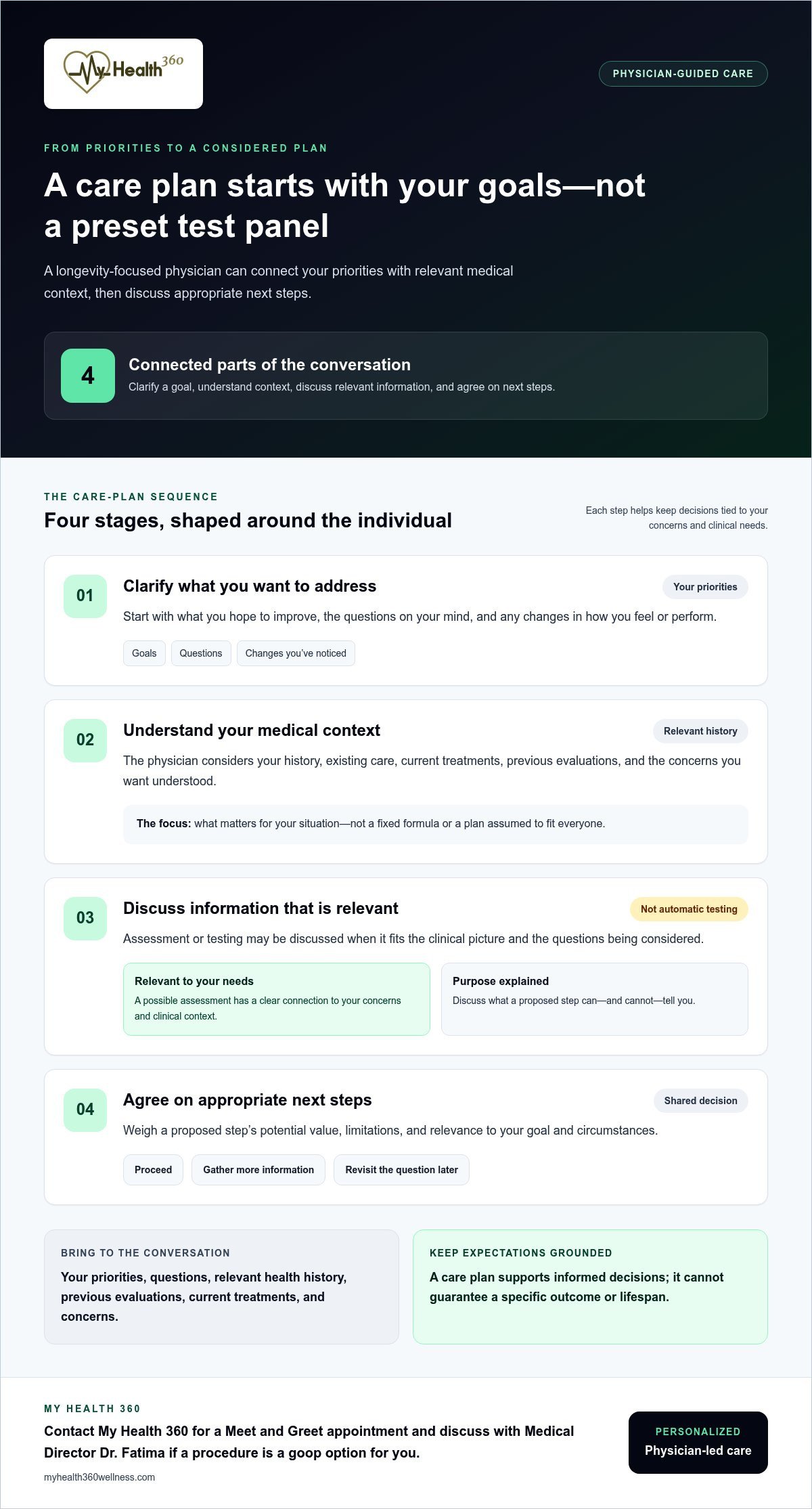
A useful care plan doesn’t begin with a preset panel of tests or a standard protocol. It develops through a sequence: clarify what you want to address, understand your medical context, discuss information that is relevant to those concerns, then agree on appropriate next steps. A longevity doctor can guide that process, helping keep the discussion focused on your priorities rather than on wellness trends alone.
A physician connects your health goals with individualized care by considering your priorities alongside relevant medical context and using that discussion to guide appropriate next steps. This doesn’t mean every patient needs testing or the same interventions. Any assessment should have a clear connection to the person’s clinical context and the questions being considered.
What Might a First Longevity Consultation Discuss?
Before a first conversation, consider what you hope to improve, what questions have been on your mind, and which parts of your health history may be relevant. You might note changes in how you feel or perform, previous evaluations, current treatments, and any concerns you want the physician to understand. These notes can make it easier to use the time well, but they don’t need to be a formal medical summary.
The discussion is two-way. The physician listens to what matters to you, asks about relevant context, and helps clarify which questions may benefit from further attention. Testing or other assessment may be discussed when it fits the clinical picture; it isn’t an automatic feature of every consultation. A personalized conversation should leave room to explain why a possible next step is being considered, as well as what it can and can’t tell you.
How Can a Physician Guide Long-Term Health Decisions?
Long-term decisions are easier to weigh when options are connected to a defined goal and your individual circumstances. A physician can help you consider the potential value, limitations, and relevance of a proposed step, then discuss whether it makes sense to proceed, gather more information, or revisit the question later. This supports realistic expectations rather than a promise of a particular result.
For a deeper look at how goals can inform a structured approach, explore this physician-guided longevity plan. If you’re considering a procedure, contact My Health 360 to arrange a Meet and Greet and discuss with Medical Director Dr. Fatima whether it’s a good option for you.
Hyper-Dilute Radiesse: Benefits, Timeline, Duration, and Risks
Hyper-dilute Radiesse is used with the aim of stimulating collagen and elastin, rather than relying only on immediate volume. That potential benefit needs to be weighed against the gradual timeline, the possibility of temporary reactions, and less common but more serious complications. As with any procedure, an individual result can’t be guaranteed.
What Benefits and Timeline Should Patients Understand?
The proposed biostimulatory effect is gradual. An initial smoothing effect may come from the gel carrier, while the primary intended benefit is stimulation of collagen and elastin. Clinical observations indicate that collagen stimulation may begin within 4-12 weeks, with peak results typically described at 3-6 months. These timeframes are estimates, not a promised schedule or outcome.
In practical terms, this isn’t a procedure to assess solely by its immediate appearance. A longevity doctor can discuss the treatment goal, the expected progression, and whether the approach fits the patient’s concerns. The benefits-and-risks balance should be individual: a proposed improvement in skin texture or firmness must be considered alongside uncertainty, recovery expectations, and potential complications.
How Long Can Effects Last, and What Complications Matter?
Clinical data indicates that the effects of hyper-dilute Radiesse typically last 12-18 months. This duration should be understood as a reported range rather than a guarantee for any individual. Patients should discuss how long results may remain noticeable in the treatment area and what follow-up maintenance might mean for their personal aesthetic goals.
- Potential benefit: Gradual collagen and elastin stimulation, with possible improvement in skin texture and firmness.
- Potential downsides: Bruising, swelling, redness, pain, or itching at the injection site; reported serious complications include nodules and vascular occlusion, which require careful technique to minimize.
Risk reduction depends heavily on appropriate clinical judgment and anatomical expertise. Only seek treatment if performed by an experienced physician. Avoid locations where advanced aesthetic procedures are performed by mid-level providers under remote physician supervision. A qualified longevity doctor can discuss whether an aesthetic procedure aligns with your overall wellness goals, but it shouldn’t be presented as a direct means of guaranteeing long-term health.
Contact My Health 360 for a Meet and Greet and discuss with Medical Director Dr. Fatima whether this procedure is a good option for you.
How Can You Make Informed Decisions About a Longevity Care Plan?
A considered care plan should make sense in relation to what you want to address, your medical context, and what is realistically known about each option. Before agreeing to a next step, take time to clarify what you hope to gain and what remains uncertain. A longevity doctor can help you examine those questions without treating every wellness goal as a reason for testing or intervention.
What Questions Help Clarify Whether Care Fits Your Goals?
Bring notes to the conversation so important details don’t get lost. You might include:
- Your main health or performance priorities, in order of importance.
- Relevant medical history, current treatments, and previous evaluations.
- Questions about how a proposed step relates to your stated goal.
- Your expectations, including what outcome would feel meaningful to you.
Then ask the physician to explain the reasoning behind a proposed option. What potential benefits are relevant to your goal? What uncertainties, risks, or limitations should you understand? Are there alternatives, including waiting or taking no immediate action? What follow-up might be appropriate? Clear answers help you distinguish a clinically grounded discussion from a generic protocol, and give you room to consider whether the plan fits your priorities.
How Should You Think About Procedure Suitability?
A broader interest in long-term health and a decision about a specific aesthetic procedure are separate matters. Suitability is an individualized medical decision, not a general recommendation based on age, a trend, or an overall interest in wellness. Discuss the procedure’s intended purpose, potential benefits, uncertainties, risks, and alternatives with the physician, and consider it on its own merits rather than as a promise of improved longevity.
For procedures, prioritize physician-led decision-making and experience. Only seek treatment if performed by an experienced physician. Avoid places where procedures are performed by mid-level providers under physician supervision. These considerations support a careful conversation about whether a procedure is appropriate for your circumstances. You can also read about integrative medicine for longevity to explore how individual priorities may shape a broader care discussion.
To discuss your questions and care priorities, contact My Health 360 to arrange a Meet and Greet with Medical Director Dr. Fatima and discuss whether a procedure is a good option for you.
Meet With a Longevity Doctor to Discuss Your Next Steps
Long-term health planning is most useful when it begins with your priorities and develops through a physician-guided discussion. A Meet and Greet offers a chance to share what you hope to address, ask questions, and learn whether integrative concierge medical care for performance optimization aligns with your goals. It isn’t a promise of a particular plan or result. It’s an opportunity to start a considered conversation.
What Happens During a Meet and Greet?
Bring the concerns or goals you’d most like to discuss, along with questions and relevant medical context. You might note a performance priority, a health concern, or a procedure you’re considering. There’s no need to arrive with a fixed plan. The conversation can help clarify what matters to you and what questions may deserve further discussion.
If you’re thinking about an aesthetic procedure, keep that decision distinct from broader longevity goals. Dr. Fatima can discuss whether a procedure is a good option for you in light of your individual priorities and circumstances. Suitability is personal, and the discussion shouldn’t be taken as a guarantee that a procedure is appropriate or will produce a specific outcome.
How Can You Take the First Step?
Before reaching out, consider writing down your main priorities, the questions you want answered, and any relevant health history or current treatments. This can help make the conversation more focused. You can also note what you hope to learn, such as whether a particular care approach fits your performance goals or whether a procedure merits further discussion.
A longevity doctor’s role is to help connect those priorities with an informed, individualized conversation. If you’re ready to discuss your next steps, Contact My Health 360 to arrange a Meet and Greet. You can share your care priorities and discuss with Medical Director Dr.
Make Your Next Health Decision With Clarity
Long-term health care begins with clear priorities, relevant medical context, and an open discussion with a physician. A longevity doctor can help connect those goals with individualized next steps, while keeping expectations realistic and distinguishing broader health planning from a decision about a specific procedure. No plan can guarantee a particular outcome.
At My Health 360, Dr. Umbrine Fatima, an American Board Certified Internal Medicine specialist, leads integrative concierge medical care for performance optimization. The practice also offers whole-body habilitation programs, bringing a physician-guided perspective to discussions about health and performance.
Bring your questions, relevant health context, and the priorities you’d like to explore. A Meet and Greet is an opportunity to discuss them with Medical Director Dr. Fatima, including whether a procedure is a good option for you. Contact My Health 360 to arrange a Meet and Greet and discuss your next steps. A thoughtful conversation can help you move forward with greater understanding and confidence.
Frequently Asked Questions
What is a longevity doctor?
A longevity doctor is a physician who discusses a person’s longer-term health goals in the context of their clinical needs and priorities. The term describes a focus and approach to care, not a guarantee of a longer life or a particular outcome. The physician’s role is to understand what matters to you, consider relevant health context, and discuss appropriate next steps together.
What does a longevity doctor do?
A longevity doctor discusses your health and performance priorities, relevant medical context, and care options that may relate to your goals. The conversation is individualized: not everyone needs the same evaluation, testing, or plan. A physician can explain why a particular next step is being considered and what it may or may not address. No specific health result should be promised.
How is a longevity doctor different from a primary care doctor?
Longevity care focuses on longer-term health goals; it isn’t a replacement for primary care or other medical care you may need. Physicians and practices can differ in their focus and approach, so it’s helpful to discuss how a particular care relationship may fit your needs. Consider what you want to address and how that focus would complement your overall medical care.
Can a longevity doctor help me decide whether a procedure is right for me?
Yes. A physician can discuss how a procedure relates to your goals, along with potential benefits, risks, uncertainties, and alternatives. Suitability is individual and can’t be promised in advance. For a procedure discussion, contact My Health 360 for a Meet and Greet and talk with Medical Director Dr. Fatima about whether it’s a good option for you.
Does hyper-dilute Radiesse improve longevity?
Hyper-dilute Radiesse is used for bio-stimulation, an aesthetic treatment purpose. That is distinct from extending lifespan or improving general health, and the procedure shouldn’t be presented as doing either. A physician can discuss the intended aesthetic goals, relevant evidence, potential risks, and whether treatment fits your circumstances. Individual suitability and results aren’t guaranteed, so keep procedure decisions separate from broader longevity goals.
How long do the effects of hyper-dilute Radiesse last?
A specific duration should only be stated when supported by reliable clinical evidence specific to hyper-dilute Radiesse. The available product-specific information here doesn’t establish a numerical duration, so one shouldn’t be assumed or promised. Ask the physician to discuss what is known, what remains uncertain, and how treatment goals and individual circumstances may affect expectations.
What complications can occur with hyper-dilute Radiesse?
Potential complications should be discussed before treatment, but a specific list should only be published or relied on after review of reliable clinical evidence specific to the procedure. Don’t assume treatment is risk-free. Ask the physician to explain the complications relevant to the proposed treatment, how individual circumstances may affect risk, and what steps are appropriate to minimize it.
How can I reduce the risk of complications from hyper-dilute Radiesse?
Discuss your individual circumstances, the procedure’s risks, and risk-reduction measures with an experienced physician before deciding. Any additional safety guidance should be grounded in reliable clinical evidence specific to the treatment. A careful discussion can support an informed decision, but it can’t guarantee a complication-free result.