What if the most effective way to lift the face isn’t by pulling the skin, but by triggering a biological restructuring from within? Many patients feel caught between the subtle limits of dermal fillers and the daunting commitment of surgical intervention. You’re likely seeking a solution that offers more than just temporary volume without the risks of general anesthesia or an “overdone” appearance. When exploring the possibilities of a PDO thread lift Buffalo NY, it’s essential to understand the medical precision required for a truly successful outcome.
This physician-led guide will empower you with the clinical science, biological benefits, and recovery protocols necessary to master the art of non-surgical rejuvenation. We’ll examine how these specialized sutures stimulate deep-tissue neocollagenesis to restore structural integrity and facial harmony. This methodical approach moves beyond simple aesthetics to consider the holistic health of your skin. By the end, you’ll have a comprehensive plan for achieving natural results that honor your unique anatomy and support long-term aesthetic longevity.
Key Takeaways
- Understand the dual-action mechanism of medical-grade polydioxanone sutures, which offer an immediate mechanical lift alongside a delayed biological stimulation of the skin.
- Explore the biological transition from Type III healing collagen to Type I structural collagen, a process known as neocollagenesis that reinforces your skin’s internal architecture.
- Contrast the benefits of subcutaneous vectoring with traditional surgical SMAS manipulation to determine if a PDO thread lift Buffalo NY is the right choice for your aesthetic goals.
- Learn how to optimize your results through specific pre-procedure protocols and physician-led recovery strategies designed to minimize downtime.
- Discover the clinical advantages of an integrative approach that combines thread lifts with whole-body habilitation programs like Bio-Restore for sustainable structural rejuvenation.
The Science of Structural Rejuvenation: What is a PDO Thread Lift?
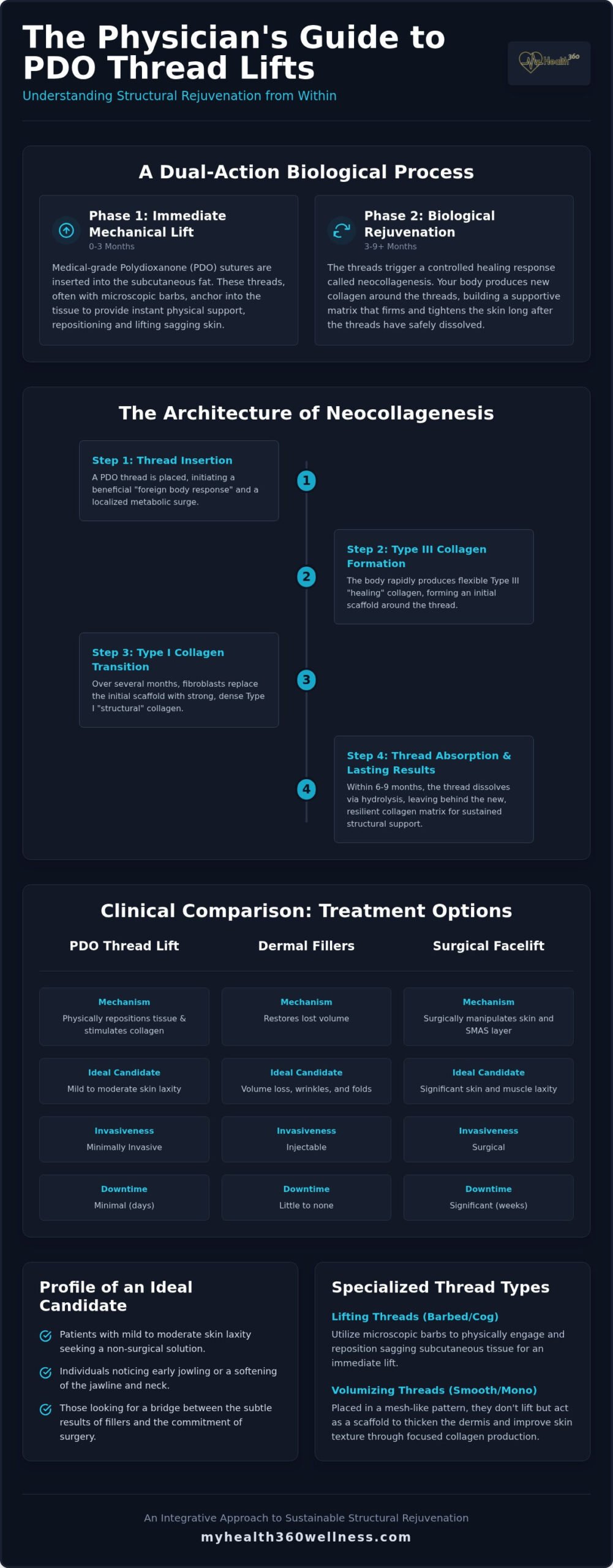
A PDO thread lift is a sophisticated medical intervention that utilizes Polydioxanone (PDO), a synthetic, absorbable polymer. While it’s gained significant popularity in the aesthetic field, this material has been a cornerstone in cardiovascular and orthopedic surgery for decades. Its exceptional safety profile and high tensile strength make it an ideal medium for internal structural support. When considering a PDO thread lift Buffalo NY, it’s helpful to view the procedure as more than a simple pulling of the skin. It’s a dual-action biological process. Initially, the threads provide an immediate mechanical lift by anchoring into the subcutaneous fat. Over the following months, they trigger a controlled healing response that stimulates your body’s own collagen production.
This structural rejuvenation specifically targets anatomical areas most prone to gravity-induced laxity. We primarily focus on the jowls, nasolabial folds, and the submental area beneath the chin. It’s important to distinguish between the types of threads used during treatment. Lifting threads utilize microscopic barbs or cogs to physically reposition sagging tissue. In contrast, volumizing or smooth threads are placed in a mesh-like pattern to thicken the dermis and improve skin texture. These don’t provide a mechanical lift but rather serve as a scaffold for biological rejuvenation.
The Clinical Evolution of Thread Lifting
The journey of thread technology has progressed significantly from the early days of permanent sutures. Early iterations, such as Contour threads, laid the groundwork for facial suspension but often faced complications due to their non-absorbable nature. Modern PDO threads represent a major clinical advancement. They’re fully biodegradable. The body naturally breaks them down through hydrolysis within six to nine months. This makes them significantly safer and more predictable than previous generations. A physician’s expertise is vital here; selecting the correct thread gauge and barb pattern is an anatomical art that determines the longevity and naturalness of the final result.
Ideal Candidates for Structural Lifting
How do you know if you’re a candidate for this procedure? We typically look for patients with mild to moderate skin laxity. If you’re noticing early jowling or a softening of the jawline, threads offer a powerful bridge between dermal fillers and invasive surgery. While fillers restore lost volume, they can’t physically reposition sagging tissue. Conversely, a surgical facelift might be excessive for someone in their late thirties or forties. A thorough medical consultation is the first step. We assess skin quality, underlying bone structure, and health history to ensure the procedure aligns with your long-term aesthetic goals.
Biological Architecture: How PDO Threads Stimulate Neocollagenesis
How does the body react to the presence of a PDO thread? It initiates what clinicians call a “foreign body response.” Far from being a negative reaction, this is a meticulously controlled, beneficial healing cascade. When a thread is inserted, the immune system identifies it as a temporary guest, prompting a localized metabolic surge. Neocollagenesis is the physician-led process of stimulating new collagen fibers for structural integrity. This biological response is the foundation of long-term skin tightening, transforming a temporary suture into a permanent structural improvement.
The transition between collagen types is a critical part of this architecture. Initially, the body produces Type III collagen. This is often referred to as “healing” collagen; it’s flexible and quick to form but lacks the long-term structural rigidity needed for lifting. Over several months, the body replaces this with Type I collagen. This is the primary structural protein found in youthful skin, providing the density and resilience required for lasting rejuvenation. Fibroblasts play the lead role here. These specialized cells migrate to the thread, weaving a new supporting matrix of fibers that remains even after the polymer is gone.
The thread itself is not permanent. It metabolizes through hydrolysis, a process where water molecules break down the polymer into harmless components that are eventually absorbed. This typically occurs over a period of six to nine months. While the thread disappears, the biological architecture it left behind persists. This is why a PDO thread lift Buffalo NY provides results that far outlast the physical presence of the sutures themselves, often maintaining structural integrity for up to two years.
Histological Effects on Skin Quality
Beyond structural lifting, the presence of PDO threads enhances the skin’s microenvironment. The healing response improves microcirculation, which in turn boosts oxygenation to the dermal layers. This metabolic activity doesn’t just produce collagen; it also impacts elastin levels and overall dermal thickness. Patients often notice a refined texture and a visible “glow” as the skin becomes more resilient and better hydrated from within. This histological improvement represents a true reversal of certain aging markers rather than a simple masking of symptoms.
Synergy with Other Aesthetic Modalities
True aesthetic longevity rarely relies on a single tool. Combining threads with a Morpheus8 treatment creates a multi-layered rejuvenation effect. While threads address the deep structural vectors, radiofrequency microneedling refines the surface texture and further tightens the extracellular matrix. This “stacking” approach ensures that every layer of the tissue is optimized for health and vitality. For those seeking a personalized plan, our integrative aesthetic consultations provide the roadmap for comprehensive structural care.
Clinical Comparisons: Thread Lifts vs. Surgical Facelifts and Dermal Fillers
How does one distinguish between the necessity of surgical intervention and the efficacy of a non-surgical lift? Understanding the anatomical depth of these procedures is the first step toward informed decision-making. A traditional surgical facelift involves the manipulation of the SMAS (Superficial Musculoaponeurotic System), which is the deep tissue layer beneath the skin. This requires significant incisions, general anesthesia, and several weeks of recovery. In contrast, a PDO thread lift Buffalo NY focuses on subcutaneous vectoring. By placing threads within the fatty layer of the skin, a physician can physically reposition sagging tissue without the systemic risks of major surgery.
The cost-benefit analysis for most patients favors the thread lift when skin laxity is mild to moderate. While a surgical result might last a decade, it comes with a higher price point and the potential for a noticeably “operated” look. Thread lifts offer a strategic middle ground: they provide a visible structural lift with a recovery period measured in days rather than weeks. This makes them a cornerstone of modern aesthetic longevity, allowing for a refreshed appearance that evolves naturally over time. While a “liquid facelift” relies entirely on injectables to mask aging, it often fails to address the heavy jowling that threads manage with ease.
Threads vs. Dermal Fillers: Lifting vs. Filling
Do you need volume or do you need a lift? This is a common point of confusion for many patients. Dermal fillers are exceptional for replacing lost volume in areas like the cheeks or temples; however, they can’t defy gravity. Attempting to lift the lower face using only fillers often leads to a heavy, over-filled appearance, sometimes referred to as “pillow face.” A physician-led approach uses threads to reposition the tissue first, then applies fillers sparingly to refine contours. This synergy ensures three-dimensional facial harmony without sacrificing natural expression or adding unnecessary weight to the face.
The Surgical Alternative: When is a Facelift Necessary?
There is a point of diminishing returns for any non-surgical modality. If skin laxity is severe or if there is significant excess skin, a surgical facelift remains the gold standard for correction. However, for many, a PDO thread lift Buffalo NY can delay the need for invasive surgery by five to ten years. By maintaining the skin’s structural integrity through neocollagenesis, you’re essentially pre-habilitating the tissue. Our physician-owned center provides an unbiased assessment, ensuring you don’t over-invest in treatments that may not meet your specific anatomical requirements.
The Patient Experience: Preparation, Procedure, and Recovery Protocols
How does a patient transition from a clinical consultation to a successful procedure? The efficacy of a PDO thread lift Buffalo NY depends as much on the patient’s physiological preparation as it does on the physician’s technical skill. Seven to ten days before your appointment, we require patients to discontinue blood-thinning agents such as ibuprofen, high-dose vitamin E, and certain herbal supplements. This meticulous preparation minimizes the risk of hematoma and ensures the skin’s microenvironment is optimized for the upcoming structural intervention. We also emphasize skin hydration and nutrition to support the immediate healing response.
The procedure itself is a study in medical precision. After applying local anesthesia to ensure comfort, the physician uses a blunt-tipped cannula to gently guide the threads into the subcutaneous layer. This technique is preferred over sharp needles as it significantly reduces tissue trauma and bruising. Once the threads are positioned according to the pre-planned vectors, the physician applies tension to achieve the desired lift. You may feel a slight “tugging” or “pressure” sensation during this phase, which is a normal part of the tissue anchoring process. The entire session typically concludes within 45 to 60 minutes.
Recovery is a two-week commitment to structural stability. While you can return to light activities almost immediately, the threads require time to integrate with your tissue. During this critical window, patients must avoid dental work, high-impact exercise, and excessive facial expressions. Mild swelling and bruising are common and usually resolve within five to seven days. Adhering to these “do’s and don’ts” prevents the threads from shifting before the body can begin the process of neocollagenesis.
The BioPrime Approach to Procedure Preparation
We believe that aesthetic outcomes are intrinsically linked to systemic health. Our BioPrime approach utilizes whole-body habilitation to ensure you are in peak physiological condition before your procedure. By addressing nutritional status and metabolic health, we optimize your body’s ability to produce high-quality Type I collagen. This concierge medical perspective ensures that the “foreign body response” is as efficient as possible, leading to faster healing and more resilient results. If you are ready to prepare your body for optimal rejuvenation, you can schedule your BioPrime assessment here.
Long-Term Maintenance and Safety
This focus on metabolic health is a growing trend in clinical aesthetics, with centers like the Houston Medical Wellness Clinic providing specialized medical weight management as part of their comprehensive wellness and anti-aging protocols.
For patients researching metabolic optimization, Medi Slim provides a comprehensive guide on how medical weight loss treatments like Semaglutide are managed under physician supervision.
Physician oversight is non-negotiable for the long-term safety of thread lifting. An expert understanding of facial anatomy is required to avoid complications like thread migration or visible puckering. Regular follow-up appointments allow us to monitor the tissue integration and ensure the inflammatory response remains beneficial rather than excessive. To extend the vitality of your results, we often recommend incorporating integrative medicine for longevity. This holistic strategy supports the extracellular matrix and maintains the structural integrity of your skin for years to come.
The Integrative Approach: Maximizing Aesthetic Longevity with Physician Oversight
Why is physician oversight the defining factor in aesthetic success? A physician-owned center provides a level of anatomical precision that goes beyond surface-level beauty. At My Health 360, we don’t view a PDO thread lift Buffalo NY as an isolated cosmetic fix. Instead, it’s a strategic intervention within a comprehensive longevity plan. Dr. Umbrine Fatima, an American Board Certified Internal Medicine specialist, oversees these complex interventions to ensure your aesthetic goals align with your systemic health. This disciplined approach minimizes risks and maximizes the natural harmony of the results by balancing clinical authority with aesthetic sensitivity.
Our philosophy centers on “Whole Body Habilitation.” This isn’t a standard cosmetic mindset; it’s a medical discipline that views the human body as an integrated system. By positioning PDO threads within this framework, we ensure that the structural lift you receive is supported by optimized biological health. This creates a synergy where the internal environment of the body is prepared to sustain the external rejuvenation for the long term.
Bio-Restore: Aesthetic Recovery as Performance
How do aesthetic procedures fit into the whole body habilitation framework? Within our Bio-Restore program, we treat the recovery from a thread lift with the same rigor as post-operative habilitation. We recognize that looking rejuvenated has a profound psychological impact, which in turn influences physiological performance. When you feel confident in your appearance, your stress markers often decrease and your overall vitality increases. My Health 360 views aesthetics as a functional component of your longevity journey, not merely a luxury service.
Concierge Medical Care for Aesthetic Precision
A physician-led consultation allows for a sophisticated analysis of complex facial anatomy. We don’t use a one-size-fits-all template. Instead, we customize thread counts and tensioning vectors based on your specific aging patterns and bone structure. By mapping out these vectors with clinical precision, we ensure the longevity of the lift is maximized through proper anchoring and tissue support. Taking the next step toward structural rejuvenation means looking at the bigger picture of your health. We invite you to begin with a concierge performance medicine evaluation to see how a PDO thread lift Buffalo NY can complement your unique path to peak longevity.
Empowering Your Aesthetic Longevity
Mastering the science of non-surgical structural rejuvenation requires a shift from viewing aesthetics as a quick fix to understanding it as a biological intervention. By leveraging the body’s natural healing cascade, PDO threads provide more than just a mechanical lift. They establish a resilient scaffolding of Type I collagen that supports the face’s underlying architecture. Choosing a PDO thread lift Buffalo NY at a physician-led center ensures that your treatment is guided by deep anatomical knowledge and a commitment to patient safety.
My Health 360, owned and operated by American Board Certified specialist Dr. Umbrine Fatima, integrates state-of-the-art medical aesthetic technology with a sophisticated focus on longevity and performance. This holistic perspective ensures that your results are natural, sustainable, and perfectly aligned with your broader health goals. You don’t have to navigate the complexities of structural aging alone. Schedule your physician-led PDO thread lift consultation at My Health 360 to begin your personalized journey toward restored vitality. We look forward to helping you achieve a refreshed, confident version of yourself that honors your unique anatomy.
Frequently Asked Questions
How long do PDO thread lift results typically last?
Aesthetic results from a thread lift typically persist for 12 to 24 months, although the physical threads are metabolized much earlier. Your body generally absorbs the polydioxanone material through hydrolysis within six to nine months. The longevity of the lift depends on the strength of the new Type I collagen matrix formed during the procedure. Individual factors like metabolic rate and skin quality also influence how long these structural benefits remain visible.
Is the PDO thread lift procedure painful?
Most patients report that the procedure is quite manageable because we utilize local anesthesia to numb the insertion points. We use blunt-tipped cannulas instead of sharp needles to guide the threads into place, which significantly reduces tissue trauma and discomfort. You might feel a slight pressure or a tugging sensation as the physician tensions the threads, but significant pain is uncommon. Post-procedure soreness is typically mild and easily managed with standard over-the-counter care.
What is the difference between PDO threads and Silhouette Soft threads?
The primary difference lies in the chemical composition and the anchoring mechanism of the sutures. PDO threads are made from polydioxanone, a material used in cardiovascular surgery that stimulates a rapid collagen response. Silhouette Soft threads are composed of poly-L-lactic acid and use small cones for anchoring. While both are effective for structural support, a PDO thread lift Buffalo NY is often preferred for its versatility in addressing tissue repositioning and skin texture through various thread gauges.
Can I combine a PDO thread lift with Morpheus8 or fillers?
Yes, combining these treatments is often the key to achieving comprehensive facial harmony. While threads provide the structural vectors for a lift, Morpheus8 refines the surface texture and further tightens the skin’s extracellular matrix. Fillers can then be used sparingly to restore lost volume in the cheeks or temples. This multi-layered, integrative strategy ensures that we address every component of aging, from deep structural laxity to surface-level fine lines and volume depletion.
Are there any risks or side effects associated with PDO threads?
Minor side effects like bruising, swelling, and a sensation of tightness are expected and usually resolve within a week. While more serious risks like thread migration, puckering, or infection exist, they’re exceedingly rare when the procedure is performed by an American Board Certified physician. Detailed pre-procedure protocols and sterile clinical environments are essential for minimizing these risks. We monitor your tissue integration closely during follow-up appointments to ensure the healing cascade remains controlled and beneficial.
How much downtime is required after a thread lift procedure?
Most patients can resume their professional and social activities within one to two days after the procedure. However, a full two-week recovery window is necessary for the threads to stabilize within the subcutaneous tissue. During this time, you should avoid high-impact exercise, dental work, and excessive facial movements. Our Bio-Restore approach focuses on optimizing your systemic health to ensure this recovery period is as efficient as possible, allowing you to return to your peak performance quickly.
What happens if I don’t like the results of my thread lift?
Because PDO threads are fully biodegradable, any aesthetic changes are not permanent and will naturally resolve as the body metabolizes the material. If you’re concerned about the initial appearance, adjustments can often be made in the days following the procedure before the threads fully anchor. A PDO thread lift Buffalo NY performed at a physician-led center provides the anatomical expertise required to assess your results objectively. We focus on natural-looking rejuvenation that honors your unique facial structure.
How many threads are usually needed for a full face lift?
There is no universal number of threads because every face requires a personalized anatomical map. For a comprehensive lift, a physician might use four to eight barbed lifting threads per side to address the jowls and midface. We frequently supplement these with dozens of smooth or volumizing threads to improve skin density in specific areas. The exact count depends on your degree of skin laxity and the structural goals established during your concierge medical consultation.