What if the right recovery plan depends not only on the injured area, but also on how you need your whole body to function? Injury rehabilitation programs vary in setting and focus, so it’s understandable to wonder which approach fits your circumstances and goals. A plan that feels too general can leave you unsure what it is meant to address or how to discuss next steps.
Your recovery deserves a thoughtful conversation, not guesswork. This guide explains how rehabilitation settings and approaches differ, what to discuss with a physician before starting care, and how to review your priorities as circumstances change. It also clarifies rehabilitation and whole-body habilitation, related ideas with different emphases.
At My Health 360, Bio-Restore is a physician-led program for post-operative and injury whole-body habilitation, serving Buffalo and surrounding Western New York communities. You’ll learn how this approach can fit into a broader recovery discussion and what to consider as you decide on a next step.
Key Takeaways
- Injury rehabilitation programs vary in setting and focus. Relevant considerations include your injury, health context, and recovery goals.
- Understand how rehabilitation, inpatient care, and whole-body habilitation differ, and what questions can help you discuss appropriate options with your physician.
- Prepare for a care conversation by noting your goals, concerns, current care, and questions about how your needs and next steps will be reviewed.
- Keep physician-led oversight central to your safety. Only seek treatment if performed by an experienced physician.
- Contact My Health 360 to arrange a Meet and Greet with Medical Director Dr. Fatima and discuss whether a procedure is a good option for you.
What injury rehabilitation programs do, and what recovery support can involve
Injury rehabilitation programs provide structured support intended to address changes in function after an injury. The focus may include movement and everyday activities, guided by the person’s priorities and care plan. The kind of support depends on individual circumstances. No single program or setting is appropriate for every injury, and participation doesn’t guarantee a particular outcome.
Rehabilitation is individualized support for recovery and function, shaped by a person’s needs, health context, and care plan. The aim is to consider the whole person, not just the injured area. For an overview of the medical field that includes physician-led rehabilitation care, see Physical medicine and rehabilitation (PM&R).
What goals can an injury rehabilitation program address?
What would you like daily life to look like as you recover? That question can help start a useful discussion with a physician or care team. Goals might relate to a work task, a household activity, comfortable movement, or returning to a valued routine. These are topics for planning, not promises about what a program will achieve.
A focused conversation can clarify which priorities matter most and how they fit within your current health and care plan. A treating physician determines what assessment or care is appropriate. Describe which activities feel difficult, what support is already in place, and what concerns you most to give the discussion useful context.
Why can recovery needs differ from person to person?
An injury’s effects vary with its circumstances and with a person’s health, responsibilities, and recovery priorities. Two people with injuries affecting a similar area might have different day-to-day challenges: one may be focused on a work-related task, while another may want to manage a household routine. These examples illustrate different priorities, not diagnoses or recommendations.
Current care and other health considerations can also shape what support is suitable. As needs and circumstances change, the questions you bring to your clinician may change too. Don’t assume a uniform schedule or preset sequence will suit everyone. The treating physician determines appropriate assessment and care.
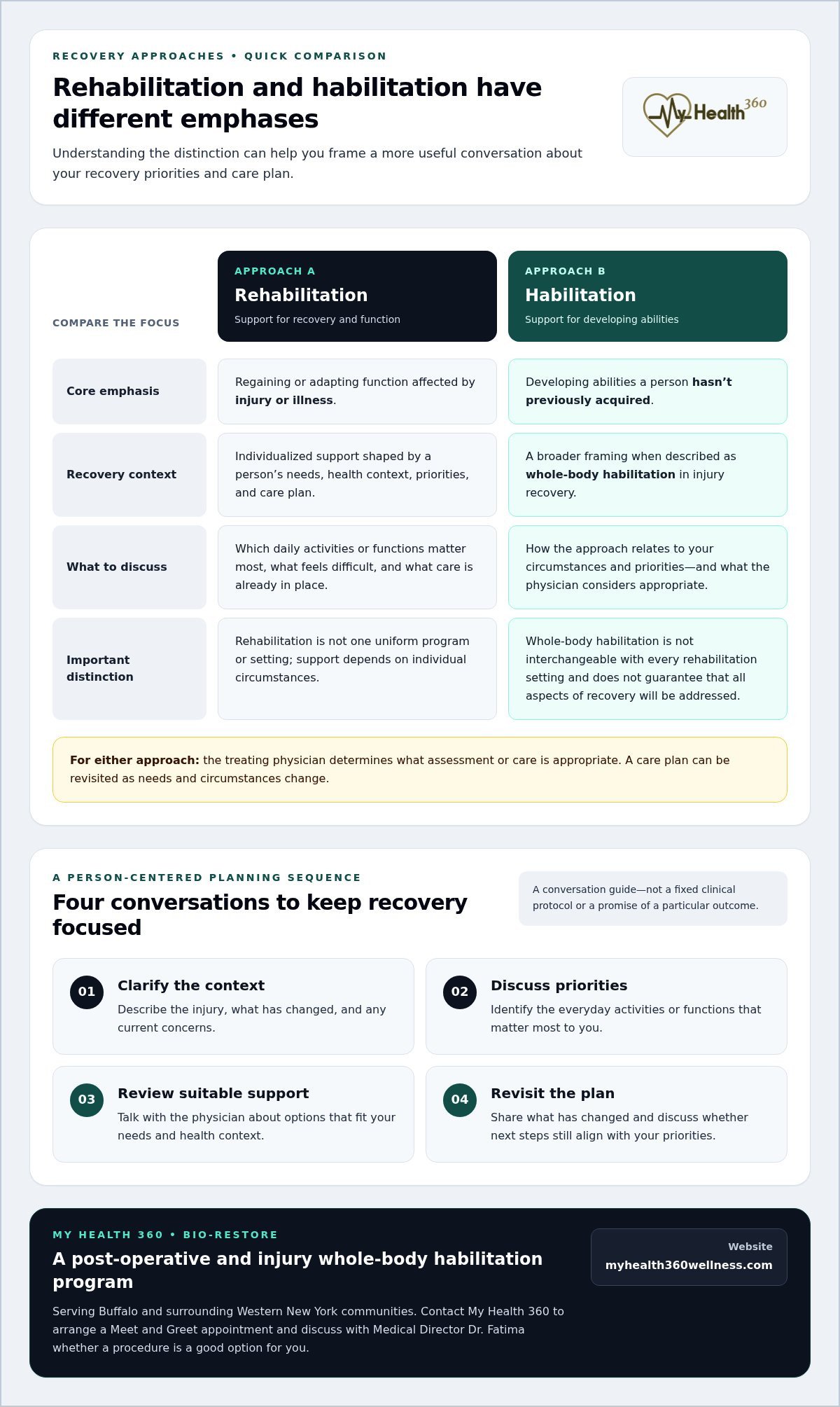
It also helps to distinguish rehabilitation from habilitation. Rehabilitation generally concerns support to regain or adapt function affected by injury or illness. Habilitation commonly describes support for developing abilities a person hasn’t previously acquired. In injury recovery, “whole-body habilitation” describes a broader framing of support. It isn’t interchangeable with every rehabilitation setting and doesn’t guarantee that all aspects of recovery will be addressed.
My Health 360’s Bio-Restore is a post-operative and injury whole-body habilitation program. If you’re in Buffalo or surrounding Western New York communities, contact My Health 360 to arrange a Meet and Greet appointment and discuss with Medical Director Dr. Fatima whether a procedure is a good option for you.
How injury rehabilitation is planned around the person
A thoughtful plan starts with the person, not a preset sequence of services. Injury rehabilitation programs can involve a series of conversations with clinicians: clarify what’s happening, identify priorities, consider suitable support, then revisit needs and progress. The treating physician determines what assessment or care is appropriate, taking your circumstances into account.
A useful planning sequence is:
- Clarify the context. Describe the injury, what has changed, and any current concerns.
- Discuss priorities. Identify which everyday activities or functions matter most to you.
- Review suitable support. Talk with the physician about care options that fit your needs and health context.
- Revisit the plan. Share what has changed and discuss whether the next steps still align with your priorities.
This sequence is a conversation guide, not a fixed clinical protocol. A plan may be adjusted as circumstances change. It doesn’t imply a standard number of visits, a set schedule, or a guaranteed milestone. Keeping your priorities clear can make each discussion more specific.
What should you discuss when planning injury recovery?
Before a conversation, consider how the injury affects your routine and what you most want to address. Tell the physician about current concerns, care already underway, and relevant health considerations. Describe which activities feel difficult, which remain manageable, and whether your priorities have shifted. These details give the physician context for discussing appropriate assessment or care.
- What changes in daily activity concern you most?
- What care are you currently receiving or following?
- Are there health considerations that may affect your recovery planning?
- What would you like to understand about possible next steps?
How can progress and next steps be discussed?
Progress conversations are a chance to compare your current needs with the priorities you discussed earlier. Explain what feels different in daily life, what remains challenging, and whether new concerns have emerged. Don’t assume progress follows a straight line or matches someone else’s experience. Clear updates help your clinician understand your perspective.
The physician can discuss whether the current program remains appropriate and whether the plan should be reconsidered. If you’re exploring physician-led recovery support, contact My Health 360 to arrange a Meet and Greet appointment and discuss with Medical Director Dr. Fatima whether a procedure is a good option for you.
Rehabilitation, habilitation, and recovery settings: how the approaches differ
Similar terms can describe different types of support. The setting, purpose, and clinical guidance matter: inpatient rehabilitation, other rehabilitation care, and whole-body habilitation aren’t interchangeable labels, and one shouldn’t be assumed to replace prescribed care. Use the comparison below to frame a conversation with your physician, not to decide which care you need.
| Approach or setting | Stated purpose | Questions to discuss with a physician |
|---|---|---|
| Inpatient rehabilitation | A hospital-based setting focused on helping a person regain function and independence after injury or illness. | What clinical needs would make this setting appropriate? How does it relate to my current care plan? |
| Other rehabilitation care | Rehabilitation support outside an inpatient hospital setting, with the specific purpose and format depending on the care provided. | What type of rehabilitation support fits my circumstances? How should it coordinate with care I already receive? |
| Whole-body habilitation | A broader whole-body approach to post-operative and injury recovery support, such as My Health 360’s Bio-Restore program. | How does this approach relate to my recovery priorities and other recommended care? |
The table describes broad distinctions, not a ranking. Inpatient rehabilitation describes a setting, while rehabilitation and habilitation describe approaches to support. A physician can explain which options are relevant to your situation and how they fit with clinical recommendations. This article can’t determine eligibility, diagnose an injury, or decide what care you need.
How does whole-body habilitation relate to injury recovery?
In this context, whole-body habilitation refers to a broader framing of recovery support rather than a specific inpatient or outpatient setting. Bio-Restore is My Health 360’s post-operative and injury whole-body habilitation program. The name alone doesn’t mean it replaces rehabilitation or other medical care. Discuss how any program may relate to your existing plan with your physician. For a wider introduction, read the sibling article, Whole Body Habilitation: A Physician-Led Guide to Longevity and Performance.
When might different care settings be discussed?
Setting is part of an individualized clinical conversation. A hospital-based inpatient model may be discussed in relation to a person’s care needs, while other rehabilitation support may take place outside that setting. Whole-body habilitation has its own framing and shouldn’t be treated as equivalent to inpatient rehabilitation. The physician considers individual circumstances and determines appropriate assessment or care.
To discuss My Health 360’s Bio-Restore program, contact the center for a Meet and Greet appointment with Medical Director Dr. Fatima. You can talk about whether a procedure is a good option for you and how the program relates to your recovery context. Contact My Health 360 about a Meet and Greet.
Preparing for injury recovery: goals, questions, and safety considerations
A physician conversation is more useful when you arrive with a clear picture of what matters to you. Injury rehabilitation programs can involve different forms of support, so preparation helps you explain your priorities and understand how a proposed approach relates to your circumstances. You don’t need to arrive with medical answers. Bring your questions and describe what you’re experiencing in your own words.
Before the appointment, consider jotting down:
- Your goals: Which everyday activities or functions would you most like to address?
- Your concerns: What feels uncertain about recovery or the support being discussed?
- Your current care: What care are you receiving or following now?
- Your health context: What health considerations may be relevant to the conversation?
- Your questions: What would you like the physician to explain about the proposed plan?
This short list can help keep the discussion focused without assuming what care is right for you. The treating physician determines appropriate assessment or care.
What questions can help clarify a recovery plan?
Open-ended questions invite an explanation tailored to your situation. Ask how the proposed support relates to your recovery priorities, what potential benefits and limitations the physician sees, and what alternatives or next steps may be relevant. You can also ask which factors in your health context inform the recommendation. The goal is to understand the reasoning, not to seek a guaranteed result.
If part of the plan involves a procedure, ask the physician to explain its purpose and what outcomes are reasonable to discuss in your circumstances. Request clarification whenever a term or recommendation isn’t clear. Understand what is being proposed before deciding how to proceed.
How should readers think about complications and risk?
Risk depends on the treatment or procedure being considered and on individual circumstances. There isn’t one complication profile that applies to every recovery approach. Discuss relevant complications and risk-reduction measures directly with the experienced physician responsible for evaluating the proposed treatment. Don’t rely on a general article to determine your personal risks or provide clinical instructions.
Only seek treatment if performed by an experienced physician. Avoid places where procedures are performed by mid-level providers under physician supervision. These are important considerations when a procedure is being discussed. The physician can explain how they apply to the specific treatment under consideration.
For a physician-led conversation about recovery support, contact My Health 360 to arrange a Meet and Greet appointment and discuss with Medical Director Dr. Fatima whether a procedure is a good option for you.
Explore My Health 360’s Bio-Restore program in Western New York
For people considering recovery support in Buffalo and surrounding Western New York communities, My Health 360 offers a physician-led setting for a conversation about whole-body habilitation. The physician-owned Longevity, Recovery, and Performance Center is operated by Dr. Umbrine Fatima, an American Board Certified Internal Medicine specialist. Its approach brings a physician’s perspective to recovery and performance, with discussion centered on individual circumstances and care priorities.
Injury rehabilitation programs and whole-body habilitation aren’t interchangeable terms. Understanding a program’s specific purpose can help you discuss how it relates to your needs and existing care. My Health 360 describes its services as physician-led and uses advanced technologies, including HIFEM, RF, and red light, to support physical recovery and performance. These are descriptions of the center’s approach, not a promise of a particular outcome or a claim about a specific treatment plan.
What is Bio-Restore at My Health 360?
Bio-Restore is My Health 360’s post-operative and injury whole-body habilitation program. This description identifies the program’s focus. It doesn’t establish a specific protocol, duration, eligibility requirement, or guaranteed result. A physician can discuss how the program relates to your situation and whether a procedure may be an appropriate option.
Whole-body habilitation is a broader way to frame recovery support. To explore the concept beyond injury and post-operative care, read Whole Body Habilitation: A Physician-Led Guide to Longevity and Performance. Understanding an approach can inform your questions, but it can’t determine which care is right for you.
How can a Meet and Greet help you consider next steps?
A Meet and Greet offers an opportunity to share what brings you to the conversation, describe your recovery priorities, and ask how a procedure might relate to them. You can also discuss your current care and ask about potential benefits, limitations, or risks. Medical Director Dr. Fatima can speak with you about whether a procedure is a good option for your circumstances.
You don’t need to arrive with a decision already made. A clear discussion can help you understand the proposed next step and how it fits within your broader care context. It also gives you space to raise concerns and ask for an explanation in language that makes sense to you.
If you’re considering post-operative or injury whole-body habilitation in Western New York, contact My Health 360 to schedule a Meet and Greet with Medical Director Dr. Fatima and discuss whether a procedure is a good option for you.
Take a thoughtful next step in your recovery
Recovery decisions don’t have to begin with a complete plan. A useful next step can be identifying what you still need to understand, such as how a proposed procedure relates to your priorities or what questions to raise about your current care. Injury rehabilitation programs vary, and your physician can help you consider options in light of your circumstances.
Bring your questions to a conversation with Medical Director Dr. Fatima. You can discuss your situation and whether a procedure is a good option for you, without assuming in advance what the right path should be.
Schedule a Meet and Greet with Dr. Fatima to discuss your next step with My Health 360.
Approach recovery one informed conversation at a time. A clear understanding of your options can help you move forward with greater confidence.
Frequently Asked Questions
What is an injury rehabilitation program?
An injury rehabilitation program is organized care that addresses needs arising after an injury, with the focus shaped by a person’s circumstances and recovery priorities. It may involve discussing how the injury affects everyday activities and what support is appropriate. Injury rehabilitation programs aren’t a uniform package, so ask the treating physician what the proposed care is intended to address and how it fits your health context.
How long does injury rehabilitation take?
There isn’t one standard duration for injury rehabilitation. The time involved depends on individual circumstances, the injury, and the care plan, so a general estimate may not describe your situation. Ask your physician what factors inform the plan, how to discuss changes in your needs, and when to revisit next steps. Avoid comparing your progress with another person’s, since their injury and health context may differ.
Can an injury rehabilitation program help after surgery?
Recovery support may be discussed after surgery, but appropriate care depends on your circumstances and medical guidance. My Health 360’s Bio-Restore is a post-operative and injury whole-body habilitation program. If you’re considering post-surgical support, discuss your existing care and priorities with a physician, including how any proposed procedure or program would relate to the care you’ve been advised to follow.
What is the difference between rehabilitation and whole-body habilitation?
Rehabilitation generally refers to support for function affected by injury or illness, while whole-body habilitation describes a broader framing of support that considers recovery beyond a single injured area. The terms don’t automatically refer to the same setting or service. Ask the physician to explain the purpose of the specific program being discussed and how it relates to your current care, rather than relying on the label alone.
What complications can occur during injury rehabilitation?
Possible complications depend on the treatment or procedure involved and on individual health circumstances. There isn’t a single risk profile that applies to every rehabilitation approach. Before proceeding with a procedure, ask the experienced physician to explain relevant complications, how they apply to your situation, and what signs or concerns should prompt follow-up. This general FAQ can’t identify your personal risks or predict how your care will go.
How can I reduce risks when considering a recovery procedure?
Discuss the procedure, your health circumstances, relevant complications, and risk-reduction measures directly with the experienced physician. Ask for clear explanations before making a decision, and share information about your current care. Only seek treatment if performed by an experienced physician. Avoid places where procedures are performed by mid-level providers under physician supervision. Your physician can address questions specific to the procedure being considered.
Where can I discuss injury recovery programs near Buffalo, NY?
My Health 360 serves Buffalo and surrounding Western New York communities, including Clarence, Orchard Park, Grand Island, Tonawanda, Elma, Amherst, and Williamsville. Contact My Health 360 to schedule a Meet and Greet with Medical Director Dr. Fatima. You can discuss your situation and ask whether a procedure is a good option for you. Bring questions about your priorities and current care to help guide the conversation.