

Could a treatment that works your pelvic floor while you remain seated be appropriate for your symptoms and health history? Before considering an Emsella chair treatment, it helps to understand what the visit involves, what the treatment is intended to address, and what questions to ask about benefits and safety.
Emsella uses electromagnetic energy to stimulate pelvic floor muscles. That description alone cannot show whether it is suitable for you. A physician-led assessment can put the treatment in context by considering your symptoms, health history, potential risks, and goals. Only seek treatment if performed by an experienced physician. Avoid places where procedures are performed by mid-level providers under physician supervision.
This guide explains how to prepare for a conversation about Emsella, what to ask about the treatment process, and how to approach potential benefits without assuming a particular result. Contact My Health 360 to arrange a Meet and Greet with Medical Director Dr. Fatima and discuss whether Emsella may be a good option for you.
Key Takeaways
- Learn what an Emsella chair treatment visit may involve, from the initial clinical discussion to planning next steps.
- Understand why your symptoms, health history, and goals matter when discussing suitability and expectations.
- Prepare specific questions about potential benefits, risks, and follow-up for a physician assessment.
- Learn how My Health 360’s physician-led care can support an informed conversation about Emsella.
- Contact My Health 360 to arrange a Meet and Greet with Medical Director Dr. Fatima and discuss whether the treatment may be a good option for you.
Emsella Chair Treatment: What It Is and Why People Consider It
Bladder-control concerns can feel personal, and bringing them up may not come easily. Leakage or urgency can affect everyday routines, confidence, and comfort. You do not need to decide what your symptoms mean on your own or assume one treatment is right for everyone. A clinical conversation can help clarify what you are experiencing and which options may be appropriate to discuss.
Featured-snippet definition: Emsella is a chair-based treatment offered by My Health 360 for people exploring care for bladder-control or pelvic-floor concerns. Whether it is suitable depends on an individual clinical assessment, and treatment does not guarantee a particular result.
The pelvic floor includes structures that support functions such as bladder control. Pelvic floor anatomy and function can provide useful background, but general information cannot explain the cause of your symptoms or establish whether Emsella is right for you. The sections below cover the treatment process, individual assessment, expectations, and safety.
What concerns lead people to explore Emsella?
People may ask about Emsella when seeking guidance for bladder control or pelvic-floor concerns. Experiences, health histories, and goals vary. One person may want to discuss leakage, while another may have questions about pelvic-floor function. These examples do not diagnose a condition or establish candidacy. Symptoms can have different causes, so a clinical discussion is a better starting point than matching a description online to a treatment.
Before an appointment, note what you have noticed, when it happens, how it affects daily activities, and what you hope to address. Share relevant health history so the physician can consider the full context. This can help clarify whether Emsella belongs in the conversation and whether further evaluation or another approach should be considered. You deserve a respectful discussion, without pressure to decide based on a general description.
What does “chair treatment” mean in practical terms?
The phrase describes a treatment delivered using a dedicated chair. It does not explain every part of an appointment or mean that the same plan suits everyone. Before you decide whether to proceed, the physician should explain the process, answer your questions, and discuss considerations that apply to you. Ask for details about your own plan rather than relying on assumptions based on the word “chair.”
Only seek treatment if performed by an experienced physician. Avoid places where procedures are performed by mid-level providers under physician supervision. Contact My Health 360 to arrange a Meet and Greet with Medical Director Dr. Fatima. You can explain your concerns and ask whether Emsella may be a good option in light of your health history and goals.
How Emsella Treatment Works and What a Visit May Involve
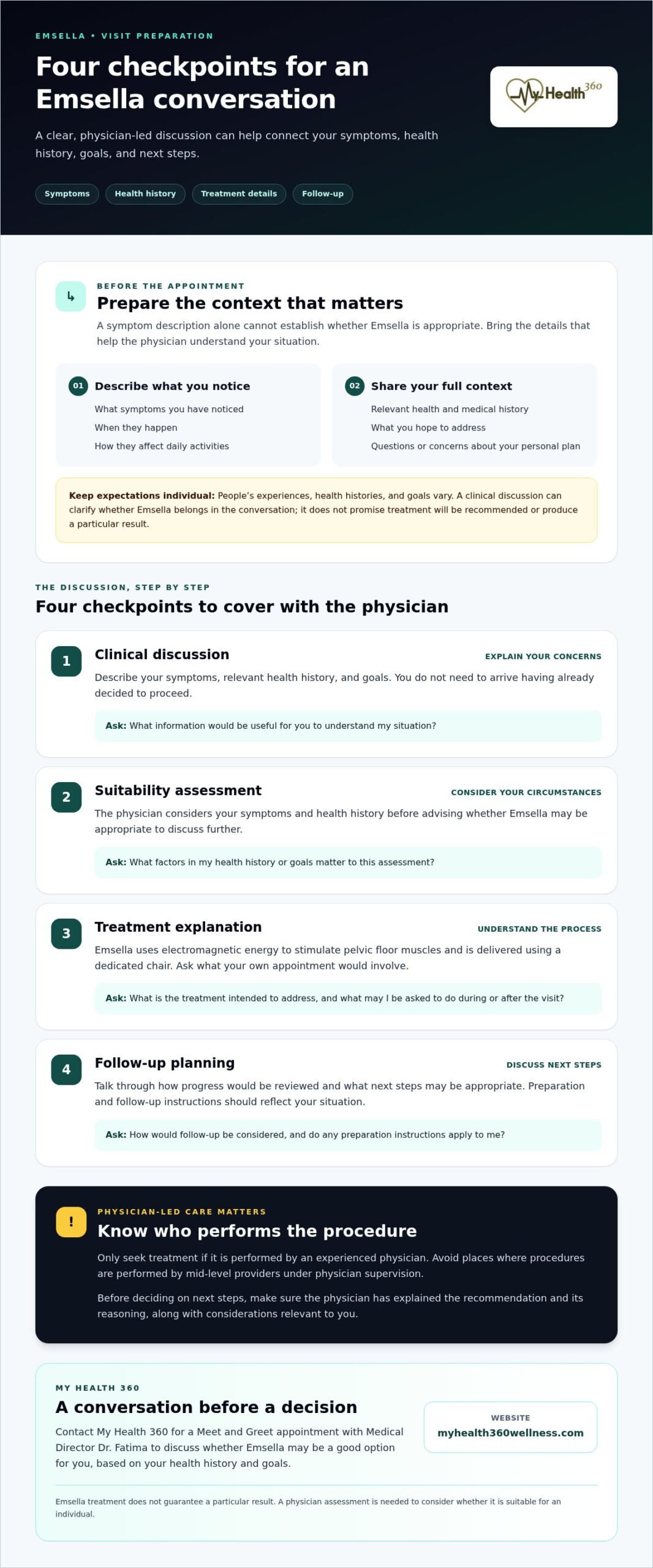
Knowing what to ask can help you make good use of a clinical conversation. The details of your visit and any treatment plan depend on the physician’s assessment. The discussion should clarify what you are experiencing, whether Emsella may be appropriate, what the treatment involves, and how follow-up would be considered. These are separate questions, not a promise that treatment will be recommended or produce a specific result.
A useful framework is:
- Clinical discussion: Describe your concerns, relevant health history, and goals.
- Suitability assessment: The physician considers your circumstances before advising whether to proceed.
- Treatment explanation: Ask how the procedure works and what it is intended to address.
- Follow-up planning: Discuss how progress would be reviewed and what next steps may be appropriate.
What happens before treatment?
Use the first conversation to explain what prompted you to seek guidance and what you hope to address. Share relevant medical history and ask about anything that might affect your personal plan. The physician can then assess whether Emsella is appropriate to discuss further. A symptom description alone cannot establish candidacy, and you do not need to arrive having already decided to proceed.
Ask the clinical team what information would be useful to bring and whether any preparation applies to your appointment. Instructions should be tailored to your situation rather than based on another person’s experience. Make sure you understand the recommendation and its reasoning before deciding on next steps.
What should patients expect during and after a visit?
The chair-based format is one general feature of Emsella, but it does not specify what will happen at every visit. Ask the physician to explain what your appointment will involve, what you may be asked to do, and whether there are instructions for afterward. Discuss any questions about sensations, preparation, or follow-up rather than assuming details from descriptions that may not reflect your plan.
It is also reasonable to ask how the treatment is intended to work. A published investigation of HIFEM technology for urinary incontinence offers research context, but a study cannot determine whether Emsella is suitable for you or predict your individual outcome.
Ask what the physician considers relevant to your case, what the treatment is intended to address, and how follow-up would be planned. For a physician-led discussion, contact My Health 360 to arrange a Meet and Greet with Medical Director Dr. Fatima and discuss whether Emsella may be a good option for you.
Who May Be a Candidate, and What Results Should You Expect?
A general description cannot determine whether Emsella is appropriate for you or predict your outcome. Similar concerns can arise in people with different health histories and goals, so candidacy should not be assumed based on age, a single symptom, or another person’s experience. A physician can consider your individual circumstances.
Exploring a treatment is not the same as receiving a recommendation, and a recommendation is not a promise of symptom relief. An assessment helps clarify whether Emsella fits the clinical picture, what it is intended to address, and what its limitations may be. Ask the physician to explain the expected benefits in the context of your own goals.
How is individual suitability assessed?
Suitability is a clinical question, not a conclusion drawn from one detail. The physician can consider your symptoms, relevant medical history, and what you hope to change. These are important discussion topics, not a checklist that determines candidacy on its own. The Medical Director can review individual considerations in the context of your health and care needs.
It may help to describe when the concern occurs, how it affects your daily life, and what you would consider a meaningful improvement. You can also mention previous evaluations or approaches to care that are relevant to your situation. This information supports an individualized discussion but does not predetermine the recommendation.
How can patients set realistic expectations?
Start with goals you can explain clearly, such as wanting to understand a symptom or its effect on a particular activity. Ask what Emsella is intended to address in your case, what it cannot address, and how the care plan would be reviewed. The treatment’s purpose is different from an assured outcome, and responses or timelines should not be presumed to be the same for everyone.
Pelvic-health concerns can involve more than one symptom or contributing factor. A discussion of urinary incontinence should be grounded in your individual situation, rather than used to infer that a specific treatment is suitable. The article’s Urinary Incontinence Treatment guide offers related educational context, while your physician can explain how your symptoms fit into the conversation.
Before deciding about Emsella chair treatment, consider asking: “What are we trying to address?”, “What would count as a meaningful change for me?”, and “How will we review whether the plan is appropriate?” These questions keep the discussion focused on your priorities without assuming a result.
To discuss your questions in a physician-led setting, Fatima. You can talk about your history, goals, and whether Emsella may be a good option for you.
Emsella Safety: Risks, Questions, and Physician-Led Precautions
Consider safety from the start, before deciding whether to proceed. This section is general information, not a substitute for a clinician’s assessment of your personal risks. Emsella may not be appropriate for everyone. An online description cannot account for your health history or determine which precautions apply to you.
Safety summary: General information can help you prepare questions, but an individualized physician assessment is needed to discuss personal risks and guide a treatment decision.
What risks and complications should be discussed?
Ask the physician to explain the potential complications, risks, and limitations relevant to your situation. Make sure you understand which concerns apply to Emsella and which relate to your individual health circumstances. Do not assume that a treatment described as non-invasive is risk-free. The physician can explain what is known about the treatment and address your personal questions before you decide.
Share relevant health history as accurately as you can, including details you think might affect the assessment. If you are unsure whether something matters, mention it rather than deciding on your own that it is unrelated. The physician can explain which details are relevant and whether further assessment is appropriate before discussing a plan.
What steps support an informed treatment decision?
Before deciding, make sure you understand who performs the treatment, how your suitability is assessed, and how clinical instructions will be communicated. Ask the physician to explain any precautions that apply to you and clarify unfamiliar terms. You can also ask what the treatment is intended to address, what it cannot address, and how your concerns will shape the discussion.
My Health 360 emphasizes physician-led care. The safety guidance is direct: Only seek treatment if performed by an experienced physician. Avoid places where procedures are performed by mid-level providers under physician supervision. Physician supervision does not change this guidance.
Pause if an explanation leaves you uncertain. You should have the opportunity to ask questions, understand the physician’s assessment, and make a considered choice without relying on broad claims about other patients’ experiences. Clear communication matters when personal health factors may affect the decision.
For a personal discussion of Emsella safety and suitability, contact My Health 360 to arrange a Meet and Greet with Medical Director Dr. Fatima. Share your health history and questions, then discuss whether Emsella may be a good option for you.
Exploring Emsella at My Health 360 in Buffalo and Western New York
For people considering Emsella in Buffalo and surrounding Western New York communities, a useful next step is a conversation grounded in individual circumstances, not a general promise. My Health 360 is a physician-owned Longevity, Recovery, and Performance Center serving the region. The center offers Emsella as part of its women’s health services and provides a physician-led setting to discuss your goals and health history.
Medical Director Dr. Umbrine Fatima is an American Board Certified Internal Medicine specialist. A Meet and Greet gives you the opportunity to raise questions, explain what you hope to address, and discuss whether the procedure may be relevant to your situation. The conversation is not a guarantee of candidacy or results. It helps put the decision in clinical context.
What does a physician-led conversation add?
A physician-led conversation connects your questions and goals with a review of relevant health history and clinical suitability. Instead of assuming that a symptom points to one particular procedure, you can describe what you have noticed and ask what Emsella may or may not address in your case. The physician’s assessment can help clarify whether it is an option to consider.
For broader pelvic-health education, My Health 360’s Urinary Incontinence Treatment guide offers related context. Use general information to prepare questions, not as a substitute for an individualized discussion. Before meeting with the Medical Director, note what you want to understand, including how your symptoms relate to your goals.
How can Buffalo-area readers take the next step?
Before a Meet and Greet, consider writing down your concerns, relevant health-history details, and what a meaningful next step would look like for you. Ask how the physician evaluates suitability, what the treatment is intended to address, and what other considerations could shape a recommendation. You do not need to decide in advance that Emsella is right for you. The purpose is to have a clear, informed conversation.
For readers in Buffalo and across Western New York, My Health 360 offers a physician-led setting to explore Emsella. Dr. Fatima can discuss your circumstances and whether the procedure may be a good option for you, without assuming the same recommendation or outcome applies to everyone.
Fatima and discuss whether Emsella may be a good option for you.
Make Your Next Step an Informed One
You do not need to arrive at a decision with certainty. Bring your questions, priorities, and concerns to a conversation where a recommendation can be considered in light of your circumstances. That keeps your decision about Emsella chair treatment grounded in what matters to you, rather than assumptions about what it may do.
If you are ready to explore the next step, contact My Health 360 to arrange a Meet and Greet with Dr. Fatima and discuss whether the procedure may be a good option for you. Ask what matters to you, take the time you need, and make an informed decision with the Medical Director.
Frequently Asked Questions
Is Emsella chair treatment suitable for everyone?
No. A general article or symptom description cannot establish whether Emsella chair treatment is suitable for you. Before an appointment, note when your concern occurs and which daily activities it affects so you can describe your experience clearly. The Medical Director can consider that context alongside your health history and goals when discussing whether Emsella is appropriate to consider.
Can men consider Emsella chair treatment?
Men can raise questions about Emsella with a physician, but gender alone does not establish suitability or predict a particular benefit. Explain the concern you want to address and share relevant health-history details rather than assuming the same recommendation applies to everyone. The physician can discuss whether the treatment is appropriate to consider in your circumstances and how it relates to your goals.
What should I wear to an Emsella appointment?
Follow the appointment guidance provided by My Health 360’s clinical team rather than assuming clothing instructions based on another clinic’s process. When arranging a Meet and Greet, ask practical questions such as what to wear and whether any preparation is needed. The Medical Director can explain the instructions relevant to your appointment and plan.
Does Emsella treatment replace other pelvic-health care?
Do not assume Emsella replaces other pelvic-health care or belongs in every care plan. The role of any treatment depends on your concerns and clinical assessment. Ask the physician how Emsella may fit alongside care you already receive, what other considerations may be relevant, and what the treatment is not intended to address. This keeps decisions about your broader care grounded in your individual needs.
How many Emsella treatments will I need?
Do not assume a session count or schedule applies to everyone. Treatment planning is a discussion to have with the physician after an individual assessment. Ask what factors inform the proposed plan, how follow-up will be approached, and when the plan might be reviewed. Schedules described elsewhere cannot replace guidance tailored to your assessment, and no schedule guarantees a specific outcome.
How do I discuss Emsella treatment with a physician in Buffalo?
Fatima. Bring your questions, explain what you hope to address, and share relevant health history. If you are in Buffalo, Clarence, Orchard Park, Grand Island, Tonawanda, Elma, Amherst, Williamsville, or elsewhere in Western New York, use the conversation to discuss whether Emsella may be a good option for you without assuming suitability or results.