
Is your current healthcare provider merely managing your symptoms, or are they actively architecting your vitality? When weighing concierge medicine vs traditional care, the distinction often comes down to whether you’re a patient in a high-volume queue or a partner in a sophisticated, high-performance longevity strategy. You’ve likely felt the frustration of fragmented care and the clinical coldness of a system that prioritizes throughput over thoroughness. It’s common to feel that your complex goals for aging and performance are often secondary to the administrative demands of a standard primary care panel.
This 2026 guide provides a comprehensive look at the structural differences between these models, illustrating why a performance-focused approach is essential for those seeking more than just the absence of illness. You’ll discover how direct physician access and the integration of medical aesthetics create a cohesive path toward functional longevity. We’ll examine the specific methodologies, such as BioPrime habilitation and the medical gym concept, that define a proactive plan for optimizing both your healthspan and your aesthetic results.
Key Takeaways
- Compare the structural impact of concierge medicine vs traditional care, focusing on how reduced patient panels transform healthcare from a transaction into a disciplined partnership.
- Discover how same-day access and extended consultations provide the clinical depth required to discuss complex longevity goals and comprehensive bio-metrics.
- Learn about the exclusive BioPrime and Bio-Restore programs designed to optimize your physiological state through physician-led habilitation.
- Explore the integration of medical-grade aesthetics and functional recovery within a Medical Gym framework to enhance both your appearance and your healthspan.
- Understand the strategic value of a membership-based model in managing your wellness objectives while maintaining your existing insurance coverage.
The Limitations of Traditional Primary Care in 2026
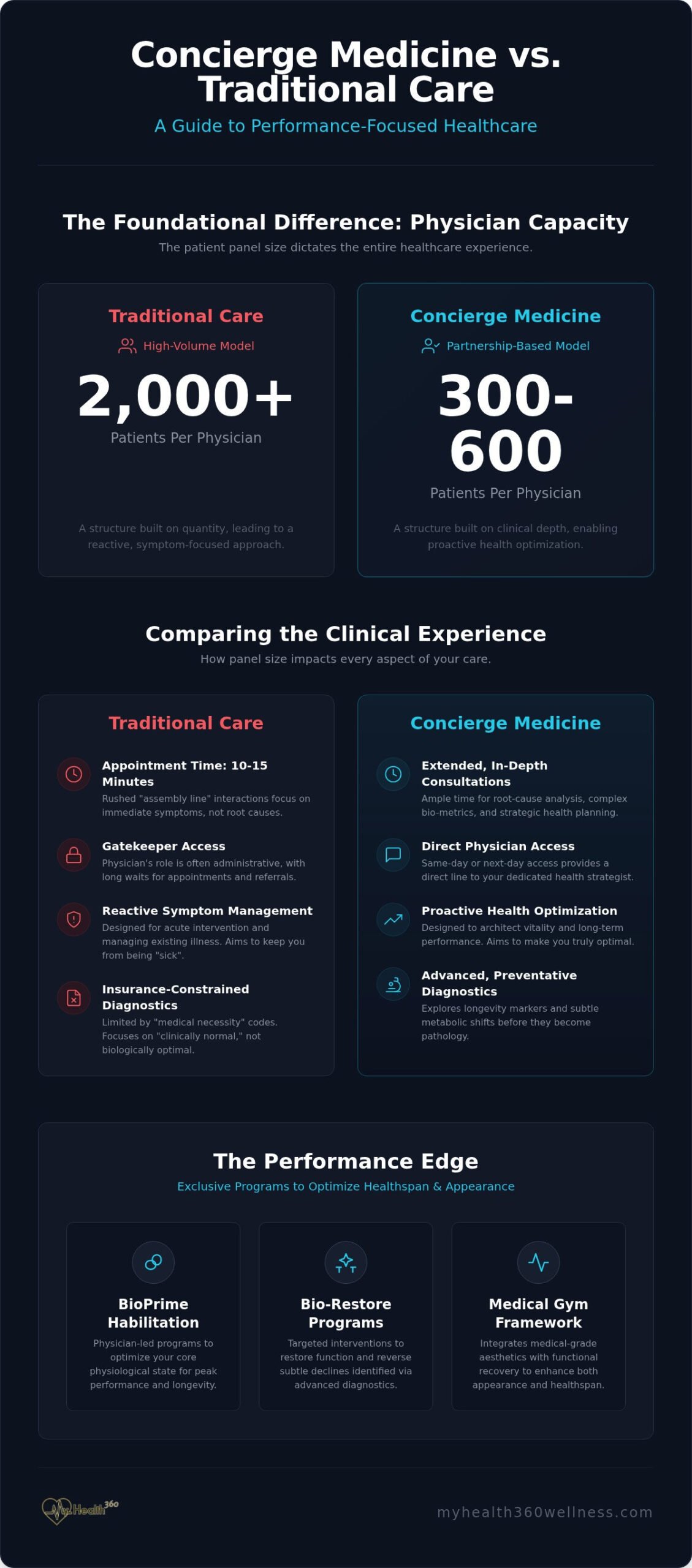
Traditional primary care operates as a high-volume, insurance-driven engine. It’s a system designed for acute intervention and management of existing illness rather than the sophisticated architecture of long-term performance. When analyzing concierge medicine vs traditional care, the most significant disparity lies in the “panel size.” A typical traditional physician manages a patient load of 2,000 individuals or more. This staggering volume isn’t a choice; it’s a financial necessity dictated by standard insurance reimbursement structures that reward quantity over clinical depth.
The result is a reactive model of medicine. In this environment, the physician’s role is often reduced to that of a gatekeeper, processing symptoms and managing administrative documentation rather than acting as a dedicated health strategist. For individuals with high-performance goals, this system feels restrictive. It lacks the capacity to integrate advanced diagnostics or the time required to understand a patient’s unique physiological history. The traditional model is built to ensure you aren’t “sick,” but it rarely has the resources to ensure you are truly optimal.
The Assembly Line Effect: Why Time is the Enemy
Why does the standard doctor’s visit feel so rushed? Most traditional clinics operate on a strict 10 to 15 minute appointment window. Within this brief period, the physician must review your history, perform an exam, and complete complex electronic health record documentation. This time constraint creates an “assembly line” effect where the focus shifts toward immediate symptom relief. There’s little room for a root-cause analysis or a discussion about how your current lifestyle impacts your future longevity. This is why many are seeking a patient centered primary care approach that prioritizes the quality of the interaction over the number of patients seen in a day.
Insurance Constraints on Preventative Innovation
Insurance companies utilize “medical necessity” codes to determine which screenings and treatments are covered. These codes are fundamentally conservative and designed to address active pathology. When a patient wants to explore advanced longevity-focused diagnostics or preventative screenings, they often hit a wall of bureaucratic friction. To better understand the structural shift away from these hurdles, it helps to define What is Concierge Medicine? and how it liberates the physician from these constraints.
In the traditional model, there’s a massive gap between “clinically normal” and “biologically optimal.” If your blood work falls within a standard reference range, the insurance-based system considers you healthy. However, for those focused on performance, being “average” isn’t the goal. Traditional care often fails to identify the subtle hormonal or metabolic shifts that signal a decline in vitality because those tests don’t meet the narrow criteria of insurance-mandated necessity.
What is Concierge Medicine? A Foundation for Performance
Concierge medicine is a membership-based clinical relationship that replaces the transactional nature of the insurance-first model with a dedicated partnership. Unlike the high-volume environment described previously, this model prioritizes availability and clinical depth. When evaluating concierge medicine vs traditional care, the foundation is built on three pillars: significantly smaller patient panels, expanded physician access, and extended visit times. This structure allows for a proactive approach where the physician has the bandwidth to move beyond basic diagnostics into true health optimization.
While standard concierge models focus primarily on convenience, integrative performance medicine utilizes this framework to drive specific longevity outcomes. It provides the necessary time for a physician to curate a longevity plan tailored to a patient’s unique biomarkers and performance goals. This model isn’t just about getting an appointment faster; it’s about what happens during that appointment when the physician isn’t rushed by a waiting room full of patients.
The Physician-Patient Relationship Reimagined
In a standard practice, a doctor might see 25 patients a day. In a concierge environment, that number drops to a handful. This reduction allows for panels of 300 to 600 people, ensuring your physician actually knows your history and physiological nuances. They become a health architect, designing a strategy that accounts for your professional demands, athletic goals, and long-term vitality. Direct communication via phone or video becomes a standard tool for maintaining this continuity, transforming the doctor from a distant gatekeeper into an accessible guide.
Integrative Concierge Medical Care for Longevity
Standard concierge care often stops at better access. Performance-driven medicine goes further by bridging the gap between traditional allopathic medicine and wellness optimization. This is where integrative medicine for longevity becomes essential. It ensures that treatments, from hormone optimization to advanced medical aesthetics, are performed under the same rigorous clinical oversight as a cardiac screening. This fundamental shift in concierge medicine vs traditional care ensures that functional health and aesthetic goals are managed in harmony. Understanding how these models differ is the first step toward reclaiming control over your health trajectory through an integrative medical approach.
Concierge vs. Traditional Care: The Direct Comparison
The structural differences between these models are best understood through the following metrics, which define the daily experience of the patient:
- Average Wait Time: Traditional (2-4 weeks) vs. Concierge (Same-day or next-day)
- Standard Visit Length: Traditional (10-15 minutes) vs. Concierge (30-60+ minutes)
- Physician Panel Size: Traditional (2,000+ patients) vs. Concierge (300-600 patients)
This reduced panel size isn’t just about convenience; it’s about continuity. When a doctor sees you frequently and without the pressure of a ticking clock, they’re far more likely to identify subtle shifts in your biomarkers. This level of attention is the cornerstone of concierge performance medicine, where the goal is to maintain peak physiological state rather than simply managing a crisis as it arises.
Proactive vs. Reactive Health Outcomes
Traditional care is fundamentally reactive. It waits for pathology to manifest before intervening. You go to the doctor because something “breaks.” Concierge medicine flips this script by prioritizing proactive habilitation. This approach is exemplified by mobile services like REVĪV, which provides concierge regenerative medicine for spine and joint pain in a home-based setting. By utilizing comprehensive bio-metrics instead of routine vitals, physicians can spot trends in inflammation, metabolic health, and hormonal balance years before they become chronic conditions.
The long-term ROI of this approach is significant. Investing in early intervention and performance optimization reduces the likelihood of expensive, debilitating chronic illnesses later in life. It’s a strategy that supports both mental and physical vitality simultaneously, ensuring that your healthspan matches your lifespan. You aren’t just living longer; you’re performing better at every stage of the journey.
How does one move beyond the basic maintenance of health into the realm of peak physiological performance? The answer lies in whole body habilitation, a concept that remains virtually absent in the standard healthcare model. When comparing concierge medicine vs traditional care, the integration of advanced recovery technologies highlights a critical gap in the insurance-based system. While traditional care reacts to injury after it occurs, concierge performance medicine prepares the body to withstand stress before it manifests as a limitation.
This proactive stance is exemplified by the BioPrime program, which focuses on pre-operative and pre-event optimization. By enhancing physiological reserves and metabolic health before a physical stressor, patients experience superior outcomes and faster return-to-play. Conversely, the Bio-Restore program provides a structured, physician-led framework for post-operative or post-injury recovery. These aren’t merely wellness perks; they’re clinical protocols that integrate medical-grade whole body red light therapy and IV hydration to accelerate cellular repair and metabolic efficiency under professional oversight.
Physician-Led Aesthetics: Morpheus8 and Emsculpt Neo
Why should a board-certified internal medicine specialist oversee body contouring and skin rejuvenation? Treatments like Emsculpt Neo and Morpheus8 treatment are often relegated to non-clinical med-spas, yet their impact on tissue health and muscle architecture is profound. In a performance center, these technologies are used to enhance the structural integrity of the body. Having a physician manage these procedures ensures that aesthetic goals never compromise safety or the overarching longevity plan. This clinical oversight provides a level of precision and risk management that traditional aesthetic environments cannot match.
HIFEM and RF Technology in Longevity
The science of High-Intensity Focused Electromagnetic (HIFEM) and Radiofrequency (RF) technology allows for simultaneous muscle building and fat reduction, providing a critical foundation for metabolic health. This extends to pelvic floor integrity through urinary incontinence treatment like Emsella, which stabilizes the core and improves quality of life. These technologies collectively support functional longevity by maintaining the muscular and structural strength necessary for an active, independent life as you age. By addressing the body as a unified system, we ensure that your physical capabilities match your long-term health aspirations.
Explore our full suite of integrative performance services to begin your optimization journey.
Choosing the Right Path for Your Health 360 Journey
Deciding between concierge medicine vs traditional care is a strategic investment in your future self. It’s a choice for those who view health as an asset to be optimized rather than a liability to be managed. While the traditional model serves its purpose for basic triage, the performance-driven approach is designed for individuals who demand a higher level of precision and advocacy. The transition isn’t merely about changing doctors; it’s about shifting your entire health paradigm from a reactive state to a proactive strategy.
A common misconception is that joining a concierge practice means you can discard your health insurance. This isn’t the case. You still need insurance for hospitalizations, major surgeries, and certain specialist visits. Think of concierge care as the specialized “architect” of your health, while insurance remains the safety net for structural emergencies. By combining the two, you ensure that your daily performance is architected by an expert while your catastrophic risks remain covered.
Who Benefits Most from the Concierge Model?
High-achievers and competitive athletes often find that standard care doesn’t account for their elevated physical and cognitive demands. Similarly, individuals navigating significant life transitions, such as hormonal shifts or recovery from chronic injury, require a level of oversight that a 15-minute appointment cannot provide. This model is also invaluable for those with complex medical histories who need a physician to bridge the gap between multiple specialists, ensuring that no treatment plan conflicts with another. Within this broader ecosystem, specialized resources like sexual wellness clinics play a vital role, ensuring that vitality and performance are addressed from every physiological angle.
The My Health 360 Difference
At My Health 360, we don’t just offer access; we offer a sophisticated blend of internal medicine and aesthetic precision. Dr. Umbrine Fatima’s “Art and Science” philosophy ensures that your functional health and aesthetic goals are treated as a single, harmonious objective. We are the exclusive providers of the BioPrime and Bio-Restore programs, offering a level of whole-body habilitation that simply isn’t available in standard insurance-based practices. This physician-led approach ensures that every treatment, from body contouring to metabolic optimization, is performed with the highest level of clinical safety and academic rigor.
Transitioning to our center begins with a comprehensive strategy session where we review your medical history and define your performance goals. From there, we build your longevity plan, integrating advanced technologies under the oversight of an American Board Certified specialist. Ready to move beyond the limitations of the standard model? Contact us today for a comprehensive wellness consultation and take the first step toward a performance-driven future.
Architecting Your Future Vitality
The evolution of healthcare in 2026 demands a departure from the high-volume, reactive systems of the past. When you choose concierge medicine vs traditional care, you’re selecting a model that prioritizes your unique physiological blueprint over administrative throughput. This shift ensures that your health isn’t just maintained but actively optimized through physician-led strategies that account for both your functional and aesthetic goals. It’s the difference between merely avoiding illness and actively pursuing peak performance.
At My Health 360, we bridge the gap between internal medicine and performance. Led by American Board Certified Internal Medicine Specialist Dr. Umbrine Fatima, our center provides exclusive access to BioPrime and Bio-Restore habilitation programs. We integrate medical-grade technologies like Emsculpt Neo and Morpheus8 to ensure your physical results match your internal vitality. This disciplined, holistic approach provides the structural framework necessary for long-term health and performance.
You deserve a health partner who views your body through a lens of both science and art. Begin your journey to peak longevity with My Health 360. Your path to a high-performance future starts with a single, intentional step toward comprehensive care.
Frequently Asked Questions
What is the main difference between concierge medicine and traditional care?
The primary distinction in concierge medicine vs traditional care is the structural shift from a high-volume, insurance-dictated model to a membership-based relationship that prioritizes physician access and clinical depth. Traditional practices focus on acute symptom management within brief time windows. Concierge care provides the time and resources necessary for proactive health architecture, allowing for extended consultations and a more comprehensive analysis of your physiological markers.
Does concierge medicine replace my health insurance?
Concierge medicine doesn’t replace your health insurance; it functions as a specialized layer of personalized care. You still require insurance to cover major medical events, hospitalizations, surgical procedures, and specialist consultations. The membership fee covers the enhanced access and performance-driven services provided by your concierge physician, ensuring you have a dedicated advocate to navigate the complexities of the broader healthcare system and insurance requirements.
Why is concierge medicine better for longevity and performance?
Concierge models excel at longevity because they move beyond the “clinically normal” benchmarks used in traditional care to target “biologically optimal” states. By utilizing advanced bio-metrics and frequent monitoring, your physician can identify subtle metabolic or hormonal shifts before they manifest as chronic conditions. This proactive framework allows for the integration of performance technologies and personalized nutrition plans that are simply not feasible in high-volume, reactive clinics.
Can I still see specialists if I have a concierge doctor?
You can and should see specialists when necessary, but a concierge doctor acts as your central advocate to ensure care isn’t fragmented. In the standard model, patients often navigate specialty referrals alone. In a concierge practice, your physician coordinates with specialists, reviews their findings through the lens of your long-term longevity plan, and ensures that all treatments are harmonized with your overall health objectives and safety.
How does concierge care integrate with medical aesthetics like Morpheus8?
At My Health 360, medical aesthetics are integrated into your health plan under the clinical oversight of a board-certified physician. Unlike traditional med-spas, we view treatments like Morpheus8 and Emsculpt Neo as vital components of tissue health and structural integrity. This ensures that aesthetic enhancements are performed with the same level of medical rigor as your internal health screenings, prioritizing clinical safety and long-term biological harmony.
What happens if I have an emergency outside of office hours?
If you experience a life-threatening emergency, you should always call 911 or visit the nearest emergency department. For urgent but non-emergency concerns, concierge care provides direct physician access via phone or video, often outside of standard business hours. While we don’t provide 24/7 emergency room services, having a doctor who knows your history available for immediate consultation can often prevent unnecessary hospital visits and ensure continuity of care.
Is concierge medicine suitable for post-operative recovery?
Concierge care is exceptionally well-suited for post-operative recovery through specialized programs like Bio-Restore. These protocols are designed to accelerate healing by utilizing medical-grade technologies such as whole-body red light therapy and IV hydration. By providing physician-led oversight during the vulnerable weeks following a procedure, the concierge model ensures that your recovery is methodical, safe, and optimized for a rapid return to your daily performance baseline.
How many patients does a concierge physician typically manage compared to traditional doctors?
The difference in panel size is significant. A traditional primary care doctor typically manages a panel of 2,000 to 3,000 patients, which necessitates the 15-minute appointment model. In contrast, a concierge physician manages a significantly smaller panel, usually between 300 and 600 patients. This reduction in volume is what allows for same-day availability, hour-long visits, and the deep clinical relationship required for effective, performance-driven healthcare.