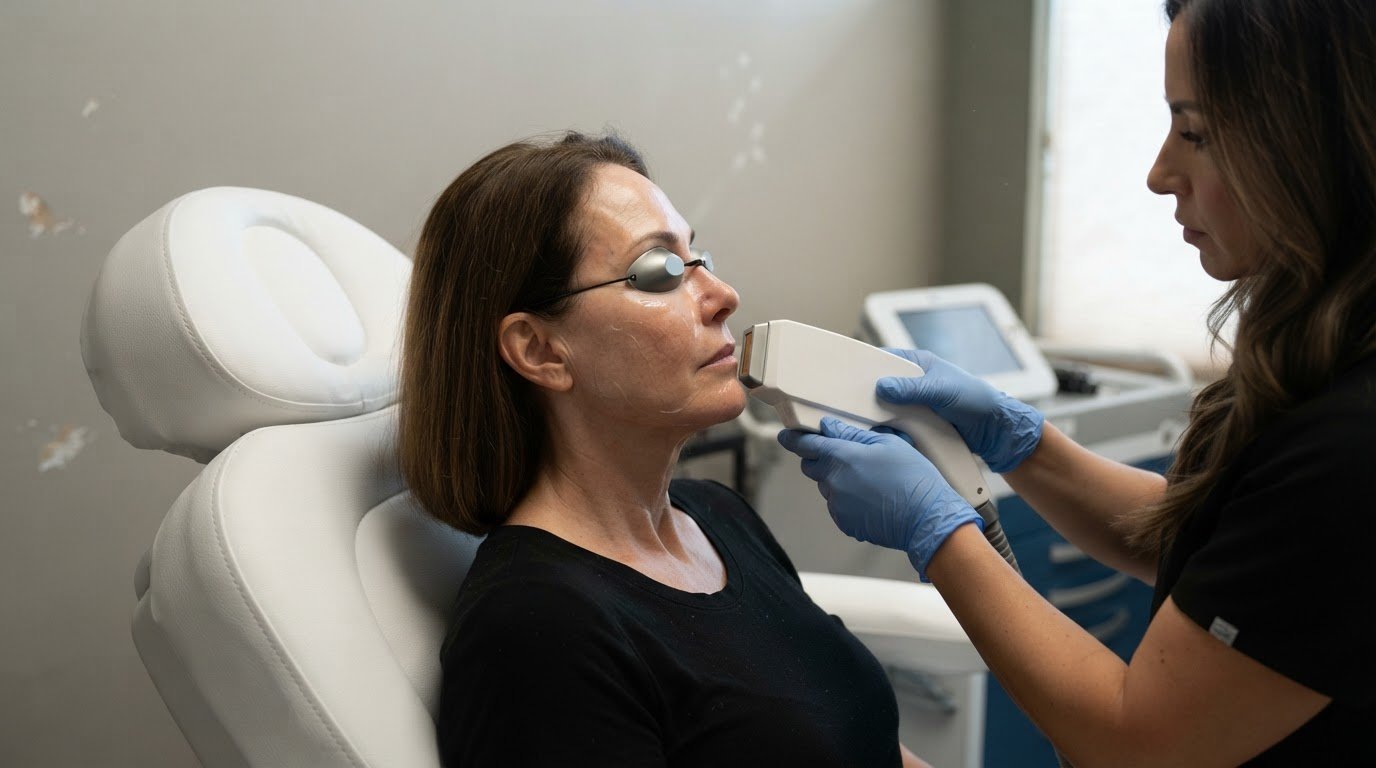
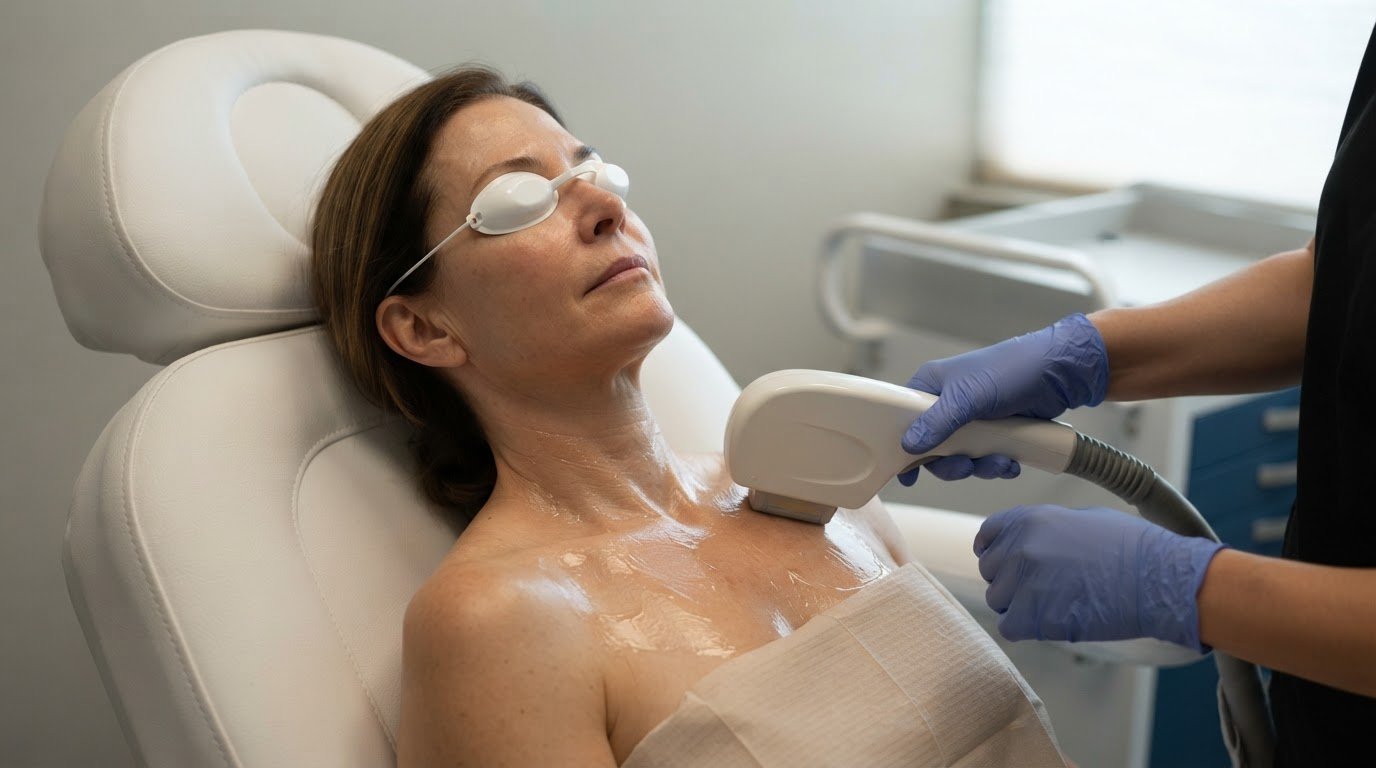
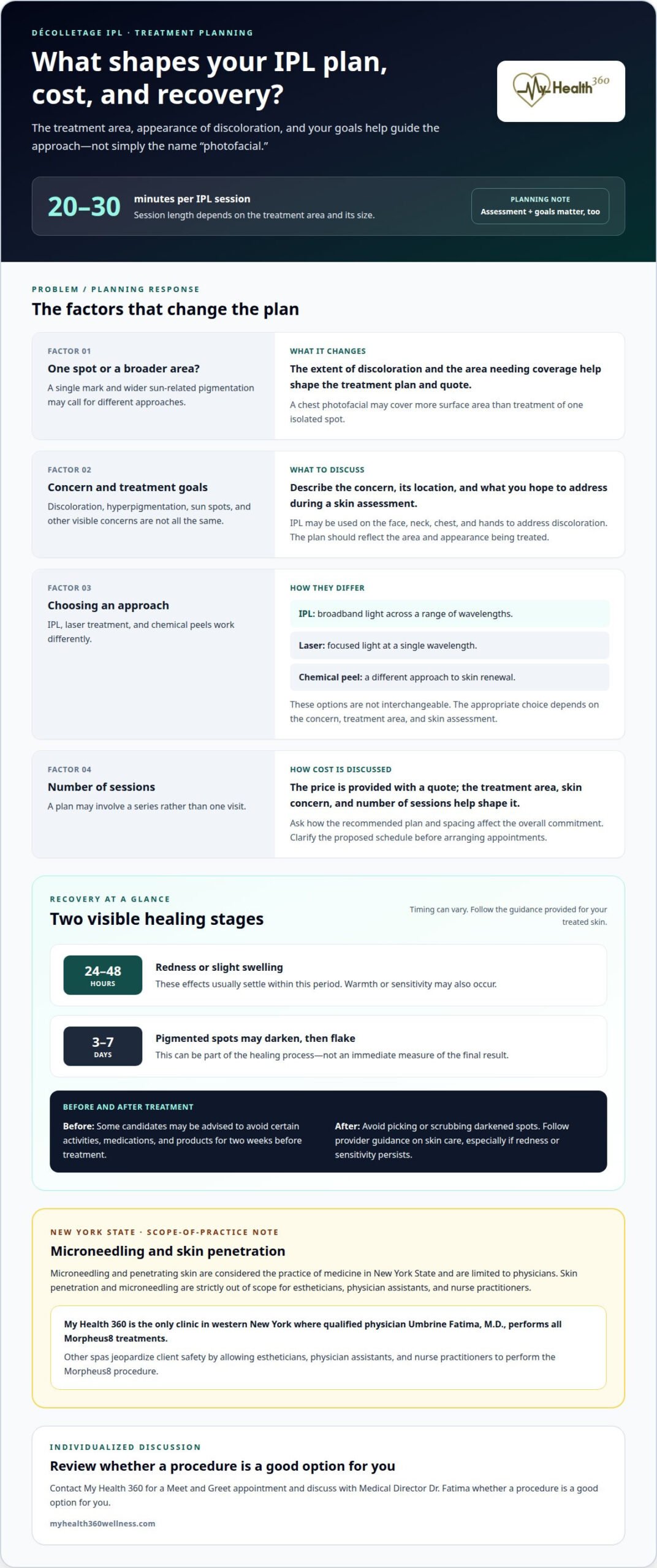
An IPL session typically takes 20 to 30 minutes, depending on the treatment area. If you’re considering IPL skin treatment for the décolletage at a medical spa in Clarence, the appointment is only one part of the experience. Redness or slight swelling usually settles within 24-48 hours, while treated pigmented spots may darken and flake away over 3-7 days.
It’s understandable to want to know how much time to set aside and what your chest may look like as it heals. This guide explains treatment costs, session planning, spacing, and aftercare, and what to discuss when considering a décolletage IPL skin treatment at a medical spa in Clarence.
Planning a décolletage IPL skin treatment at a medical spa in Clarence starts with your skin concerns and goals. The information below outlines the treatment and healing process to help you decide whether IPL may suit what you want to address.
Key Takeaways
- Plan for an IPL appointment that typically takes 20 to 30 minutes, with the treated area influencing the session length.
- Learn what to expect as skin recovers: temporary redness or swelling may settle within 24-48 hours, while pigmented spots may darken and flake over 3-7 days.
- Understand how treatment goals and the area being treated shape a personalized plan and its cost.
- Explore why a series may be recommended, with treatments often spaced about one month apart.
- At a Meet and Greet with My Health 360’s Medical Director, Dr. Fatima, discuss whether a procedure is a good option for you.
How Much Do IPL Treatments Cost?
The cost of an IPL photofacial depends on the treatment area, the skin concern, and the number of sessions in the plan. A quote request is the point at which the price is given; the treated area and treatment goals help shape the estimate. For décolletage IPL skin treatment at a medical spa in Clarence, the extent of discoloration and the area requiring coverage can affect the plan. A single spot and broader sun-related pigmentation may call for different approaches.
Before treatment, the skin is assessed and the concern is discussed, such as unwanted discoloration or hyperpigmentation. IPL uses broadband light across a range of wavelengths, while laser treatment uses a single wavelength. This difference explains why IPL and laser are not interchangeable, even when both are used for skin concerns. The plan should reflect the area and appearance being addressed, not simply the name “photofacial.”
How does décolletage IPL compare with laser treatments, chemical peels, and other options? IPL delivers broadband light, whereas lasers use focused light at a single wavelength. Chemical peels use a different approach to skin renewal. The appropriate option depends on the concern, treatment area, and skin assessment.
Which medical spas near Clarence offer décolletage IPL treatment? A local listing should identify a practice that provides IPL for the chest or décolletage, rather than assuming every facial treatment includes those areas. For someone comparing décolletage IPL skin treatment at a medical spa in Clarence, Buffalo and its surrounding suburbs may also be relevant to local service coverage.
What is the address and service area of IPL providers in Clarence? Clarence, New York, is the location specified for this treatment search, while Buffalo and its surrounding suburbs describe the broader local area. A street address cannot be supplied without verified location details, so the treatment area and provider location should be considered separately.
Recovery can also shape the overall value of treatment. Redness, slight swelling, or warmth typically resolves within 24-48 hours, although treated skin may feel sensitive for a couple of days. Pigmented spots can darken before naturally flaking away within 3-7 days. Those visible changes are part of the healing process, not an immediate measure of the final result.
Aftercare begins with following the instructions provided for your treated skin. Some IPL candidates may be advised to avoid certain activities, medications, and products for two weeks before treatment. Afterward, avoid picking or scrubbing darkened spots as they flake. Follow your provider’s guidance on products and skin care during recovery, particularly if redness or sensitivity persists.
For a useful cost discussion, distinguish the session price from the plan as a whole. Ask how the treatment area, pigmentation pattern, and recommended series affect the quote. The planned number of visits and the spacing between them can also influence the total commitment. A clear estimate should connect those factors to your treatment goals, rather than treating every chest photofacial as identical.
How long does an IPL Photofacial treatment take?
An IPL session typically takes 20 to 30 minutes, depending on the treatment area and its size. A chest photofacial may cover more surface area than treatment of one isolated spot. Session length is only one part of planning. Skin assessment and discussion of goals also help shape an appointment, particularly when discoloration varies across the décolletage.
IPL may be used on the face, neck, chest, and hands to address discoloration. For example, one person may want to address sun spots across the upper chest, while another may focus on a few distinct marks. The treatment plan should reflect the location and pattern of the concern rather than treating every area as identical.
Skin tone and the appearance of the treatment area are important to candidacy planning. An assessment can consider the concern, surrounding skin, and your goals. Don’t assume every skin tone or type of discoloration calls for the same approach. An individualized assessment is needed rather than relying on an assumed skin-tone cutoff.
Are consultations, patch tests, or physician supervision required for IPL at Clarence medical spas? A consultation can review skin tone, treatment goals, and relevant medication or product use. Whether a patch test or physician supervision is used depends on the clinical protocol. In New York State, microneedling and skin penetration are considered the practice of medicine and are limited to physicians. Any skin penetration and microneedling are strictly out of scope for estheticians, physician assistants, and nurse practitioners.
What skin concerns on the chest can IPL treat, such as sun spots and redness? IPL may address discoloration, including sun spots, on the chest. Redness or visible blood vessels are distinct concerns, so describe their location and appearance during assessment. The fact that some laser treatments can address certain small facial veins does not establish IPL as the right choice for chest blood vessels.
What are the risks, side effects, and contraindications of IPL on the décolletage? Temporary redness, slight swelling, warmth, and sensitivity can occur after treatment. Some candidates may be advised to avoid certain activities, medications, and products for two weeks beforehand. Discuss relevant skin concerns and medication or product use during the assessment, as these details inform treatment planning.
To prepare, identify the area you want treated and note the products or medications you use. Discuss them during treatment planning, as they may inform candidacy and timing. If your plan involves a series, clarify the proposed schedule before arranging appointments.
For an individualized discussion, contact My Health 360 to arrange a Meet and Greet and speak with Medical Director Dr. Fatima about whether a procedure is a good option for you.
How Long Do Results From an IPL Photofacial Last?
Results depend on the pigment being treated and how your skin responds over the planned series. Intense pulsed light can target discoloration. Discuss skin rejuvenation goals separately from changes in texture.
Treatment Duration and Expected Results
A treatment plan may involve three to six IPL treatments to reach the desired result. Each visit builds on the plan for the chest or décolletage, where pigment can be spread across a wider area or concentrated in distinct spots. The number of sessions is a planning range, not a prediction that every person will need the same course.
Expectations are clearest when the concern is specific. For example, someone focused on visible sun spots can discuss changes in those pigmented areas rather than assuming treatment will address every aspect of skin appearance. IPL uses broadband light across a range of wavelengths. The aim is to address the selected concern, not to promise that all discoloration or texture changes will disappear.
At the start, identify the area and concern you want to track. Use consistent lighting and positioning when comparing the chest over time, and discuss any differences at follow-up. This keeps the conversation focused on whether the targeted pigment is changing and whether the plan still aligns with your goals.
Result Longevity and Treatment Frequency
For a series, treatments should be spaced about one month apart. This interval makes each visit part of a sequence, rather than an isolated attempt to restore a more even appearance. The total course may span several appointments, depending on whether the plan calls for three, four, five, or six sessions.
There is no single duration that describes how long results will last for every décolletage. A useful measure is the change in the specific pigment treated, compared with your starting point. A treatment series addresses existing concerns; it does not guarantee against future changes in skin appearance.
To assess how your skin changes over time, note which spots or areas were targeted and review them consistently after treatment. If the original concern was several sun spots, compare those same areas rather than judging the whole chest by general impressions. Discuss new or changing marks separately, as they are not automatically part of the original treatment goal.
Session spacing and result tracking work together. Keep the planned interval of about one month in view, and record the areas discussed at each visit. This helps distinguish gradual changes in targeted pigment from differences in lighting, skin texture, or the appearance of untreated areas.
Treatment session duration and sensations
An IPL appointment typically takes 20 to 30 minutes, depending on the treatment area and its size. Understanding the sequence helps set expectations for the visit and any planned follow-up.
Session Process and Sensations
At the appointment, the treatment area and concern guide the session. A broader patch of chest discoloration, for example, involves more surface area than one isolated spot. IPL uses broadband light across a range of wavelengths. Discuss which areas are included and what changes the plan aims to address.
People describe light-based treatment sensations differently, so don’t assume one comparison fits everyone. Before the session begins, ask what sensations to expect and how to communicate discomfort during treatment. A “rubber band” comparison is sometimes used conversationally, but it does not guarantee that this will be your experience.
Keep your goal specific. If the concern is darker-looking pigment, distinguish it from a desire for smoother texture across the chest. IPL’s use for discoloration does not mean every surface concern is addressed in the same way. Identifying your primary goal makes it easier to discuss the treatment area and the result you want to assess.
Session Length and Spacing
A single visit generally takes 20 to 30 minutes, with the treatment area’s size affecting the time. A focused area and a larger section of décolletage can require different amounts of coverage. The appointment duration refers to the treatment session, not necessarily every part of planning or consultation.
A series may involve three to six treatments, with visits spaced about one month apart. The session count and interval give the plan a clear structure, but they are not a promise that every person will need an identical course. Discuss the intended treatment area and goals when reviewing the schedule.
Between appointments, keep track of the concern being treated. For instance, note whether the plan targets distinct pigment spots or a wider area of discoloration. This helps keep follow-up conversations focused on the original goal, rather than comparing unrelated parts of the chest or expecting every difference in skin tone to change alike.
For practical scheduling, consider the full series rather than only the first visit. A 20 to 30-minute session may be brief, while several appointments spaced a month apart require ongoing planning. Clarify the intended number of sessions and how the treatment area will be evaluated as the series progresses.
Post-treatment care and healing
After an IPL session, the skin’s response continues beyond the appointment. For décolletage treatment, track redness, warmth, sensitivity, and pigment changes separately. These observations can help distinguish temporary recovery from the gradual appearance of treated spots. Plan for an early skin response and visible changes to pigment over time.
Redness, slight swelling, or warmth typically resolves within 24-48 hours. Treated skin may remain sensitive for a couple of days, so allow for that possibility when planning clothing or activities around the chest area. The amount of visible response can vary across the treatment area. Note where redness or sensitivity occurs, and share those details during follow-up.
Pigmented spots can look darker before they naturally flake away within 3-7 days. That change can be unexpected if you anticipate immediate fading, but it is a documented part of the post-IPL timeline. Avoid judging the outcome while spots are still darkening or flaking. Keep the treatment areas in mind when describing how the skin changes over those first days.
Preparation matters, too. Some IPL candidates may be advised to avoid certain activities, medications, and products for two weeks before treatment. Since the treatment area is the chest or décolletage, review products used on that skin, not only facial products. Discuss medications and activities during planning, and follow the specific instructions provided for your appointment.
IPL uses broadband light across a range of wavelengths. The device and treatment plan are selected for the intended concern and area, while healing follows its own course. If your plan includes a series, treatments may be spaced about one month apart. Account for recovery alongside planned visits instead of scheduling sessions without considering your skin’s response.
Patients can make recovery easier to describe by noting the day treatment occurred and when changes appear. For example, record whether redness eases within 24-48 hours and whether pigmented spots flake during the 3-7-day period. These details offer a useful timeline for follow-up. If your response differs from the instructions you received, contact the treating medical professional for guidance.
To discuss healing expectations and whether a procedure is a good option for you, contact My Health 360 to arrange a Meet and Greet with Medical Director Dr. Fatima.
My Health 360
My Health 360 is the only clinic in Western New York where qualified physician Umbrine Fatima, M.D., performs all Morpheus8 treatments. Her physician-led approach supports discussion of treatment questions and patient safety.
In NYS, skin penetration and microneedling are the practice of Medicine and strictly out of scope for estheticians, physician assistants, and nurse practitioners. Other spas jeopardize patient safety when these providers perform Morpheus8. Contact My Health 360 to arrange a Meet and Greet with Medical Director Dr. Fatima to discuss your goals and whether a procedure is a good option for you.
Choose Your Next Step With Clarity
A décolletage IPL skin treatment at a medical spa in Clarence is a personal decision, shaped by your skin concerns and expectations. Before moving forward, consider what change matters most to you and what questions you want answered about treatment suitability. A focused conversation can help connect those priorities with an informed next step, without treating every aesthetic concern as the same.
My Health 360’s broader offerings include Emsculpt Neo, BioPrime pre-operative and pre-event whole-body habilitation, and Bio-Restore post-operative and injury whole-body habilitation. These services address different needs, while a Meet and Greet provides an opportunity to discuss your procedure questions directly with Medical Director Dr. Fatima and whether it may be a good option for you.
Arrange a Meet and Greet with My Health 360 to talk through your goals and make a considered plan. Taking that first step can help you move forward with greater clarity and confidence.
Frequently Asked Questions
What Is Intense Pulsed Light (IPL) Treatment?
Intense pulsed light, or IPL, is a treatment that uses broadband light across multiple wavelengths. Unlike a laser, which uses a single wavelength, IPL may be used to address discoloration on areas such as the chest. “Photofacial” describes the cosmetic treatment context, rather than a separate type of light. Whether it fits your concern depends on the area and skin assessment.
Who Is a Good Candidate for IPL Treatments?
A suitable candidate has a concern IPL may address, such as visible discoloration, and skin that can be assessed for treatment. Candidacy also involves discussing skin tone, the precise area, medications, and topical products. These details help inform whether IPL is appropriate and how the plan should be tailored. Bring questions about your chest or décolletage, including your desired outcome, to the assessment.
How Does an IPL Photofacial Work?
An IPL photofacial directs broadband light toward the selected treatment area. IPL light can penetrate to the dermis, the second layer of skin, without harming the epidermis. The treatment is used for concerns such as discoloration. For a chest photofacial, the treatment plan identifies which areas and visible changes are being addressed, rather than treating the name “photofacial” as a guarantee of a specific result.
Is IPL painful?
Pain is individual, so there isn’t one sensation or comfort level that applies to everyone. The experience may depend on the treatment area and how the session is performed. Before starting, ask the treating professional what sensations to expect and how to communicate discomfort. This gives you a clear way to pause and discuss your comfort during the appointment.
What Happens During IPL Treatment?
An IPL session applies light to the selected treatment area to address the concern discussed during planning. For a chest appointment, clarify which parts of the décolletage are included and what the treatment is intended to target. The clinician can explain the planned approach before beginning, helping align the session with your goals and distinguish the treated area from nearby skin.
What is IPL treatment for the décolletage and how does it work?
Décolletage IPL is a light-based treatment for concerns such as discoloration on the upper chest. Its broadband wavelengths distinguish IPL from laser treatments, which use a single wavelength. The plan focuses on the area and concern selected during assessment. For example, identify whether your priority is scattered visible spots or a broader area of uneven pigmentation.
How much does décolletage IPL cost at medical spas near Clarence?
Cost depends on the provider’s pricing and how the treatment area and session plan are defined. Ask for a quote that clearly states whether it covers the chest, décolletage, or both, and whether it includes a single visit or a series. For local planning, Clarence and nearby communities such as Buffalo may be relevant. Compare the quoted treatment scope, not just the service name.
How many IPL sessions are typically needed for the chest, and how far apart?
A series commonly involves three to six treatments, spaced about one month apart. The number of visits is planned around the concern and desired outcome, so the same schedule won’t necessarily suit every chest treatment. Before arranging appointments, clarify the intended series and how the treated area will be reviewed between visits. That makes it easier to plan the full course rather than only the first session.