
What if a treatment described as “fat reduction” isn’t intended to reduce fat? Hyper-dilute Radiesse is used for bio-stimulation, so the phrase Non-invasive fat reduction treatment may set expectations that don’t match the treatment’s stated purpose.
Before considering an aesthetic procedure, it helps to separate what a treatment is used for from the result you hope to achieve. This article explains what can be said about hyper-dilute Radiesse, what to discuss about benefits and timing, and how to approach questions about complications and risk reduction. It also offers a practical framework for discussing your goals with a physician, without promising a particular outcome.
Physician expertise matters. Only seek treatment if performed by an experienced physician. Avoid places where procedures are performed by mid-level providers under physician supervision. A thoughtful, physician-led conversation can help you clarify the treatment’s purpose, understand potential complications, and decide whether it aligns with your goals.
Key Takeaways
- Hyper-dilute Radiesse is used for bio-stimulation. A Non-invasive fat reduction treatment may not describe the goal or purpose you have in mind.
- Separate the treatment’s stated purpose from claims about visible results or changes in body shape.
- Discuss the benefits timeline and how long an effect may last with an experienced physician. Don’t assume a specific schedule or duration.
- Ask for a clear explanation of potential complications and measures to minimize risk.
- Contact My Health 360 to arrange a Meet and Greet with Medical Director Dr. Fatima and discuss whether the procedure may be a good option for you.
What Does Non-Invasive Fat Reduction Mean for Hyper Dilute Radiesse?
People searching for a Non-invasive fat reduction treatment may have different goals. Some are focused on body shape, while others are concerned with skin appearance. Search terms can group different concerns together, but they don’t establish what a particular procedure is intended to do. Hyper-dilute Radiesse is used for bio-stimulation. Keeping that distinction clear helps you ask focused questions and set expectations before considering treatment.
“Fat reduction” is a broad phrase that may refer to different procedures. A general overview of non-invasive fat removal procedures offers context about the broader terminology, but it does not define the purpose of hyper-dilute Radiesse. Discuss the proposed treatment on its own terms rather than assuming it has the same purpose as another procedure.
What is hyper dilute Radiesse used for?
Hyper-dilute Radiesse is used for bio-stimulation. That describes its stated purpose, but it does not establish that the treatment removes fat, changes measurements, or produces a particular contour. Ask an experienced physician to explain how the treatment is being considered for your goals and to distinguish its purpose from any outcome you hope to achieve.
Does the phrase non-invasive describe this treatment precisely?
The phrase “non-invasive” may not explain what a specific procedure involves. Ask the physician to describe the proposed procedure in plain language, explain its intended purpose, and clarify whether the terminology you encountered accurately describes the plan. This is especially useful if a treatment description combines fat reduction, skin concerns, and bio-stimulation.
Hyper-dilute Radiesse is used for bio-stimulation; that fact alone does not establish fat removal or a specific body-contouring result.
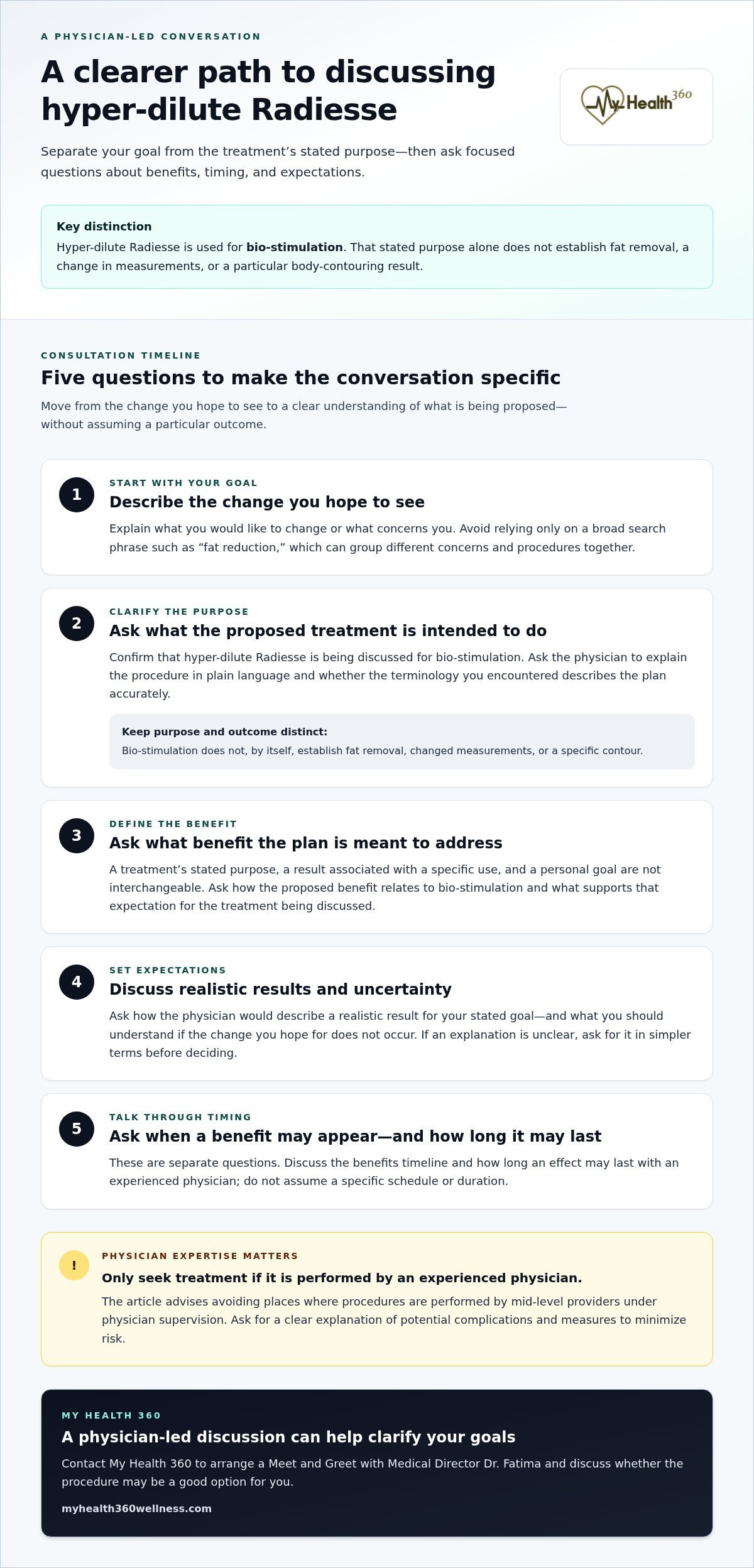
To make the consultation more useful, describe the change you hope to see rather than relying on a broad search phrase. Then ask whether the treatment’s stated purpose aligns with that goal, what benefit is being discussed, and how the physician would explain the expected result. If the answer includes a claim about body shape or fat reduction, ask how that claim relates specifically to the proposed treatment.
At My Health 360, contact the team to arrange a Meet and Greet and discuss your goals with Medical Director Dr. Fatima. Dr. Fatima is an American Board Certified Internal Medicine specialist. The conversation can help clarify terminology and whether the procedure may be a good option for you, so you can consider the information before making a decision.
Potential Benefits of Hyper Dilute Radiesse: What Can Be Stated Responsibly?
“Benefit” can mean the purpose of a treatment, a result supported by evidence, or a personal goal. Those meanings should not be treated as interchangeable. A broad overview of nonsurgical fat reduction does not establish benefits for hyper-dilute Radiesse specifically. Its stated purpose is bio-stimulation, and that purpose alone does not predict a particular visible result for an individual.
Which benefits should the article explain?
A careful discussion should make clear that bio-stimulation is the stated purpose, rather than presenting it as proof of a particular change in appearance or body shape. Claims about a specific result should be discussed in relation to the treatment being considered. Ask the physician to explain what benefit the plan is intended to address and what supports that expectation.
When you hear a promised or strongly stated outcome, ask what it refers to. Is it the treatment’s purpose, an outcome associated with the specific use being discussed, or a general claim about aesthetic procedures? The distinction helps prevent broad promotional language from being mistaken for a guarantee. It also gives you a chance to ask the physician to explain uncertainty directly, rather than filling gaps with assumptions.
How can readers set realistic expectations?
Start with a plain-language description of your goal. For instance, explain what you would like to change or what concerns you, without assuming that the treatment will reduce fat or produce a particular contour. Then ask the physician whether the goal aligns with the treatment’s stated purpose and how any proposed benefit should be understood.
These questions can help keep the conversation specific:
- What benefit is the proposed procedure intended to address?
- How does that benefit relate to bio-stimulation?
- What supports the expectation for the treatment being discussed?
- How would you describe a realistic result for my stated goal?
- What should I understand if the change I hope for does not occur?
Use the answers to separate what you hope to achieve from what the physician is describing. If the explanation is unclear, ask for it in simpler terms before deciding. A consultation can address your individual goals, but this article cannot assess your circumstances or determine whether the procedure is right for you.
For a physician-led conversation about your goals and the potential benefits, contact My Health 360 to arrange a Meet and Greet and discuss with Medical Director Dr. Fatima whether the procedure may be a good option for you.
Timeline: When Benefits Appear and How Long They Last
Two questions often arise before a procedure: when might a benefit become noticeable, and how long might an effect last? These are separate questions, and neither should be answered with an assumed schedule. For hyper-dilute Radiesse, ask an experienced physician to discuss timing and duration in relation to the specific treatment being considered. Don’t rely on timelines associated with other procedures or infer them from the phrase “Non-invasive fat reduction treatment.”
What is known about the benefits timeline?
Do not treat a single timeline as universal or as a promise. Ask the physician what timing applies to the proposed treatment and what the estimate means. A time point for reviewing progress, for example, is not necessarily a promise about when a benefit will appear. Make sure the distinction is clear before you use a timeline to plan around treatment.
Questions to ask during the consultation include:
- What does the proposed timeline refer to?
- How does it apply to the treatment plan being discussed?
- When would you review progress, and what would that review involve?
- What should I understand if I do not notice a change within the discussed period?
These questions help turn a general estimate into a clearer conversation about expectations. They also give the physician an opportunity to explain what is being projected and what is uncertain. Avoid interpreting a suggested review point as a guaranteed result or a fixed schedule for every person.
How long does the effect last?
Duration is different from the time it takes to notice a benefit. Ask the physician how long an effect may last for the treatment being discussed and what the answer is based on. Do not assume that an effect is permanent or that a particular follow-up schedule applies unless the physician explains it in relation to your plan.
It may help to write down the two questions separately before your appointment: “When might I notice a benefit?” and “How long might an effect last?” Ask the physician to answer each one directly. If the response covers only one, follow up on the other. Keeping onset and duration distinct makes it easier to understand what is being discussed without treating one as an answer to both.
For a personalized discussion, contact My Health 360 to arrange a Meet and Greet with Medical Director Dr. Fatima. Bring your questions about timing and duration and discuss whether the procedure may be a good option for you.
Complications and Risk Reduction: What Should Patients Understand?
Before considering treatment, ask for a clear discussion of complications associated with the procedure. The phrase “Non-invasive fat reduction treatment” should not replace a conversation about the specific treatment being proposed. An experienced physician should explain potential complications, how they relate to the plan, and what to do if you have concerns.
Which complications should readers understand?
Ask the physician to describe the complications associated with hyper-dilute Radiesse and explain them in plain language. Make sure the discussion covers what concerns may arise, when you should seek guidance, and whom to contact with questions. A general description of aesthetic procedures is not a substitute for understanding the potential complications of the specific procedure being considered.
Before you leave the consultation, check that you understand the answers. You can repeat the main points back in your own words and ask the physician to clarify anything that is still confusing. Do not treat a complication as impossible simply because it is described as uncommon, and do not assume that another procedure has the same risk profile.
What measures can help minimize risk?
Provider expertise is central to risk reduction. Only seek treatment if performed by an experienced physician. Avoid places where procedures are performed by mid-level providers under physician supervision. Treat these as essential safety measures when deciding whether to proceed and where to seek treatment.
Before making a decision, ask who will perform the procedure and make sure you receive a clear answer. Discuss the physician’s experience with the treatment and ask for an explanation of how potential complications will be addressed. You should also have a clear understanding of any preparation and aftercare instructions specific to the proposed procedure.
Follow the instructions provided by the physician responsible for your care. If you are unsure what an instruction means or have a concern, seek clarification from that physician rather than relying on assumptions or generic advice. A thorough discussion should give you a chance to raise questions about your circumstances, understand the treatment plan, and consider its potential complications. No measure eliminates risk, so careful clinical judgment and informed decision-making remain important.
Before proceeding, make sure you can describe the treatment’s purpose, the potential complications discussed, and why physician experience matters. If you still have unanswered questions, raise them before deciding. Being clear about the information you need can help you make a considered choice without assuming that any procedure is risk-free.
Contact My Health 360 to arrange a Meet and Greet and discuss the procedure’s risks and suitability with Medical Director Dr. Fatima.
Considering Hyper Dilute Radiesse in Buffalo? Discuss Your Goals with Dr. Fatima
If you are in Buffalo or elsewhere in Western New York and considering hyper-dilute Radiesse, a physician-led conversation can help you understand how the treatment relates to your goals. Contact My Health 360 to arrange a Meet and Greet with Medical Director Dr. Fatima and discuss whether the procedure may be a good option for you. Dr. Fatima is an American Board Certified Internal Medicine specialist. The discussion can clarify your questions, but it does not guarantee candidacy or a particular result.
What should patients discuss during a Meet and Greet?
Describe the change you hope to achieve in your own words. If the phrase Non-invasive fat reduction treatment brought you to this topic, explain what “fat reduction” means to you and ask the physician to clarify the procedure’s purpose. This helps distinguish your goal from assumptions attached to a broad search term.
Consider bringing a written list of questions about:
- The benefit the proposed treatment is intended to address.
- How bio-stimulation relates to the treatment being discussed.
- When a benefit might appear and how long an effect may last.
- Potential complications and measures to minimize risk.
- Who will perform the procedure and what preparation or aftercare instructions apply.
A written list can help you keep the conversation focused and remember to ask about each topic. If an answer uses unfamiliar language, ask for a plain-language explanation. Clear answers can help you weigh the information against your priorities and identify what still needs discussion.
How does a physician-led discussion support an informed decision?
Dr. Fatima can discuss your goals, whether the procedure may be a good option for you, and how the proposed approach relates to those goals. The decision should follow an individualized conversation, not a broad description or an assumption that a particular outcome will occur.
Physician expertise is also central to safety. Only seek treatment if performed by an experienced physician. Avoid places where procedures are performed by mid-level providers under physician supervision. Keep these measures in mind as you decide whether and where to pursue treatment.
You do not need to arrive with every answer. Bring the concerns that matter most, ask for clear explanations, and take time to consider the information before deciding. A careful conversation can support an informed choice without pressure to proceed. My Health 360 serves Buffalo and surrounding Western New York communities, including Clarence, Orchard Park, Grand Island, Tonawanda, Elma, Amherst, and Williamsville.
Contact My Health 360 to schedule a Meet and Greet with Dr. Fatima and discuss your goals and whether the procedure may be a good option for you.
Make Your Next Step an Informed One
Your next step does not have to be a decision to proceed. It can be a focused conversation about what you hope to change, what hyper-dilute Radiesse is used for, and what you need to understand before considering treatment. If the phrase Non-invasive fat reduction treatment describes your search, bring that wording to the discussion and explain the goal behind it. Clear language can help you and the physician discuss whether the treatment’s stated purpose aligns with your priorities.
Before the Meet and Greet, write down your questions about benefits, timing, duration, complications, and risk reduction. During the discussion, ask for clear explanations and take time to consider the physician’s guidance. A thoughtful decision reflects your priorities and takes potential complications seriously, rather than relying on pressure or a promised result.
Contact My Health 360 to arrange a Meet and Greet with Dr. Fatima and discuss whether hyper-dilute Radiesse may be a good option for you. Take the next step at your own pace, with your questions at the center of the conversation.
Frequently Asked Questions
What does hyper dilute mean in hyper dilute Radiesse?
For an explanation of what “hyper dilute” means in the procedure being discussed, ask an experienced physician to clarify the terminology in plain language. This keeps the conversation focused on the proposed treatment rather than assumptions based on the name.
Is hyper dilute Radiesse used for bio-stimulation?
Yes. That describes its stated purpose, but it does not establish fat removal or a particular result. Ask an experienced physician to explain what bio-stimulation means in the context of the treatment being discussed and to distinguish the purpose from any outcome claims.
Can a physician determine whether hyper dilute Radiesse is a good option for me?
A physician can discuss your goals and whether the procedure may be a good option for you, but a conversation does not guarantee candidacy or results. If you are considering a Non-invasive fat reduction treatment, explain the change you hope to achieve and ask how the treatment relates to that goal. Contact My Health 360 for a Meet and Greet with Medical Director Dr. Fatima. The center serves Buffalo and surrounding Western New York communities, including Clarence, Orchard Park, Grand Island, Tonawanda, Elma, Amherst, and Williamsville.
Who should perform hyper dilute Radiesse treatment?
Ask who will perform the procedure and make sure the answer is clear. Discuss the physician’s experience with the treatment and raise any questions about potential complications during your consultation. Do not treat a general description of the procedure as a substitute for understanding who will perform it.
Should I avoid a place where a mid-level provider performs the procedure under physician supervision?
Yes. Avoid places where procedures are performed by mid-level providers under physician supervision. Seek treatment only if it is performed by an experienced physician. Ask for a clear explanation of who will perform the procedure before making a decision.
What questions should I ask before considering hyper dilute Radiesse?
Ask an experienced physician to explain the treatment’s purpose and the benefits being discussed. Talk about when a benefit might appear, how long an effect may last, potential complications, and measures to minimize risk. You can bring these topics as a written list so none are missed. The answers can support an informed discussion, but they do not establish that treatment is right for you.