

What if the recovery tool getting the most attention isn’t the one that best fits your training? Advanced recovery for athletes can involve different devices and modalities, but more options don’t automatically mean better results. Sleep, nutrition, hydration, and a well-planned training schedule remain central to recovery.
If conflicting claims have left you unsure what’s relevant to your sport, start with the basics: define what you want to address, consider how your training and routine have changed, and assess any option in the context of your goals and health history. Advanced recovery should complement those fundamentals, not distract from them.
This guide explains how to compare recovery approaches, from everyday habits to physician-led options, and how to consider their role in an individual plan. My Health 360 offers integrative concierge medical care for performance optimization, whole-body red light therapy, low-level laser therapy, IV Hydration, and other services. Athletes in Buffalo and Western New York can contact My Health 360 to arrange a Meet and Greet with Medical Director Dr. Fatima and discuss whether a procedure may be a good option for them.
Key Takeaways
- Advanced recovery for athletes should complement training fundamentals, with choices guided by your sport, training demands, and goals.
- Different modalities have different purposes. Consider the evidence and limitations behind each rather than assuming they work in the same way.
- Use a practical sequence to shape your approach: define your goal, review your routines, assess relevant options, and evaluate how they fit.
- Physician-led performance care, whole-body red light therapy, low-level laser therapy, and Bio-Restore each have distinct roles in a broader recovery discussion.
- Contact My Health 360 to arrange a Meet and Greet with Medical Director Dr. Fatima and discuss whether a procedure may be a good option for you.
What Advanced Recovery for Athletes Means Beyond Rest and Equipment
Advanced recovery for athletes is the considered use of additional strategies or clinician-directed services to support recovery goals alongside training fundamentals. It is not a promise of faster recovery or improved performance. A device or treatment may have a particular intended use, but that does not mean it suits every athlete or will produce a specific result.
Recovery is best considered in relation to the demands placed on the body and how an athlete is responding. Training load describes the demands of practice and competition; perceived readiness is the athlete’s own sense of preparedness to train. Neither tells the whole story on its own. A demanding week, a change in routine, discomfort, or a shift in readiness may be a reason to review the overall plan, rather than automatically add another tool.
How recovery fits into an athlete’s training
Training and recovery are connected parts of the same plan. The aim isn’t to add a procedure whenever an athlete feels tired. First consider whether training demands, rest, and everyday routines align with the athlete’s goals. General wellness practices are distinct from clinician-directed services: a self-selected recovery habit is not the same as a medical service that calls for individual assessment. A device can’t guarantee faster recovery, and adding equipment shouldn’t displace the fundamentals of a well-considered training routine.
Keep the decision practical: what are you trying to address, and how will you judge whether an option fits your plan? Athletes may also encounter substances promoted for performance or recovery. These are a separate category from devices and medical services, and shouldn’t be assumed to have the same purposes or considerations. See this overview of performance-enhancing substances and advanced recovery.
Why recovery needs differ between athletes
A recovery approach that seems relevant to one athlete may be less suitable for another. Sport, training demands, goals, and individual health context all shape the discussion. For instance, someone managing a high-volume training schedule may have different considerations from an athlete returning to activity after an injury. The label “recovery” alone doesn’t tell you whether a modality is appropriate or how it might fit with other priorities.
Professional assessment can help clarify those priorities and distinguish a general wellness option from a clinician-directed service. Only seek treatment if performed by an experienced physician. Avoid places where procedures are performed by mid-level providers under physician supervision. At My Health 360, contact the team to arrange a Meet and Greet appointment with Medical Director Dr. Fatima and discuss whether a procedure may be a good option for you.
How Advanced Recovery Approaches Relate to the Body
Recovery modalities are not interchangeable. Cold-based approaches, heat, light-based therapy, and stimulation have distinct intended contexts. A proposed effect on the body doesn’t establish that an approach will improve an athlete’s function or training outcomes. Advanced recovery for athletes is best considered by matching a modality’s purpose and evidence to the person’s goals, health context, and training demands.
What to understand about recovery modalities
Cold approaches are often used with the aim of easing perceived soreness, but that sensation is not the same as evidence of improved tissue recovery or athletic performance. Research on routine cold exposure and longer-term training adaptation remains nuanced, so it shouldn’t be treated as an automatic choice after every session. Heat-based approaches create a different experience and are used for different reasons; their effects shouldn’t be assumed to mirror those of cold.
Light-based options, including whole-body red light therapy and low-level laser therapy, are associated with proposed effects on biological processes. A proposed mechanism is a rationale for study, not proof that a particular treatment changes recovery or performance for every athlete. Stimulation approaches also vary in purpose and application. Broad claims about “activating recovery” can obscure important differences between methods and the outcomes they are intended to address.
Why mechanism does not equal an outcome
A physiological explanation can sound persuasive: a modality may be described as influencing circulation, cellular activity, or muscle response. But identifying a possible pathway doesn’t demonstrate a meaningful benefit. Evidence needs to address the outcome an athlete cares about, such as a change in symptoms, function, or ability to follow a training plan, rather than relying only on a proposed mechanism.
It also helps to distinguish an immediate sensation from a lasting or useful change. Feeling relaxed, warm, cool, or temporarily less sore may matter to an individual, but it doesn’t by itself show that a treatment has accelerated recovery or improved performance. Responses can differ with the athlete, training context, and modality, so outcomes shouldn’t be promised.
When evaluating a claim, look for current, authoritative evidence that relates to the specific method and outcome being discussed. Evidence for one light-based treatment shouldn’t automatically be applied to another device or approach. If research is limited or mixed, that uncertainty matters: a proposed explanation should not be presented as an established result.
Individual assessment makes the discussion more practical. A physician can consider an option in relation to an athlete’s goals and health context, rather than treating a category of technology as a universal solution. Only seek treatment if performed by an experienced physician. Avoid places where procedures are performed by mid-level providers under physician supervision. Contact My Health 360 to arrange a Meet and Greet appointment with Medical Director Dr. Fatima and discuss whether a procedure may be a good option for you.
Comparing Advanced Recovery Options Without Overpromising
A useful comparison starts with the athlete’s goal, not the number of devices available. Advanced recovery for athletes can include clinician-directed services and technology, but a service’s presence in a recovery setting doesn’t establish that it will improve athletic performance. The distinctions below can help frame a discussion without treating different options as interchangeable.
| Option | Intended context | Evidence caveat | When assessment matters |
|---|---|---|---|
| Whole-body red light therapy | A light-based service to consider in a broader recovery or performance discussion. | Don’t assume a proposed biological mechanism proves a specific recovery or performance outcome. | Discuss the athlete’s goals, health context, and the evidence relevant to the intended outcome. |
| Low-level laser therapy | A light-based modality that may be considered as part of an individualized care discussion. | Claims should be tied to evidence for the particular approach and outcome, not generalized from other light-based methods. | Assessment can help clarify whether the modality is relevant to the athlete’s situation. |
| IV Hydration | A medical service to discuss in relation to an individual’s health and hydration context. | Don’t infer an athletic benefit from the service name or assume it suits every athlete. | Discuss it with a physician, who can consider personal health context and whether it is appropriate. |
| Bio-Restore | Post-operative or injury whole-body habilitation, rather than a general performance tool. | Its role should be understood in the context of the individual’s recovery needs, not as a guaranteed athletic outcome. | Clinical context is central when recovery involves injury or a post-operative period. |
Compare options by goal and context
Keep the purpose specific. A discussion about returning to training after injury differs from one about general performance optimization, and neither should be conflated with an aesthetic goal. My Health 360 provides whole-body red light therapy, low-level laser therapy, IV Hydration, Bio-Restore, and integrative concierge medical care for performance optimization. These offerings have distinct contexts. A physician-led conversation can help determine which, if any, aligns with an athlete’s goals. Avoid places where procedures are performed by mid-level providers under physician supervision.
Questions that help interpret recovery claims
Before treating a claim as a reason to choose a modality, consider what it actually measures. Is the evidence from relevant human research, and does it concern comfort, function, or athletic performance? Those are different outcomes. Also consider whether a recommended schedule is supported for your circumstances or is a general protocol presented without individualized context. Advice about timing after exercise shouldn’t be treated as a universal prescription.
Comparison takeaway: prioritize fit, relevant evidence, and appropriate assessment over accumulating equipment or following a one-size-fits-all schedule. Contact My Health 360 to arrange a Meet and Greet appointment with Medical Director Dr. Fatima and discuss whether a procedure may be a good option for you.
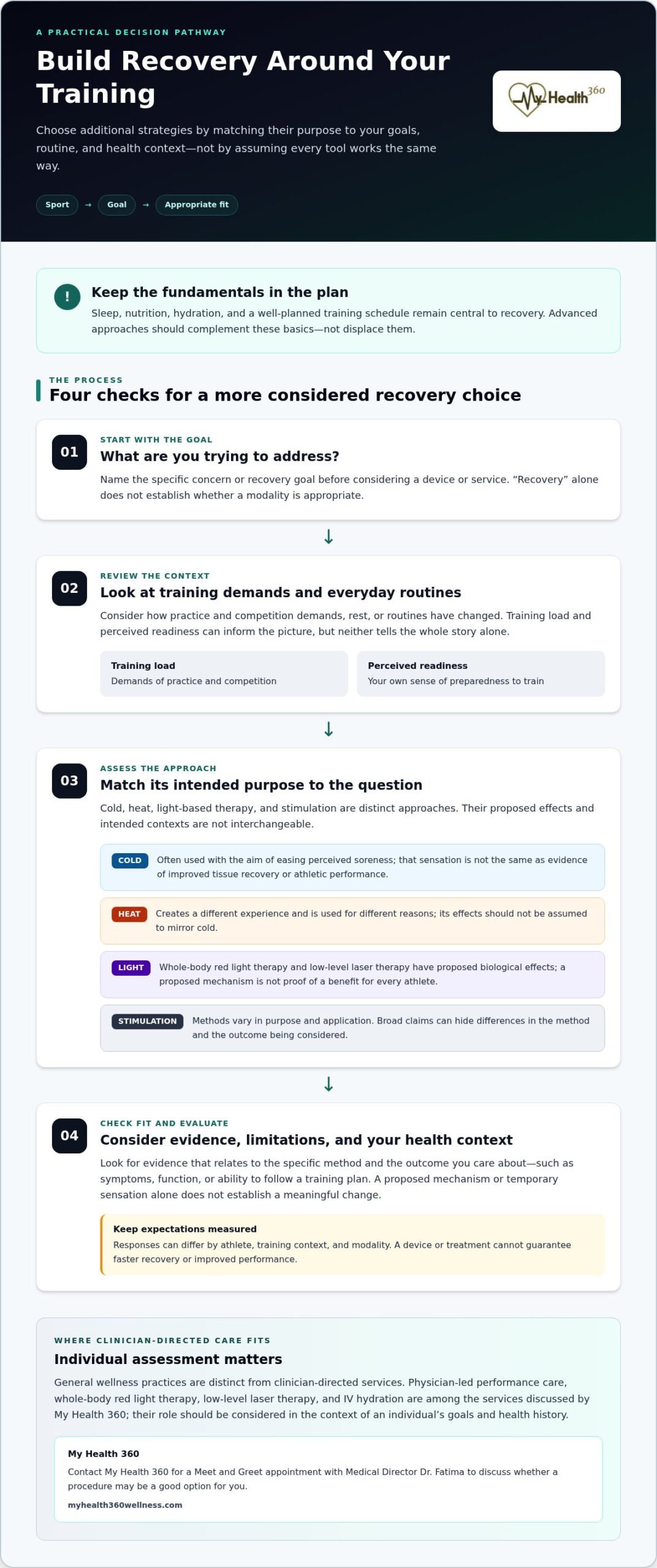
Build a Practical Recovery Plan Around Training Fundamentals
A useful plan doesn’t begin with a device. It begins with a clear question: what are you trying to support, and what does your current training and recovery routine look like? Advanced recovery for athletes is most practical when an additional option has a defined purpose and fits around sound training habits, rather than becoming a substitute for them.
A stepwise way to evaluate recovery choices
Use this sequence to make the decision more deliberate:
- Define the concern. Identify what you want to address, such as how you feel during training, a challenge in your routine, or support while returning to activity. Keep the goal specific enough to guide a discussion.
- Review your current routine. Consider training demands alongside everyday recovery habits, including sleep, nutrition, and hydration. Notice whether the issue coincides with a change in training or routine before adding another modality.
- Assess relevant options. Consider the purpose of an approach, the evidence for the outcome you care about, and whether it fits your individual health context. A published protocol or a friend’s experience may provide ideas, but it isn’t a personalized plan.
- Evaluate your response. Keep a simple record of how the choice fits your routine and how you feel in relation to your original goal. Avoid assuming that a short-term sensation proves a lasting change in function or performance.
Keep the basics in view as you evaluate. If an added option takes attention away from a manageable training plan or consistent recovery habits, pause and reconsider its role. For broader physician-led context, concierge performance medicine explains how performance goals may be discussed within individualized medical care.
When professional assessment is appropriate
Some questions are about organizing training and everyday routines; others involve health concerns that call for medical assessment. New or persistent symptoms, a concern related to injury, or uncertainty about whether a procedure suits your health context are reasons to seek professional guidance rather than trying to diagnose the issue yourself. An article or general protocol can’t determine the cause of a symptom or prescribe treatment.
Physician-guided care can place recovery choices in a broader context, including an athlete’s goals and relevant health history. My Health 360 offers integrative concierge medical care for performance optimization and Bio-Restore for post-operative or injury whole-body habilitation. Learn how whole-body habilitation relates to physician-guided care for recovery and performance.
For an individualized conversation, contact My Health 360 to arrange a Meet and Greet appointment with Medical Director Dr. Fatima and discuss whether a procedure may be a good option for you.
Physician-Led Advanced Recovery for Athletes in Buffalo and Western New York
For athletes in Buffalo and surrounding Western New York communities, My Health 360 offers a local, physician-led setting to discuss recovery and performance goals. The physician-owned Longevity, Recovery, and Performance Center provides integrative concierge medical care for performance optimization, whole-body red light therapy, low-level laser therapy, and Bio-Restore for post-operative or injury whole-body habilitation. These services have distinct contexts, so a conversation can help place them in relation to an athlete’s needs without promising a particular result.
Discussing recovery goals with My Health 360
A Meet and Greet is an opportunity to speak with Medical Director Dr. Fatima about your goals and whether a procedure may be appropriate for you. Describe the demands of your sport, what you hope to address, and any relevant health context. This gives the discussion a useful focus: not simply which recovery option is popular, but whether it makes sense for you and your circumstances. For additional context on individualized performance care, explore Concierge Performance Medicine.
Physician-led assessment also helps distinguish a general performance conversation from care related to an injury or post-operative recovery. My Health 360’s offerings include performance care and services with different intended contexts. Bio-Restore, for example, is for post-operative or injury whole-body habilitation. The purpose of a discussion is to consider suitability and priorities, not to guarantee an athletic outcome.
A local next step for athletes
Before an appointment, reflect on your training demands, your main concern, and what you’d like to understand about available options. Share relevant health information and any recovery approaches you’re already using, so the conversation can be grounded in your individual context. You don’t need to arrive with a chosen treatment. The aim is to discuss your goals and consider an appropriate next step with the Medical Director.
Only seek treatment if performed by an experienced physician
Avoid places where procedures are performed by mid-level providers under physician supervision
Advanced recovery for athletes is most responsible when it’s approached with care, clear goals, and appropriate medical guidance. To discuss your situation with Dr. Fatima, contact My Health 360 to arrange a Meet and Greet appointment and talk about whether a procedure may be a good option for you.
Make Your Next Recovery Decision with Intention
Advanced recovery for athletes doesn’t need to mean adding more treatments or equipment. A thoughtful next step is to identify the question you want answered, then discuss how your training goals and personal health context shape the options. That conversation can help you decide what merits further consideration and what may not be a priority right now.
If you’re considering a procedure, speak with the Medical Director about whether it may be appropriate for you. Contact My Health 360 to arrange a Meet and Greet with Dr. Fatima and discuss your goals in a physician-led setting. A clear, individualized conversation is a practical way to move forward and keep your recovery choices connected to the bigger picture of your health and training.
Frequently Asked Questions
Can advanced recovery replace sleep and other training fundamentals?
No, recovery methods shouldn’t replace sleep, appropriate training, or other foundational habits. For example, if an athlete feels persistently under-rested during a demanding training block, adding a device may not address the underlying issue. Consider what has changed in the routine and whether the training plan remains manageable. If a concern continues to affect training or daily activities, seek individualized medical guidance rather than relying on a general online protocol.
Is advanced recovery appropriate for every athlete?
No, suitability depends on the athlete and the specific approach being considered. A modality that seems relevant to one person’s goals may not fit another person’s training demands or health context. Don’t treat a teammate’s experience or a broad marketing statement as a personal recommendation. Before exploring an option, clarify what you hope to address and discuss relevant health considerations with a physician.
How do I know whether a recovery method is evidence-based?
Check whether the claim is about a defined outcome and whether the evidence directly relates to the method being promoted. Research on a similar device or a proposed biological mechanism may not show that the specific approach improves an athlete’s performance. Pay attention to what the evidence can and can’t establish, and be cautious if claims promise universal results. A physician can help interpret information in light of your goals and health context.
Can I combine different recovery modalities?
Possibly, but combining methods shouldn’t be assumed to improve results or suit every athlete. Before layering options, write down what each one is intended to address and whether you can distinguish its effect within your routine. Discuss the combination with an experienced physician, particularly if a procedure is involved or you have relevant health considerations. This helps keep choices reasoned rather than driven by online protocols or the appeal of using more tools.
When should an athlete seek medical guidance about recovery?
Consider medical guidance if a concern persists, interferes with training or daily activities, or makes you uncertain about a treatment’s suitability. An educational article can’t assess your health or determine whether an injury is present. Note what you’ve observed and how it affects your activities so you can explain the concern clearly. For urgent or severe symptoms, seek appropriate medical care instead of relying on a recovery device or routine.
What can I discuss at a recovery Meet and Greet in Buffalo?
A Meet and Greet is an opportunity to discuss your performance goals with Medical Director Dr. Fatima and whether a procedure may be appropriate for you. You can describe your sport, training demands, and main concerns. My Health 360 serves athletes in Buffalo, New York, Clarence, Orchard Park, Grand Island, Tonawanda, Elma, Amherst, Williamsville, and Western New York. Contact My Health 360 to arrange a Meet and Greet and discuss your situation with Dr. Fatima.