
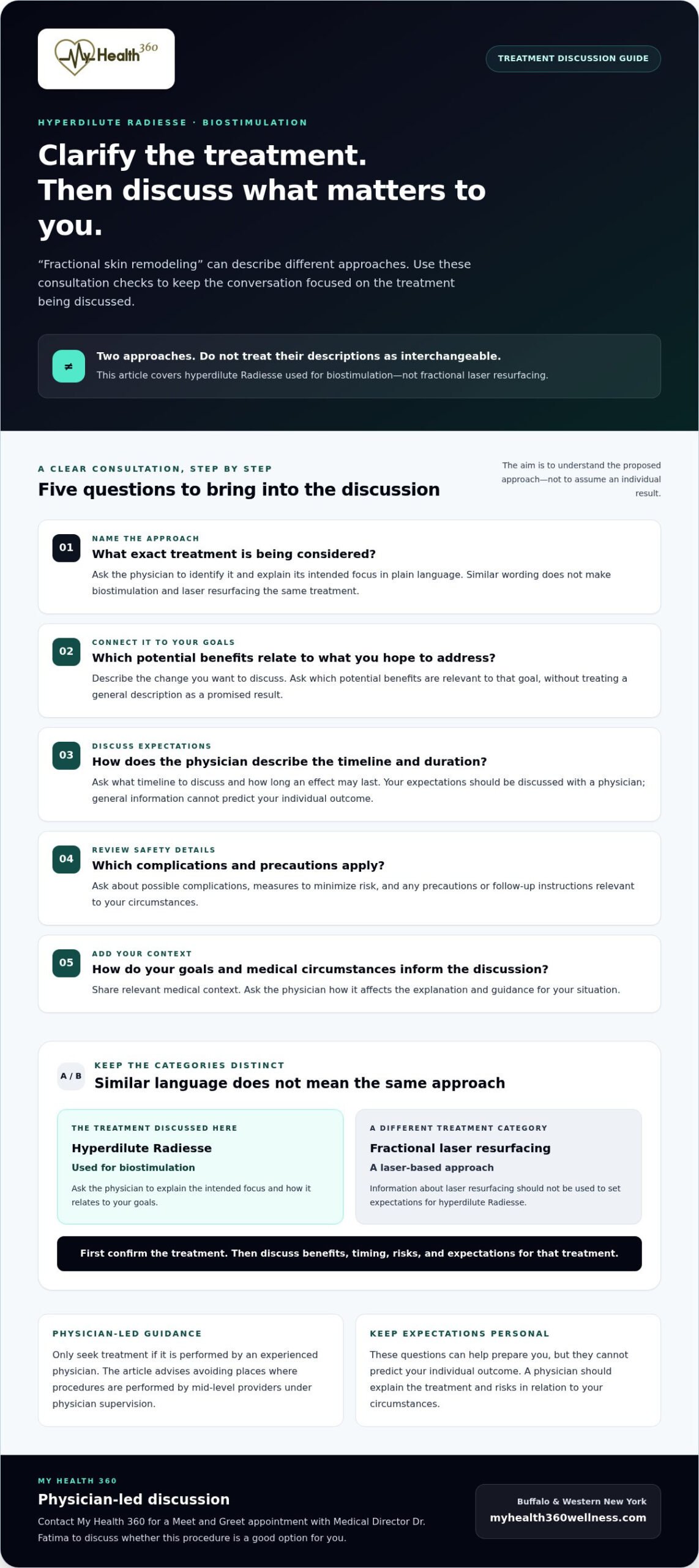
A Fractional skin remodeling treatment can refer to different approaches, so the label alone may not tell you what a treatment involves or what it is intended to do. This article focuses on hyperdilute Radiesse used for biostimulation. It is a different approach from fractional laser resurfacing, and information about one should not be used to set expectations for the other.
Before considering treatment, clarify what potential benefits are relevant to your goals, how the timeline is described, how long an effect may last, and which complications to discuss. The information here can help you prepare questions, but it cannot predict your individual outcome. A physician should explain the treatment and its risks in relation to your circumstances.
Only seek treatment if performed by an experienced physician. Avoid places where procedures are performed by mid-level providers under physician supervision. If you are in Buffalo or Western New York, contact My Health 360 to schedule a Meet and Greet with Medical Director Dr. Fatima and discuss whether this procedure is a good option for you.
Key Takeaways
- “Fractional skin remodeling treatment” can refer to different approaches. This article covers hyperdilute Radiesse for biostimulation, not fractional laser resurfacing.
- Discuss which potential benefits are relevant to your goals and what the physician can explain about this treatment.
- Ask about the expected timeline and how long an effect may last. Individual expectations should be discussed with a physician.
- Review possible complications and measures to minimize risk with an experienced physician. Avoid places where procedures are performed by mid-level providers under physician supervision.
- Contact My Health 360 for a Meet and Greet with Medical Director Dr. Fatima to discuss whether treatment is a good option for you.
Fractional Skin Remodeling Treatment: Clarify the Approach Before Deciding
Does “fractional skin remodeling” mean a laser procedure or another treatment? The phrase alone may not identify the approach. In this article, Fractional skin remodeling treatment refers to hyperdilute Radiesse used for biostimulation. It is not fractional laser resurfacing. Similar language about skin remodeling does not make these approaches interchangeable.
What does fractional skin remodeling treatment mean here?
This article focuses on hyperdilute Radiesse for biostimulation. That description identifies the treatment discussed, but it does not promise a particular result. If you encounter the phrase in another context, ask what specific treatment it refers to before comparing benefits, timing, or safety information.
This distinction matters when you are researching options. A description of laser resurfacing may explain a laser approach, but it should not be treated as an explanation of hyperdilute Radiesse. For general context on light-based photorejuvenation, including fractional laser technology, see photorejuvenation, including fractional laser technology. It covers a different treatment category.
Before interpreting a claim about results or recovery, identify the treatment being discussed and ask the physician to explain it in plain language. This helps keep your expectations tied to the right approach instead of transferring details from a procedure with a similar-sounding name.
What should you understand before considering treatment?
Start by deciding what you want to discuss. A physician can explain the treatment’s intended focus, address questions about potential benefits and risks, and consider how your goals and circumstances affect the conversation. My Health 360 is physician-owned and operated by Medical Director Dr. Umbrine Fatima, an American Board Certified Internal Medicine specialist.
Keep the main questions separate. What is the treatment intended to address? Which potential benefits are relevant to your goals? What timeline and duration should you discuss? Which complications and precautions apply? Clear answers to each question can help you understand the proposed approach without assuming that a general description predicts your personal result.
- Ask the physician to name the exact treatment and explain its intended focus.
- Describe the change you hope to discuss, then ask which potential benefits relate to that goal.
- Ask how the physician explains the timeline, duration, complications, and precautions for this treatment.
- Share relevant medical context and ask how it informs the discussion.
Only seek treatment if performed by an experienced physician. Avoid places where procedures are performed by mid-level providers under physician supervision. For a physician-led discussion in Buffalo and Western New York, contact My Health 360 to schedule a Meet and Greet with Dr. Fatima and discuss whether this procedure is a good option for you.
How Hyperdilute Radiesse Biostimulation Should Be Explained
A clear explanation starts with the treatment’s stated focus: hyperdilute Radiesse used for biostimulation. Ask the physician to explain what that means in everyday language and how the intended focus relates to your goals. Do not assume that the term by itself describes a particular result or tells you how your own response will look.
How can the treatment mechanism be described clearly?
When a medical term is unfamiliar, ask for a plain-language explanation rather than relying on the term alone. The physician should distinguish the treatment’s intended focus from the benefits you might hope to see and explain which details are relevant to your situation. A clear discussion should not borrow descriptions of another procedure or make a general term sound like a guaranteed outcome.
This is another reason to distinguish biostimulation from laser resurfacing. Mayo Clinic’s overview of laser resurfacing at Mayo Clinic discusses laser-based approaches, including fractional lasers. It can provide context about that category, but it should not be used to explain hyperdilute Radiesse. Similar wording does not mean the treatments work in the same way.
For a useful discussion, first confirm which treatment is being considered. Then ask the physician to explain the intended focus, the potential benefits that relate to your aims, and what expectations cannot be made for an individual. That keeps the conversation centered on hyperdilute Radiesse rather than details drawn from laser treatments or other procedures.
Which treatment details belong in a consultation?
A consultation gives you an opportunity to connect general questions to your own goals and medical context. Explain what you hope to address and ask which aspects of the treatment are relevant to that aim. If a term or explanation is unclear, ask for a simpler description before making a decision.
- Explain what you hope to address and what a satisfactory outcome would mean to you.
- Ask the physician to describe the treatment’s focus in plain language.
- Discuss the potential benefits, expected timeline, duration, and possible complications.
- Share relevant medical context and ask how it informs the physician’s guidance.
- Ask which precautions and follow-up instructions apply to your circumstances.
These questions can help you prepare, but they cannot determine suitability on their own or guarantee a particular result. Contact My Health 360 to arrange a Meet and Greet appointment with Medical Director Dr. Fatima and discuss whether hyperdilute Radiesse is a good option for you.
Benefits, Benefit Timeline, and How Long the Effect Lasts
Potential benefits, the timeline for noticing a change, and how long an effect may last are separate questions. A treatment’s intended focus does not establish what result a particular person will experience or when. For hyperdilute Radiesse, ask the physician to discuss each point in relation to your goals and individual circumstances.
What benefits should readers discuss with the physician?
Begin with the change you hope to address. Rather than assuming that “skin remodeling” means the same thing for everyone, describe your priorities and ask which potential benefits of hyperdilute Radiesse are relevant to them. Ask the physician to explain what those benefits mean in practical terms and how they relate to the treatment’s biostimulation focus.
For example, if you have a particular area or concern in mind, explain it clearly and ask what kind of improvement is appropriate to discuss. You can also ask how the physician would describe or assess that change. The purpose is to understand the treatment’s potential benefits, not to assume that a specific result is certain or that the same outcome applies to everyone.
It can help to separate your goals into questions: What am I hoping to change? Which potential benefit relates to that goal? What should I understand about individual variation? A focused conversation can make it easier to decide whether the treatment’s intended focus fits what you want to explore.
What is the timeline of benefits?
Ask the physician to explain the timeline using information specific to hyperdilute Radiesse. Do not use a schedule for fractional laser treatment or another procedure as a substitute. The timeline should be discussed in the context of this treatment and your circumstances, without assuming a particular date or pace of change.
You can make this discussion more concrete by asking what the physician would consider a meaningful change, how progress would be assessed, and what variation in timing may matter for your expectations. If you have an event or personal deadline in mind, mention it during the consultation rather than relying on a generic calendar. The phrase Fractional skin remodeling treatment does not provide a reliable timetable by itself.
How long does the effect last?
Ask how the physician describes duration for this specific treatment and what information informs that discussion. Personal expectations may vary, so avoid applying a timeframe from another treatment or assuming that a general description predicts how long an effect will last for you.
It is also useful to clarify what you mean by “lasting effect.” Ask how duration relates to the goal you have discussed and whether any future decisions should be based on an individual assessment. The physician can address these questions in a way that reflects the treatment and your circumstances, rather than setting an expectation that may not fit your situation.
In summary: Discuss potential benefits, the timeline, and duration as separate topics. Ask the physician to connect each answer to hyperdilute Radiesse and your goals. Contact My Health 360 to schedule a Meet and Greet with Medical Director Dr.
Hyperdilute Radiesse Complications and Measures to Minimize Risk
Safety calls for a direct, treatment-specific conversation. Complications associated with fractional laser resurfacing should not be presented as complications of hyperdilute Radiesse, because these are different approaches. Ask the physician to explain the possible complications associated with the treatment being discussed and how they may relate to your circumstances.
Which complications should readers understand?
Ask the physician to explain possible complications in plain language. For each concern, clarify what it means, how it relates to the proposed treatment, and what signs or concerns should prompt follow-up. A useful explanation should be specific to hyperdilute Radiesse rather than a list copied from information about laser resurfacing or another procedure.
Before deciding, raise any concern you have, even if it seems minor or difficult to describe. Ask which risks are relevant to the treatment and how your circumstances inform the discussion. If a term is unfamiliar, ask the physician to explain it rather than trying to interpret information about a different treatment. This helps you understand what is being discussed without relying on assumptions or making a decision based on a general description.
Make sure you understand how to raise a concern after treatment and what follow-up guidance the physician provides. The aim is to leave the conversation knowing which complications have been discussed and what instructions apply to you. A clear discussion supports an informed decision, but it does not remove risk or guarantee a particular outcome.
What measures can minimize risk?
Before deciding, describe your goals and share relevant medical context with the physician. Ask for an explanation of the treatment plan, the precautions that apply to it, and any preparation or follow-up instructions you should understand. If an instruction is unclear, ask for clarification so you know what applies to your situation.
Pause if you do not understand the explanation or feel your questions have not been addressed. Before proceeding, make sure you have discussed the potential complications, how your circumstances inform the recommendation, and what to do if you have a concern. This supports a more informed decision than relying on broad claims or applying advice intended for another procedure.
Safety summary: Ask an experienced physician to explain the complications and precautions relevant to hyperdilute Radiesse. Do not assume that laser-related risks apply to this treatment, and do not treat general educational content as an individualized safety assessment.
For a physician-led discussion, contact My Health 360 to schedule a Meet and Greet appointment with Medical Director Dr. Fatima. You can review your concerns and discuss whether the procedure is a good option for you.
Discuss a Fractional Skin Remodeling Treatment with My Health 360 in Buffalo
Reading about hyperdilute Radiesse can help you prepare questions, but a physician-led conversation is where those questions can be considered alongside your goals and medical context. A Meet and Greet gives you an opportunity to discuss the treatment’s intended focus, potential benefits, timeline, duration, and possible complications. The discussion can help you understand the approach and whether it is a good option for you, without promising a particular result.
My Health 360 serves people in Buffalo and Western New York, including Clarence, Orchard Park, Grand Island, Tonawanda, Elma, Amherst, and Williamsville. At a Meet and Greet, you can discuss your questions with Medical Director Dr. Fatima and share what you hope to address. Ask her to explain which expectations are appropriate to explore and what information is relevant to your circumstances.
What should you bring to a physician-led discussion?
Prepare the questions that matter most to you. You might ask which potential benefits relate to your goals, how the physician describes the timeline, how long an effect may last, and what complications to understand. Share relevant medical context directly with the physician so the discussion can take your circumstances into account. You do not need to arrive with a decision already made.
It can also help to explain what a satisfactory outcome would mean to you. One person may want to understand the treatment’s intended focus, while another may have questions about timing or safety. Specific questions help identify what the physician can explain and which expectations need an individualized discussion.
How do you take the next step in Buffalo?
Use the Meet and Greet to have a physician-led conversation, not to assume that a general description settles suitability. Medical Director Dr. Fatima can discuss whether hyperdilute Radiesse is a good option for you, including your goals, expectations, timeline, duration, and concerns about risk. Your questions can guide the discussion.
- Describe the result you hope to discuss.
- Ask which potential benefits and timeline information relate to the treatment.
- Raise questions about duration and possible complications.
- Share relevant medical context with Dr. Fatima.
A considered decision starts with clear information and room to ask questions. Contact My Health 360 to schedule a Meet and Greet and discuss with Medical Director Dr. Fatima whether this procedure is a good option for you.
Contact My Health 360 to schedule a Meet and Greet.
Make Your Next Step a Considered One
Choosing whether to explore this option is not about committing based on a label or pursuing an idealized result. Consider whether the treatment’s intended focus aligns with your goals and whether you understand the potential benefits, timeline, duration, and risks. A Fractional skin remodeling treatment discussion can begin with a simple question: What do I need to understand before making an informed decision?
Give yourself time to weigh the physician’s explanation, your priorities, and any concerns that remain. You may decide to continue exploring, take time to reflect, or conclude that the approach does not fit your goals. A discussion is an opportunity to consider the option, not a commitment to treatment.
For a personal conversation, contact My Health 360 to arrange a Meet and Greet and discuss with Medical Director Dr. Fatima whether this procedure is a good option for you. Bring your questions and take the time you need to make an informed decision.
Frequently Asked Questions
Is hyperdilute Radiesse the same as fractional laser resurfacing?
No. Hyperdilute Radiesse used for biostimulation and fractional laser resurfacing are distinct treatment approaches. If you see “fractional skin remodeling treatment” in a description, ask the physician to clarify precisely what treatment is meant before comparing it with laser information. This helps prevent laser-specific explanations or expectations from being applied to a discussion about hyperdilute Radiesse.
What benefits of hyperdilute Radiesse should I discuss with a physician?
Describe your goals and ask which potential benefits of hyperdilute Radiesse relate to them. Ask the physician to explain the treatment’s biostimulation focus in plain language and how the potential benefits connect to what you hope to address. A general description does not guarantee a particular aesthetic outcome.
How long does it take to see benefits from hyperdilute Radiesse?
Ask the physician to explain the expected timeline using information specific to hyperdilute Radiesse. Do not assume a schedule from laser treatments or another procedure applies. You can ask how the physician would assess progress and what variation in timing means for your expectations.
How long does the effect of hyperdilute Radiesse last?
Discuss duration directly with the physician, who can explain how it relates to the treatment and your goals. Avoid relying on a timeframe from another treatment or assuming a general description applies to you. Ask what “lasting effect” means in the context of your individual discussion.
What complications are associated with hyperdilute Radiesse treatment?
Ask the physician to explain the possible complications relevant to hyperdilute Radiesse in practical language. Information about fractional laser side effects should not be treated as a list of Radiesse complications. Clarify which concerns relate to this treatment and what guidance applies if you have a concern.
How can I minimize the risk of complications?
Before deciding, share relevant medical context, ask about the precautions and follow-up instructions that apply to you, and raise any concerns with the physician.
Who should perform hyperdilute Radiesse treatment?
If you are in Buffalo or Western New York, including Clarence, Orchard Park, Grand Island, Tonawanda, Elma, Amherst, or Williamsville, contact My Health 360 to schedule a Meet and Greet and discuss with Medical Director Dr. Fatima whether treatment is a good option for you.