

What if the right starting point for pelvic health concerns isn’t a particular exercise or device, but a careful assessment of what your body needs? If you’re exploring pelvic muscle rehabilitation therapy, it can be hard to know which approaches relate to your concerns and what to ask before considering treatment. The most appropriate option depends on your symptoms, goals, health history, and a physician’s assessment.
This article explains common approaches, including pelvic muscle exercises and biofeedback, and offers practical questions to bring to a physician. It also covers privacy, safety, and how Emsella may fit into a physician-led conversation. Only seek treatment if performed by an experienced physician. Avoid places where procedures are performed by mid-level providers under physician supervision. At My Health 360, you can request a Meet and Greet to discuss with Medical Director Dr. Fatima whether Emsella may be a good option for you.
Key Takeaways
- Pelvic muscle rehabilitation therapy can involve different approaches. Understanding their general purposes can help you prepare for a focused discussion.
- When comparing options, consider your goals, symptoms, health history, and personal concerns.
- An individualized pelvic health conversation can help clarify priorities, review options, and identify possible next steps without assuming a particular treatment is right for everyone.
- Emsella is one pelvic-health option to discuss with a physician as part of your care considerations.
- Contact My Health 360 to request a Meet and Greet with Medical Director Dr. Fatima and discuss whether Emsella may be a good option for you.
What Is Pelvic Muscle Rehab and What Does It Treat?
Pelvic muscle rehabilitation is an individualized approach to assessing and addressing how the muscles of the pelvic floor function. It describes a category of care, not a diagnosis, and it can’t promise a particular outcome. Pelvic muscle rehabilitation therapy may come up when symptoms suggest pelvic muscle function could be relevant. A symptom alone, however, doesn’t establish its cause or determine which care option is appropriate.
Pelvic floor muscles contribute to support and are involved in functions such as bladder and bowel control. Their coordination, strength, and ability to relax may all be relevant in a pelvic health assessment. That doesn’t mean every concern is caused by these muscles or that strengthening is automatically the answer. An overview of Pelvic Floor Physical Therapy describes a broad field of care; individual decisions still call for attention to your symptoms, health history, and goals.
Which concerns might lead someone to explore pelvic muscle rehabilitation?
People may seek guidance about urine leakage, difficulty controlling bowel movements, pelvic discomfort, pain with intercourse, or a sensation of pressure or heaviness. These experiences can have different explanations and may call for different clinical discussions. For context on one common concern, the physician-led guide to urinary incontinence treatment discusses how urinary symptoms fit into a broader pelvic health conversation.
To make that conversation more useful, note what you experience, when it happens, and how it affects daily activities. For example, record whether a concern occurs during a particular activity or at another time, and whether the pattern changes. Share these details with a qualified physician rather than assuming they point to a specific diagnosis or treatment. Pelvic health can feel personal; you’re entitled to discuss it at a pace that feels comfortable.
Why an individualized assessment matters
A similar symptom can have different contributing factors from one person to another. Your goals, medical history, and the pattern of symptoms can shape what a physician considers and which options warrant discussion. A general article, symptom checklist, or online search can’t establish whether a particular approach is suitable for you.
For a conversation about your circumstances, contact My Health 360 to request a Meet and Greet with Medical Director Dr. Fatima and discuss whether Emsella may be a good option for you. Only seek treatment if performed by an experienced physician. Avoid places where procedures are performed by mid-level providers under physician supervision.
How Pelvic Muscle Rehabilitation Approaches Differ
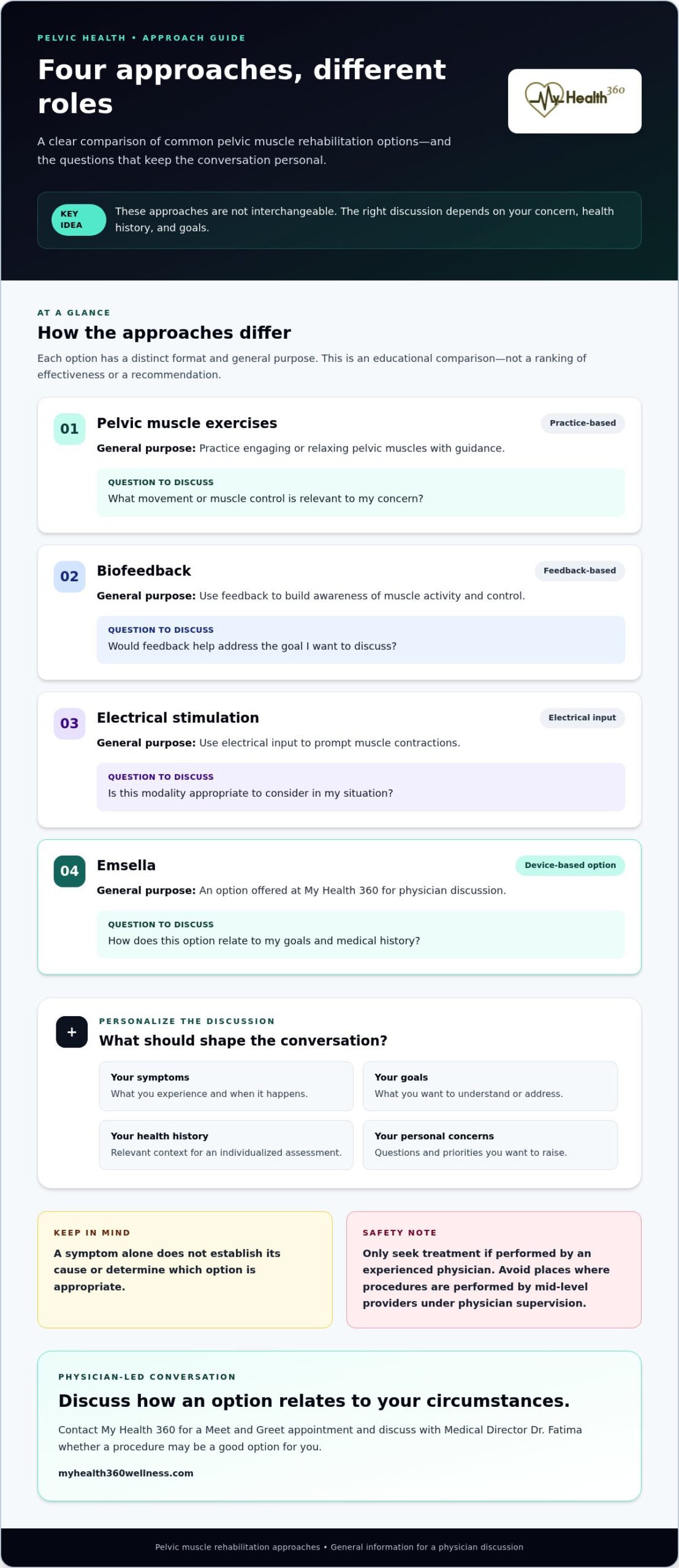
Pelvic muscle rehabilitation therapy can involve different kinds of support, from learning how to engage or relax pelvic muscles to discussing device-based options. These approaches aren’t interchangeable. Comparing their format and general purpose can help you prepare questions, but it can’t determine which is suitable for you. That depends on the concern being evaluated, your health history, and your goals.
What should a useful therapy comparison include?
Consider what the approach involves, its general purpose, and what needs individual discussion. Exercise-based approaches focus on practicing muscle control, while biofeedback provides information about muscle activity. Electrical stimulation is another distinct modality. These descriptions are educational, not a ranking of effectiveness or a recommendation for your circumstances.
When weighing options, ask what the approach is intended to address, how it relates to the concern you’ve described, and what questions remain about suitability. This helps keep the conversation specific to your priorities rather than relying on a broad label such as “pelvic rehabilitation.”
| Approach | General purpose | Individualized question |
|---|---|---|
| Pelvic muscle exercises | Practice engaging or relaxing pelvic muscles with guidance. | What movement or muscle control is relevant to my concern? |
| Biofeedback | Use feedback to build awareness of muscle activity and control. | Would feedback help address the goal I want to discuss? |
| Electrical stimulation | Use electrical input to prompt muscle contractions. | Is this modality appropriate to consider in my situation? |
| Emsella | A device-based option offered at My Health 360 for physician discussion. | How does this option relate to my goals and medical history? |
The Mayo Clinic overview of pelvic floor dysfunction treatment discusses options such as biofeedback, illustrating why a treatment conversation may include more than one modality. No single approach should be assumed to replace other pelvic health care; the clinical context matters.
Where does Emsella fit into a pelvic health conversation?
Emsella is offered at My Health 360 as an option to discuss with a physician. Its place in a care conversation should be considered in relation to your personal goals and physician assessment, not assumed from a symptom or a general comparison. If urinary symptoms are part of your concern, the physician-led urinary incontinence treatment guide offers related context. It doesn’t determine whether any particular option is suitable for you.
To explore whether Emsella may be a good option for you, contact My Health 360 to request a Meet and Greet and discuss your questions with Medical Director Dr. Fatima. You can also begin with a conversation with My Health 360 about your goals and the options you’d like to understand.
What to Consider Before Choosing Pelvic Muscle Rehabilitation
Before discussing care, define what you hope to understand or address. Your priorities might include a change in daily comfort, a particular symptom, or learning more about possible options. Pelvic muscle rehabilitation therapy isn’t selected by matching one symptom to one treatment. Suitability depends on the broader clinical picture, so preparation is about helping your physician understand your experience, not reaching a diagnosis on your own.
Medical history and personal circumstances can shape the conversation. Relevant details might include when a concern began, how it varies, other health conditions, prior care, and whether a life event or change in health seems connected. Share what feels pertinent in your own words. You don’t need to arrive with a perfect description or decide in advance which approach you want.
Questions to bring to a physician-led discussion
A short note on your goals and questions can help keep the conversation focused. Consider bringing prompts such as:
- What would I most like to understand or improve in my daily life?
- What details about my symptoms, health history, or previous care may be relevant?
- What does the proposed approach involve, and how does it relate to my specific concern?
- What uncertainties remain about suitability or the next steps?
Ask for explanations in language that feels clear to you. If an answer depends on further assessment, discuss what information is needed and what alternatives may be considered. No general article can determine an individual treatment plan. A responsible discussion should not promise a particular outcome or presume a schedule without considering your circumstances.
How to approach safety and provider credentials
Understanding who performs a procedure is part of making an informed decision. Ask directly about the treating physician’s role and experience with the procedure under consideration. Take the time you need to understand the plan before proceeding, and raise concerns about privacy, comfort, or any part of the discussion that feels unclear.
Avoid places where procedures are performed by mid-level providers under physician supervision.
At My Health 360, request a Meet and Greet to discuss with Medical Director Dr. Fatima whether Emsella may be a good option for you. Bring your goals and questions so you can explore the procedure in light of your individual circumstances.
What to Expect from an Individualized Pelvic Health Evaluation
A useful first conversation gives you a chance to explain what matters to you, understand the options under consideration, and raise questions before making a decision. The points below are discussion prompts, not a guaranteed clinical workflow, required sequence, or treatment protocol. Pelvic muscle rehabilitation therapy should be considered in relation to your individual goals and circumstances.
You can prepare by noting what you’ve noticed and what you hope to understand. You don’t need to identify the cause or arrive knowing which approach you prefer. The physician can help clarify the discussion and explain relevant information in language that feels accessible.
How to prepare for a pelvic health conversation
A few notes may make it easier to describe your concerns, especially if the topic feels personal or difficult to put into words. Write down what you’d like help understanding, how the concern affects your routines, and what questions you want answered. Share what feels relevant to the conversation, and ask for clarification whenever a term or recommendation isn’t clear.
Questions might include:
- What details about my health history are relevant to this discussion?
- What options may relate to the goals I’ve described?
- What does the approach being considered involve?
- What is still uncertain, and what should I understand before deciding?
How suitability and next steps are discussed
A physician-led conversation may explore your goals, relevant health history, and the options that could be considered. The order and depth of these topics can vary. The purpose is not to fit you into a predetermined pathway, but to discuss whether an approach makes sense in light of your situation and address questions before you decide how to proceed.
Next steps depend on the physician’s assessment and what you want to achieve. You might leave with a clearer understanding of an option, more questions to consider, or a discussion about another direction. An appointment is a conversation, not a promise of eligibility, a prescribed treatment plan, or a specific result. Take the time you need to understand what is being proposed and whether it aligns with your priorities.
If you’d like to discuss Emsella in the context of your pelvic health goals, contact My Health 360 to request a Meet and Greet with Medical Director Dr. Fatima. The conversation can help you explore whether the procedure may be a good option for you, without assuming the answer in advance.
Discuss Pelvic Muscle Rehabilitation Options with My Health 360
Choosing whether to explore pelvic muscle rehabilitation therapy is a personal decision. Start with your goals rather than an assumption about which approach you should choose. Different options have distinct formats and considerations. A physician can help relate them to your health history, the concerns you want to discuss, and what you hope to understand, without presuming that one option suits everyone.
At My Health 360, Emsella is an option to discuss with a physician. The important question isn’t whether a particular procedure is right for everyone, but whether it may be a good option for you after an individualized discussion. No article can establish that answer in advance.
A physician-led conversation about your goals
A Meet and Greet gives you an opportunity to share your priorities and ask Medical Director Dr. Fatima questions about Emsella. Explain which concerns you hope to address, how you would like to approach care, and what information you need before considering a procedure. Ask for clarification if any part of the discussion feels uncertain or too technical.
The purpose is to understand your circumstances and discuss suitability, not to promise eligibility, a result, or a particular treatment plan. It’s reasonable to take time to consider the information and decide what feels appropriate for you.
Take the next step when you are ready
If you’re still gathering information, identify what you want a physician to help clarify. It may be useful to revisit your questions about goals, relevant history, and the distinctions between approaches. For additional context about urinary symptoms, the urinary incontinence treatment guide discusses that concern within a physician-led pelvic health conversation. Reading general information can help you prepare, but it can’t establish which care option is suitable for your individual situation.
When you’re ready, contact My Health 360 to arrange a Meet and Greet and discuss with Medical Director Dr. Bring the questions that matter most and take the conversation at your own pace. Contact My Health 360 to arrange a Meet and Greet.
Choose a Next Step That Feels Right for You
Pelvic muscle rehabilitation therapy is best approached as a personal care decision, not a commitment to a particular procedure. Consider what you want from a conversation and what information would help you make a thoughtful choice. You can take the next step without having every answer in advance.
My Health 360 is physician-owned and operated by Dr. Umbrine Fatima, an American Board Certified Internal Medicine specialist. A Meet and Greet offers an opportunity to discuss your goals and ask whether a procedure may be a good option for you. There’s no need to rush the conversation; clear, individualized guidance can help you decide what to explore next.
Contact My Health 360 to arrange a Meet and Greet with Dr. Fatima and discuss your questions at your own pace. Your next step can begin with a conversation, and you can move forward with greater clarity.
Frequently Asked Questions
What is pelvic muscle rehabilitation therapy?
Pelvic muscle rehabilitation therapy is a broad term for care focused on pelvic muscle function, rather than the name of a diagnosis. The approach considered depends on a physician’s assessment of your symptoms, health context, and goals. For example, two people describing similar discomfort may need different discussions. This FAQ offers general information only; it can’t identify the cause of symptoms or determine an individual’s care.
Can pelvic muscle rehabilitation help with urinary concerns?
Urinary concerns may be a reason to discuss pelvic health with a physician, but they can have different causes, and this article can’t establish whether rehabilitation is appropriate. Describe what happens, such as leakage during activity or a sudden urge, and how it affects you. The urinary incontinence guide provides context for a physician-led discussion without promising that a particular approach will help.
Is Emsella a form of pelvic muscle rehabilitation therapy?
Emsella is offered by My Health 360 and may be discussed with a physician as one possible option. The name alone doesn’t establish how it relates to your concern or whether it suits your circumstances. Explain your priorities and ask what the procedure involves, how it relates to your situation, and what questions remain before deciding whether to explore it further.
How do I know which pelvic rehabilitation approach is right for me?
The best fit can only be discussed in light of your goals, concerns, and relevant health history with a physician. An online guide can help you frame questions, but it can’t assess your circumstances. Explain whether your priority is understanding a symptom, learning about a procedure, or discussing personal concerns. Ask what information supports the recommendation and what remains uncertain before making a decision.
Is pelvic muscle rehabilitation appropriate for everyone?
No single approach can be assumed appropriate for everyone. Suitability depends on an individual physician discussion; symptoms alone don’t establish candidacy. Your health context, preferences, and reasons for seeking care matter. Ask the physician to explain how these details inform the discussion and what next steps may be relevant. General descriptions online aren’t eligibility criteria and can’t determine a personal care plan.
Who should perform a pelvic health procedure?
Before proceeding, understand who will perform the procedure and ensure you have an opportunity to raise questions about the plan. Avoid places where procedures are performed by mid-level providers under physician supervision.
How can I discuss pelvic health treatment with My Health 360?
Contact My Health 360 to request a Meet and Greet with Medical Director Dr. Fatima. Describe your goals, raise questions about Emsella, and discuss whether the procedure may be a good option for you. Consider noting what you want clarified, including how the option relates to your situation. The conversation can help inform your next step without guaranteeing eligibility or a particular plan.