

Could the treatment that sounds most advanced be the wrong fit for your concern? A non-surgical pelvic floor treatment can mean very different things, from guided muscle training and changes to daily habits to supportive devices and technology-based options. It’s understandable to feel uncertain when each approach is described differently, especially when safety, suitability, and expectations matter as much as the treatment itself.
Start with the concern you want to address, not a device or technique in isolation. This article compares the main categories of non-surgical care, explains how they differ, and outlines questions to raise when considering your options. You’ll also learn how Emsella may fit into a physician discussion, without assuming it’s right for everyone. At My Health 360, you can arrange a Meet and Greet appointment to discuss with Medical Director Dr. Fatima whether a procedure may be a good option for you.
Key Takeaways
- Pelvic floor concerns can have different causes and goals, so describing your symptoms clearly is a useful first step.
- Non-surgical pelvic floor treatment includes distinct approaches, such as muscle training, supportive devices, behavioral care, and clinician-directed options.
- Use comparisons to prepare questions, not to self-diagnose or assume one treatment category is interchangeable with another.
- Before considering an option, note your goals, relevant health context, and questions for a physician.
- My Health 360 offers Emsella as an option to discuss with Medical Director Dr. Fatima during a Meet and Greet appointment.
What Does Non-Surgical Pelvic Floor Treatment Address?
Pelvic floor concerns can feel personal or difficult to raise, especially when symptoms affect private routines or daily comfort. You don’t need to arrive with a diagnosis or know which treatment category applies. Start by describing what you’ve noticed and how it affects you.
Non-surgical pelvic floor treatment refers to care that doesn’t involve an operation. It’s a broad category, not a promise that a particular approach will be effective or suitable for every person. Options may focus on managing symptoms, training pelvic floor muscles, using a supportive device, or considering a clinician-directed device-based approach. These categories aren’t interchangeable. Symptoms, health context, and clinical assessment all matter when considering what may be relevant.
Which pelvic floor concerns may lead someone to explore treatment?
People may seek guidance about urinary symptoms, such as leakage or difficulty managing bladder urges, or concerns related to pelvic organ prolapse, which can involve a sensation of pressure or bulging. These examples don’t establish a diagnosis. Similar symptoms may have different causes, so assessment can help clarify what may be contributing and which options are relevant. For more on bladder-control concerns, explore this physician-led guide to urinary incontinence treatment.
Before a conversation, note when symptoms occur and how they affect activities such as exercise, work, sleep, or social plans. Identify what you’d most like to address: feeling more confident during movement, understanding a sensation of pressure, or finding ways to manage symptoms in everyday life. These details make a clinical discussion more specific without requiring you to label the cause yourself.
What does non-surgical mean in this context?
It describes an approach that doesn’t involve an operation. On its own, the term doesn’t indicate the level of evidence, expected result, or suitability. Pelvic floor muscle training, behavioral strategies such as bladder training, supportive devices such as pessaries, and device-based approaches are distinct options. An overview of Pelvic Floor Dysfunction also describes a range of symptoms and treatment approaches, including muscle therapy, biofeedback, and pessaries.
Some exercises or behavior changes may be self-directed, while clinician-guided care involves professional assessment and direction. Neither description alone determines what’s appropriate. The person’s concern and health context matter. My Health 360 offers Emsella as an option to discuss with a physician, without assuming it’s the right fit for every individual. Contact My Health 360 to arrange a Meet and Greet appointment and discuss with Medical Director Dr. Fatima whether a procedure may be a good option for you.
How Do Non-Surgical Pelvic Floor Treatment Approaches Differ?
The main difference is what each approach is designed to address. Muscle training focuses on pelvic floor function, behavioral strategies address patterns such as bladder habits, supportive devices provide physical support, and clinician-directed treatments may involve a device or another intervention. These categories aren’t substitutes for one another, and a treatment’s label alone doesn’t establish whether it suits a particular concern.
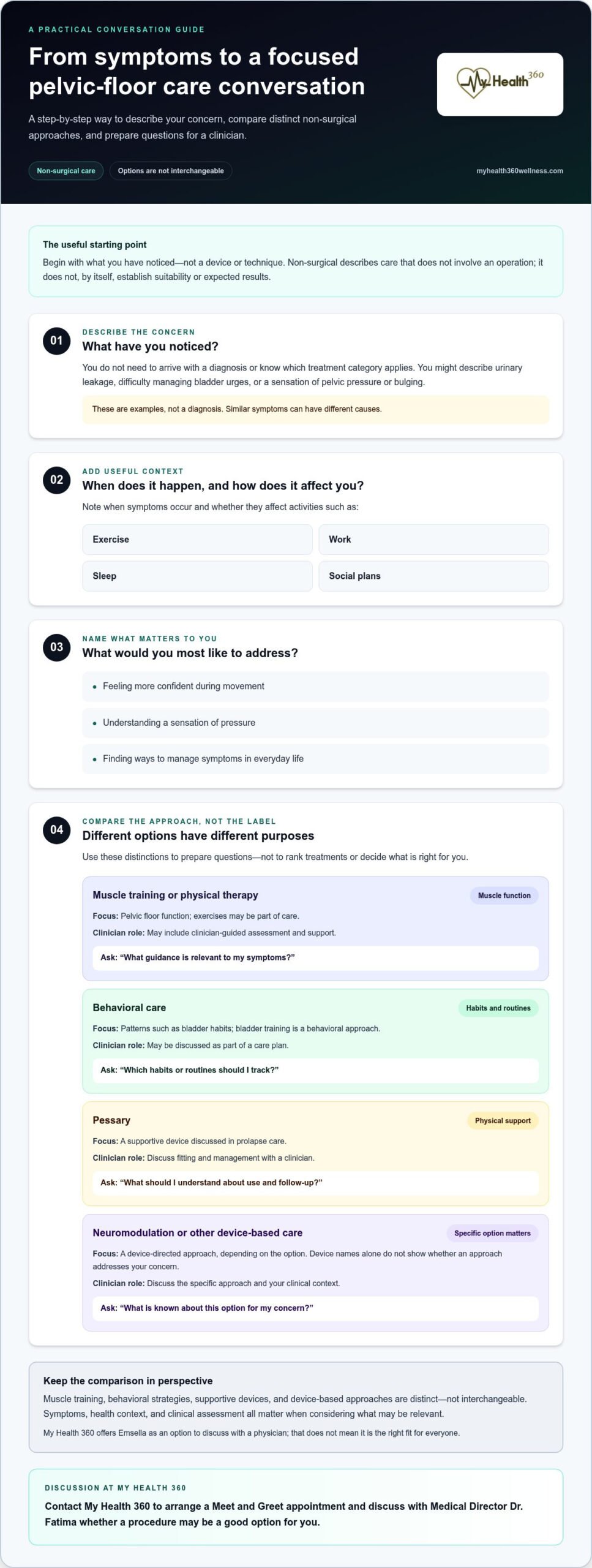
Use the comparison below to organize questions, not as a recommendation. The role of a clinician varies by approach and individual circumstances. An assessment can help clarify the concern, relevant health context, and the kind of guidance that may be appropriate.
Pelvic floor physical therapy, exercises, and behavioral strategies
Pelvic floor physical therapy offers clinician-guided support focused on pelvic floor function. Exercises may be part of care, while bladder training is a behavioral approach that addresses bladder habits. Their aims differ: one involves working with muscle function, while the other focuses on patterns and routines. Guidance should reflect an individual assessment rather than generic instructions.
Pessaries, neuromodulation, and device-based approaches
A pessary is a supportive device discussed in prolapse care. Neuromodulation is another treatment category, distinct from muscle exercises, behavioral strategies, and mechanical support. Device-based approaches also vary, and their names don’t tell you whether they address your concern. My Health 360 offers Emsella as an option to discuss with a physician, without assuming it’s appropriate for everyone.
| Approach | General purpose | Clinician involvement | Discussion point |
|---|---|---|---|
| Muscle training or physical therapy | Focus on pelvic floor function | May include clinician-guided assessment and support | What guidance is relevant to my symptoms? |
| Behavioral care | Address patterns such as bladder habits | May be discussed as part of a care plan | Which habits or routines should I track? |
| Pessary | Provide support in prolapse care | Discuss fitting and management with a clinician | What should I understand about its use and follow-up? |
| Neuromodulation or other device-based care | Device-directed approach, depending on the option | Requires discussion of the specific approach and clinical context | What is known about this option for my concern? |
Think of the table as a way to prepare for a conversation, not rank treatments. A physician can discuss an option’s purpose, potential considerations, and whether it aligns with your health context. If you’d like to explore Emsella, contact My Health 360 to arrange a Meet and Greet appointment and discuss with Medical Director Dr.
How Can You Compare Non-Surgical Pelvic Floor Treatment Options?
A useful comparison starts with your main concern, then considers what each approach involves and what you want clarified before deciding. The table below is educational, not a treatment recommendation or substitute for an individual assessment. It separates general pelvic floor care categories from Emsella, an offering at My Health 360. The categories aren’t interchangeable, and the details of a specific option matter.
| Approach category | Concern to discuss | Clinician involvement | Questions to raise |
|---|---|---|---|
| Pelvic floor physical therapy or muscle training | Whether pelvic floor function or exercise guidance is relevant to your concern | May involve clinician-guided assessment and support | What would guidance involve for my situation? |
| Behavioral strategies, such as bladder training | Whether bladder habits or daily routines are part of the concern | Discuss how the approach may relate to your symptoms and health context | What should I track, and how would we review it? |
| Supportive device, such as a pessary | Whether physical support is a relevant topic in prolapse care | Discuss use and management with a clinician | What should I understand about use, care, and follow-up? |
| Neuromodulation | Whether this treatment category is relevant to the concern being assessed | Ask about the specific approach and its role in care | What does this option involve, and what considerations apply? |
| Emsella | Whether this My Health 360 offering merits discussion for your goals | Discuss suitability and expectations with a physician | What should I know about the option in light of my health context? |
Match the conversation to your concern and priorities
Before comparing options, identify the symptom or functional change you most want to address. Consider how it affects your routines, what feels comfortable or uncomfortable, and what treatment preferences you have. Relevant health context may also shape the discussion. These factors help make the conversation personal and practical, without implying that one approach is universally superior or appropriate.
For each category, clarify its purpose, what clinician involvement may look like, and what you would need to understand before deciding. Avoid judging an option by its name alone. A device-based approach, a supportive device, and guided muscle training are different categories. Any discussion of potential benefits or limitations should be specific to the approach and grounded in an assessment.
Where Emsella fits in the comparison
My Health 360 offers Emsella as one option to discuss, not an automatic recommendation. Ask what the option involves, how it relates to the concern you want to address, and what considerations apply to your health context. Contact My Health 360 for a Meet and Greet appointment to discuss pelvic health options with My Health 360 and ask Medical Director Dr.
What Should You Discuss Before Choosing a Non-Surgical Treatment?
A thoughtful discussion can help you understand what an option involves and how it relates to your goals. You don’t need to arrive with a diagnosis or a perfect account of every symptom. A few notes about what you’ve noticed, what matters most to you, and what you’d like clarified can keep the conversation focused.
Prepare useful information for a physician discussion
Use this sequence to organize what you want to share. Write down questions as they occur to you, and treat your notes as a record of your experience, not a way to diagnose yourself.
- 1. Describe the concern. Note what you feel or observe, when it tends to happen, and whether it changes with particular activities or routines. If symptoms vary, describe the pattern rather than trying to explain its cause.
- 2. Clarify your goals. Identify the change you most hope to address. You might want to understand a symptom, feel more comfortable during a daily activity, or discuss available approaches. Naming your priorities helps the physician understand what matters to you.
- 3. Review relevant health context. Share your health history, current concerns, and any prior care related to pelvic health. Mention approaches you’ve tried and how you experienced them. This context can inform the discussion without requiring you to decide what treatment you need.
- 4. Discuss the options and uncertainties. Ask how the approaches under consideration differ, what each involves, and what remains uncertain in your individual situation. You can also ask what additional assessment may help guide the decision.
There’s no need to minimize symptoms or use technical terms. A straightforward account of how the concern affects work, exercise, sleep, or other routines can be more useful than a label you’re unsure about. If you feel uncomfortable discussing a detail, note it in advance so you can decide how you’d like to raise it.
Keep safety and expectations clear
Physician oversight and informed discussion are central when considering a procedure. Before deciding, make sure you understand what is being proposed, what is known and uncertain, and how the discussion relates to your health context. No option should be presented as a guaranteed result or as suitable for everyone.
Only seek treatment if performed by an experienced physician. Avoid places where procedures are performed by mid-level providers under physician supervision. These are important safety considerations, not a substitute for understanding a procedure’s specific risks, limitations, or relevance to you. Raise any unanswered questions before making a decision.
If you’re considering a procedure or want to discuss your goals, contact My Health 360 to arrange a Meet and Greet appointment and speak with Medical Director Dr. Fatima about whether a procedure may be a good option for you.
How to Explore Pelvic Floor Care at My Health 360
After learning how pelvic floor approaches differ, you can take the next step with an individualized conversation. You don’t have to arrive knowing which category fits or having settled on a procedure. Share what you’ve noticed, what you hope to address, and what questions remain. That gives the discussion a practical starting point without assuming that a particular treatment will suit every person.
My Health 360 offers Emsella as one option to discuss. Its inclusion in the conversation doesn’t mean it’s automatically appropriate for your circumstances or that a particular outcome can be promised. A physician discussion can put the option in context with your goals and health history, and clarify what is known and what still needs consideration for you. A non-surgical pelvic floor treatment is still a medical decision to approach thoughtfully, not a choice to make based on a device name alone.
What to expect from an initial conversation
The Meet and Greet appointment is an opportunity to share your concerns and discuss your goals with the medical team. You might describe the symptoms or functional changes you’ve noticed, how they affect your routines, and what you’d like to understand about available approaches. Medical Director Dr. Fatima can discuss whether a procedure may be a good option for you. The conversation is individualized, not a promise of candidacy or results.
It may help to bring notes about your health history, prior care, and questions you want answered. For example, ask what an option is intended to address, what considerations apply to your situation, and what uncertainties remain. If you’re not sure how to describe a concern, use your own words. Clear communication matters more than having a medical term or a prepared conclusion.
Take the next step with physician-led guidance
Physician-led discussion can connect an option to your individual concerns rather than treating all symptoms as the same. My Health 360 is physician-owned and operated by Dr. Umbrine Fatima, an American Board Certified Internal Medicine specialist. You can raise questions about Emsella with Dr. Fatima and discuss whether a procedure may be a good option for you. No single approach should be assumed to fit everyone, and the discussion should leave room to understand your priorities and the information available.
There’s no need to rush toward a decision. Use the appointment to clarify your goals and ask for the information you need to consider an option carefully. Contact My Health 360 to arrange a Meet and Greet appointment and discuss with Medical Director Dr.
Make Your Next Step a Personal Conversation
Choosing a non-surgical pelvic floor treatment doesn’t have to begin with a firm decision. It can begin with a question, a concern you’d like to understand, or a goal you want to explore. Talking through those priorities can make the next step feel more considered and less overwhelming.
A Meet and Greet appointment gives you an opportunity to discuss your individual goals with My Health 360’s Medical Director, Dr. Fatima, and whether a procedure may be a good option for you. Bring the questions that matter to you and have a physician-led conversation without assuming a particular approach is right for everyone.
Contact My Health 360 to arrange a Meet and Greet appointment and discuss your options with Dr. Fatima. A thoughtful conversation can help you move forward with greater clarity and confidence.
Frequently Asked Questions
Can non-surgical pelvic floor treatment help with urinary symptoms?
Non-surgical approaches may be considered for some urinary concerns, but the appropriate option depends on the cause, symptoms, and your health context. Possibilities include clinician-guided muscle care, behavioral strategies such as bladder training, and device-based approaches, without a guarantee of improvement. Note whether symptoms occur with coughing, urgency, or particular activities, then discuss that pattern with a physician. This urinary incontinence guide offers related context.
Is pelvic floor physical therapy the same as Emsella?
No. Pelvic floor physical therapy and Emsella are different treatment categories, so they shouldn’t be treated as interchangeable. If both come up in a conversation, ask how each relates to the concern you want to address and what is known about the option in your circumstances. A physician can consider your goals and health context without assuming either approach is appropriate or predicting a result.
Can a pessary treat every pelvic floor problem?
No. A pessary is described as a supportive option in pelvic organ prolapse care, not a universal treatment for every pelvic floor concern. Symptoms such as urinary changes or pelvic pressure should be discussed in context rather than used to choose a device on your own. A clinician can assess whether prolapse is part of the concern and discuss whether a pessary and its fitting warrant consideration.
How do I know which non-surgical pelvic floor treatment is right for me?
There isn’t one option that fits everyone. Start by describing what you hope to address, such as a symptom during exercise or a change in daily function, then share relevant health history and preferences. Those details support a more personal discussion than choosing from a comparison alone. Contact My Health 360 for a Meet and Greet appointment and discuss with Medical Director Dr.
Can non-surgical treatment replace surgery for pelvic organ prolapse?
Not necessarily. Non-surgical care and surgery are distinct approaches, and the options described for prolapse don’t establish that one can replace the other for an individual. The discussion depends on how symptoms affect you, your health context, and what you want care to address. Ask a physician to explain the options relevant to your circumstances, including what each is intended to address and what uncertainties remain.
What should I ask before considering Emsella?
Ask how Emsella relates to the concern you want to address, what is known about expectations, and what uncertainties apply to your circumstances. You can also ask what information the physician uses to discuss suitability and whether other categories should be considered. Discuss the option in the context of your health history and ask for a clear explanation of any proposed steps before deciding.
Is non-surgical pelvic floor treatment safe for everyone?
No treatment should be presented as appropriate for everyone. Safety depends on individual circumstances and clinical assessment. Before proceeding, make sure a physician discusses the proposed treatment, relevant health context, and any questions you still have. Only seek treatment if performed by an experienced physician. Avoid places where procedures are performed by mid-level providers under physician supervision. This guidance doesn’t guarantee that a particular treatment is suitable.