

What if protecting your performance started before an ache became an injury? Injury prevention for high performers calls for more than waiting for pain to pass or relying on generic stretch-and-rest advice. When recurring discomfort threatens your training, work, or competitive goals, it’s reasonable to want a plan grounded in your individual physiology and reviewed by a physician.
Proactive care doesn’t mean accepting forced downtime as inevitable. It means identifying where your body may need support and building a measured approach to physical longevity. In this article, discover how physician-led physiological habilitation and advanced medical technology may help address the demands placed on your body, while keeping your performance goals in view.
We’ll explore how BioPrime supports pre-performance preparation, how medical oversight can help validate an individualized plan, and where technologies such as HIFEM and red light therapy may fit. You’ll also learn why consistent, supervised maintenance can be part of a broader strategy for staying resilient, rather than relying on a one-size-fits-all routine.
Key Takeaways
- Injury prevention for high performers starts with recognizing how sustained physical demands can affect the body before discomfort becomes a bigger disruption.
- Learn how physiological habilitation differs from rehabilitation and why preparing for performance may complement care after an injury.
- Explore how Emsculpt Neo and whole body red light therapy may fit into a physician-guided approach, based on individual needs.
- Consider BioPrime and consistent, supervised maintenance as potential parts of a plan designed around your performance demands.
- Contact My Health 360 to arrange a Meet and Greet with Medical Director Dr. Fatima and discuss whether a procedure may be a good option for you.
The High-Performance Tax: Why Peak Performance Requires Proactive Protection
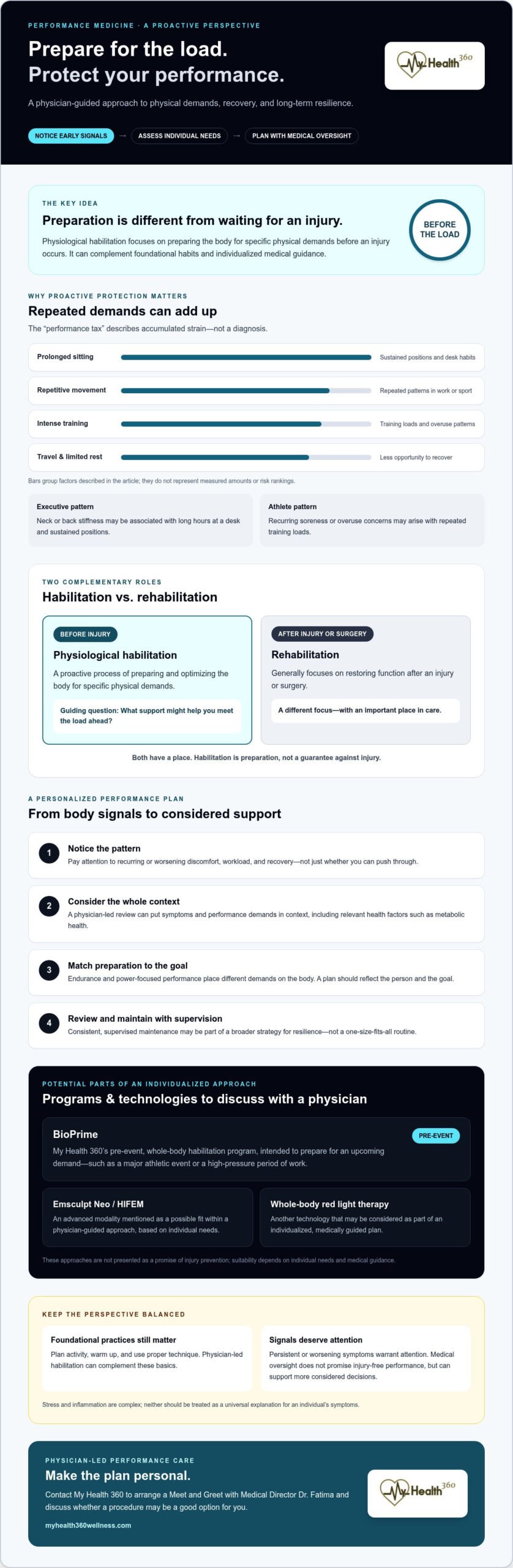
High-output work and training ask the body to meet repeated demands, often with limited opportunity to recover. The resulting “performance tax” is the accumulated strain of prolonged sitting, repetitive movement, intense training, travel, and insufficient rest. It isn’t a diagnosis, but a useful way to describe why a body that performs well today may still be developing vulnerabilities.
Early signals are easy to dismiss. An executive may normalize neck or back stiffness after long hours at a desk; an athlete may treat recurring soreness as an unavoidable part of training. Motivation, packed schedules, and the pressure to stay dependable can all make it tempting to push through. Yet persistent or worsening symptoms deserve attention, not assumptions. Sports medicine brings together medical approaches to physical activity, injury, and performance, offering a wider lens than simply waiting for a problem to interrupt routine.
The Silent Cost of Excellence
Stress physiology is complex: cortisol is a normal hormone, not inherently harmful, but prolonged stress and inadequate recovery may affect the body’s capacity to adapt and repair. Inflammation also has many causes; it shouldn’t be treated as a direct, universal explanation for ligament laxity. The practical point is to look at the whole pattern, including recurring pain, workload, recovery, and health factors, rather than relying on “no pain, no gain.” Pushing through can obscure useful warning signals and may prolong a problem.
Identifying Your Structural Vulnerabilities
Risk patterns vary. Executives may experience discomfort associated with sustained positions and repetitive desk habits, while athletes may face overuse problems from repeated training loads. Neither pattern is inevitable. A physician-led review can help put symptoms and performance demands in context, while considering relevant health factors, including metabolic health, that may influence musculoskeletal resilience. This shifts the goal from tolerating strain to maintaining optimized integrity.
That’s where concierge performance medicine can support a proactive perspective: identifying concerns before they become more disruptive, rather than waiting for a clinical issue to dictate the next step. Medical oversight doesn’t promise injury-free performance. It does provide a more considered basis for decisions, helping distinguish a manageable signal from a concern that needs further evaluation. That’s the difference between relying on luck and building toward longevity.
For a physician-led approach to performance optimization, contact My Health 360 to arrange a Meet and Greet and discuss with Medical Director Dr. Fatima whether a procedure may be a good option for you.
Beyond Stretching: The Science of Physiological Habilitation
Stretching can be useful, but it isn’t a complete strategy for preparing the body for demanding work or sport. Physiological habilitation is a proactive process of preparing and optimizing the body for specific physical demands before an injury occurs. Rehabilitation, by contrast, generally focuses on restoring function after injury or surgery. Both have a place; habilitation asks a different question: what support might help you meet the load ahead?
For Injury prevention for high performers, the distinction matters. Preparation shouldn’t be reduced to a generic routine. The University of Oregon’s guidance on injury prevention includes foundational practices such as planning activity, warming up, and using proper technique. Physician-led habilitation can complement those basics by considering an individual’s health and performance goals. My Health 360’s whole-body habilitation approach frames preparation as support for the body as a system, rather than a response limited to one sore area. Think of it as building a potential buffer, not a guarantee against injury.
The BioPrime Protocol: Preparing for the Load
BioPrime is My Health 360’s pre-event whole-body habilitation program. Its purpose is to prepare for an upcoming demand, whether that’s a major athletic event or a high-pressure period of work. The plan should reflect the person and the goal: endurance places different demands on the body than power-focused performance. A physician can assess whether habilitation is appropriate and what factors need consideration, rather than assuming that the same preparation suits everyone. This is preparation, not a promise of faster recovery or immunity from injury.
Muscle and connective tissue are part of the broader picture, alongside recovery habits and overall health. “Optimizing the internal environment” is best understood as considering relevant health factors in the medical plan, not as a guaranteed result. The aim is to prepare thoughtfully for the load ahead.
The Bio-Restore Bridge
After an injury or minor trauma, a changed movement pattern can place additional demands elsewhere. That doesn’t mean secondary injury is inevitable, but it’s a reason to take persistent or changing symptoms seriously and seek medical guidance. Bio-Restore is My Health 360’s post-operative and injury whole-body habilitation program. A physician can guide whether and when it may be appropriate as someone works toward their performance goals.
Transitioning back to demanding activity calls for experienced physician oversight. Ask who will perform any procedure; My Health 360 advises seeking treatment performed by an experienced physician, not a setting where procedures are performed by mid-level providers under physician supervision. To explore whether BioPrime or another procedure may be a good option for you, contact My Health 360 for a Meet and Greet appointment and discuss your goals with Medical Director Dr. Fatima.
Reactive Rehab vs. Proactive Performance Medicine: A Strategic Shift
“Wait and see” can feel reasonable when discomfort is mild. But if a recurring ache changes how you train, work, or move, postponing assessment may leave you making decisions without a clear understanding of the cause. Proactive performance medicine shifts the focus from responding only after an injury disrupts your routine to reviewing your health, physical demands, and goals before problems escalate.
Injury-related downtime can carry personal and professional costs: missed training, interrupted work, and frustration when progress stalls. The impact varies from person to person, so there’s no single figure that captures it. A physician-guided longevity plan can help organize preventive decisions around your circumstances, while recognizing that no plan can guarantee injury prevention.
Recovery and Readiness Are Different Goals
Physical therapy can be an important part of recovery and restoring function. That goal may differ from preparing to meet the demands of high-level performance, such as returning to a demanding training schedule or maintaining capacity through a busy work cycle. The distinction isn’t that one approach is universally better; it’s that readiness may require a broader conversation about medical history, current symptoms, and what “ready” means for you. Physician oversight can help clarify when additional evaluation is appropriate.
The Concierge Advantage
Integrative concierge medical care for performance optimization offers a physician-led context for discussing health and performance goals together. Rather than assuming a protocol should stay fixed, a clinician can review relevant changes in symptoms, workload, and priorities over time. At My Health 360, care is physician-led by Dr. Umbrine Fatima. Ask who will perform any procedure; the practice’s guidance is to seek treatment performed by an experienced physician, not a setting where procedures are performed by mid-level providers under physician supervision.
Useful monitoring doesn’t need to mean collecting data without a purpose. Keep a consistent record of items such as recurring symptoms, activity demands, and how your capacity changes, then discuss patterns with a qualified physician. These observations aren’t a diagnosis, but they can make a clinical conversation more specific. Any monitoring or assessment plan should be based on what’s relevant to the individual, rather than on assumed tests or technology.
For a physician-led discussion about your performance goals, contact My Health 360 to arrange a Meet and Greet with Medical Director Dr. Fatima. You can ask whether a procedure is a good option for you and how it may fit into a broader plan.
Advanced Modalities for Structural Integrity: From HIFEM to Photobiomodulation
Technology can complement training and recovery, but no modality should be treated as a guaranteed way to prevent injury. For Injury prevention for high performers, the key question is whether a treatment suits your health, goals, and current condition, and whether an experienced physician is directing your care.
Reinforcing the Core with Emsculpt Neo
Emsculpt Neo combines radiofrequency (RF) with high-intensity focused electromagnetic (HIFEM) technology. HIFEM induces muscle contractions through electromagnetic stimulation, providing a different stimulus from voluntary exercise. It may be considered alongside, not instead of, an appropriately designed training plan. While core strength contributes to movement and stability, it would be misleading to promise that a treatment prevents back or joint injuries.
Rather than assuming a device is appropriate, discuss its potential role and limitations with a physician. My Health 360 also offers a Medical Gym Membership as an option for consistent, supervised maintenance. Ask how supervision is provided and whether the approach fits your needs; don’t assume a membership or device makes every form of high-intensity conditioning safe for every person.
Cellular Recovery with Red Light and IV Therapy
Photobiomodulation, commonly called red light therapy, uses red or near-infrared light to influence cellular activity. Its effects depend on factors such as dose and wavelength, so claims about reducing systemic inflammation or accelerating repair shouldn’t be treated as assured outcomes. My Health 360 offers whole body red light therapy and LLLT Low Level Laser. A physician can help determine whether either modality is appropriate and what expectations are reasonable.
IV Hydration is another offering, but it shouldn’t be presented as a universal solution for metabolic fatigue or electrolyte balance. Hydration needs vary, and a clinician should assess whether this option suits an individual’s circumstances. A thoughtful recovery plan may also include established fundamentals such as training adjustments and adequate recovery, rather than adding treatments without a clear purpose.
These options aren’t interchangeable, and combining them isn’t automatically beneficial. Medical oversight matters: choose treatment performed by an experienced physician, and avoid settings where procedures are performed by mid-level providers under physician supervision. My Health 360 is physician-owned and operated by Dr. Umbrine Fatima.
Contact My Health 360 to arrange a Meet and Greet appointment and discuss with Medical Director Dr. Fatima whether a procedure may be a good option for you.
The Physician-Led Protocol: Designing Your Sustainable Performance Plan
A sustainable performance plan should fit your life, not just your next workout or event. Begin by clarifying what you want to maintain or improve, whether that’s preparing for a competition, managing the physical demands of an executive role, or staying consistent through changing training cycles. Then discuss your health history, current concerns, and goals with an experienced physician who can help determine what care may be appropriate.
This is the practical shift behind Injury prevention for high performers: moving from simply enduring physical demands to making informed choices that support performance over time. No protocol can guarantee that an injury won’t occur, but medical guidance can help you evaluate options and avoid relying on guesswork.
Selecting Your Performance Partner
Physician ownership can help establish clear medical leadership, but it’s also important to ask who will personally perform any procedure. My Health 360 is physician-owned and operated by Dr. Umbrine Fatima. The practice advises seeking treatment performed by an experienced physician and avoiding settings where procedures are performed by mid-level providers under physician supervision.
During an introductory conversation, consider asking:
- Who evaluates whether a procedure is appropriate and who performs it?
- How will my goals, health history, and current concerns inform recommendations?
- How will different options, such as BioPrime, whole body red light therapy, or a Medical Gym Membership, fit my individual needs?
These questions help you understand the medical oversight and reasoning behind a recommendation. A multi-modality approach should mean considering relevant options with care, not combining treatments automatically.
Your Next Steps to Peak Longevity
For an upcoming event or demanding performance period, discuss BioPrime as a possible pre-event habilitation option and plan timing with your physician. Ongoing maintenance can also be considered in the context of your goals and changing demands. A Medical Gym Membership may support consistent, supervised maintenance, but neither membership nor habilitation guarantees prevention of acute injury.
A Meet and Greet is an opportunity to discuss your priorities with Medical Director Dr. Fatima, ask how physician oversight works, and find out whether a procedure may be a good option for you. Contact My Health 360 to arrange a Meet and Greet and have that conversation. The aim is a thoughtful, personalized plan that helps you move beyond merely surviving performance demands toward a more sustainable approach to longevity.
Make Longevity Part of Your Performance Strategy
Injury prevention for high performers is not about expecting your body to withstand every demand. It’s about making considered, physician-guided choices that support performance over time. Physiological habilitation shifts attention toward preparation, while medical oversight helps ensure that potential procedures are assessed in the context of your individual goals and health.
My Health 360 is a physician-owned performance center led by Dr. Umbrine Fatima, with BioPrime pre-event habilitation protocols for people preparing for demanding performance periods. The right next step is a conversation, not an assumption that any one treatment is suitable for everyone.
Contact My Health 360 to arrange a Meet and Greet and discuss with Medical Director Dr. Fatima whether a performance procedure may be a good option for you. Bring your goals, questions, and any recurring concerns to help guide the discussion. A thoughtful plan can help you pursue performance with greater confidence and a longer view of your health.
Frequently Asked Questions
What is the difference between injury prevention and habilitation?
Injury prevention describes efforts to reduce the likelihood of injury; habilitation focuses on preparing and optimizing the body for specific demands before an injury occurs. For example, an athlete preparing for an event may discuss physical goals and readiness with a physician in advance. Rehabilitation generally addresses recovery after injury or surgery. Habilitation isn’t a guarantee against injury, but it offers a proactive framework for planning around individual needs.
How does Emsculpt Neo contribute to injury prevention for athletes?
Emsculpt Neo combines radiofrequency with HIFEM, which induces muscle contractions through electromagnetic stimulation. It may be considered as one part of a physician-guided performance plan, but it shouldn’t be presented as a proven way to prevent injuries or protect joints. It also isn’t a substitute for appropriate training. Injury prevention for high performers requires individualized consideration of health, activity demands, and whether a procedure is appropriate.
Is physician oversight necessary for performance recovery treatments?
Physician oversight is important for assessing whether a treatment is appropriate, considering health history, and discussing potential risks and expected benefits. The person who evaluates you and the person who performs a procedure should be clear. Only seek treatment if performed by an experienced physician. Ask questions before proceeding, especially if you have recurring symptoms, a recent injury, or uncertainty about returning to demanding activity.
Can IV hydration therapy actually prevent muscle injuries?
IV Hydration shouldn’t be relied on as a method to prevent muscle injuries. My Health 360 offers IV Hydration, but whether it’s suitable depends on individual circumstances and should be discussed with a physician. Hydration is only one part of overall health and performance; it doesn’t address every factor involved in injury risk. Ask a qualified physician about persistent symptoms or concerns rather than self-treating them with hydration therapy.
What should a high performer look for in a performance medicine center?
Look for clear physician leadership, individualized recommendations, and transparency about who evaluates you and performs procedures. Ask how your health history and performance goals inform the plan, and how options such as BioPrime or a Medical Gym Membership may fit your needs. You can contact My Health 360 for a Meet and Greet to discuss your goals with Dr. Fatima.
How often should I undergo red light therapy for peak performance?
There isn’t a universal frequency that can be recommended for every person or performance goal. Treatment considerations can depend on individual circumstances and the specific therapy being discussed. My Health 360 offers whole body red light therapy and LLLT Low Level Laser. Ask an experienced physician whether either option is appropriate for you, what a suitable plan may involve, and what outcomes are realistic rather than assuming more frequent treatment is better.
What is the BioPrime program and who is it for?
BioPrime is My Health 360’s pre-operative and pre-event whole body habilitation program. It’s designed for people preparing for a planned physical demand, which may include athletes or executives with an upcoming high-performance period. Whether it fits depends on personal health and goals. Discuss timing and suitability with a physician, and remember that habilitation is preparation, not a guarantee that injury won’t occur.
Why should I avoid med spas where mid-level providers perform the treatments?
Procedures require appropriate medical judgment and should be performed by an experienced physician. A physician’s general supervision doesn’t mean that physician personally evaluates or performs your procedure. Before proceeding, ask directly who will assess you and who will carry out the treatment. Avoid places where procedures are performed by mid-level providers under physician supervision. For a personal discussion, contact My Health 360 to arrange a Meet and Greet with Medical Director Dr. Fatima.